Alabama Social Studies SS24.US1.14
Standard Cluster
Explain how westward expansion after the Civil War created economic growth in the West and affected the people living there as well as those migrating to the region. 14a Evaluate the contributions of the Homestead Act and the transcontinental railroad to increased migration to and settlement of the West. 14b Describe the economic and environmental impacts of new industries during the settlement of the West, including the mining and cattle industries. 14c Explain the effects of federal policies and military actions on Native Americans after the Civil War and describe Native American resistance to these actions.
2024 Alabama Course of Study: Social Studies
Cluster contents
Standards in This Cluster
SS24.US1.14 is a cluster heading. These are the individual standards under it.
- SS24.US1.14a
Evaluate the contributions of the Homestead Act and the transcontinental railroad to increased migration to and settlement of the West.
- SS24.US1.14b
Describe the economic and environmental impacts of new industries during the settlement of the West, including the mining and cattle industries.
- SS24.US1.14c
Explain the effects of federal policies and military actions on Native Americans after the Civil War and describe Native American resistance to these actions.
Teacher's field guide
What This Cluster Means
What Students Need to Do
- Students explain how homestead claims and the railroad drew migrants west. They describe how mining and cattle ranching changed jobs and the land. They explain how federal policies and military campaigns affected Native nations, and how Native nations resisted.
What Mastery Looks Like
- A student can link the Homestead Act to farm claims and the railroad to cheaper travel and freight. They can explain how mining created jobs but polluted streams, while cattle ranching supplied meat but damaged grassland. They can describe forced moves to reservations and Lakota and Cheyenne resistance at Little Bighorn.
Common Misconceptions
- Students may think homestead land was easy to farm or that the railroad gave settlers land through the Homestead Act. They may overlook mining pollution and overgrazing. Some mistake Native resistance at Little Bighorn for an unprovoked attack.
How to Assess It
- Exit ticket: Explain how the Homestead Act and railroad helped settlers move west, name one benefit and one land cost of mining or ranching, and give one example of Native resistance to federal action.
Lesson moves
Ways to Teach It
Have groups overlay a railroad map and a reservation map on tracing paper, then mark where settler routes crossed Native lands.
Display a railroad map and a Native land map; ask students to write who benefited from a new rail stop and who lost land.
Pairs match six event cards to result cards: farm claims, rail travel, mining jobs, overgrazing, forced relocation, and Lakota resistance.
Show a current photo of Butte's Berkeley Pit beside an 1880s mining photo; students identify mining jobs and lasting water damage.
Free download
Printable SS24.US1.14 Worksheet
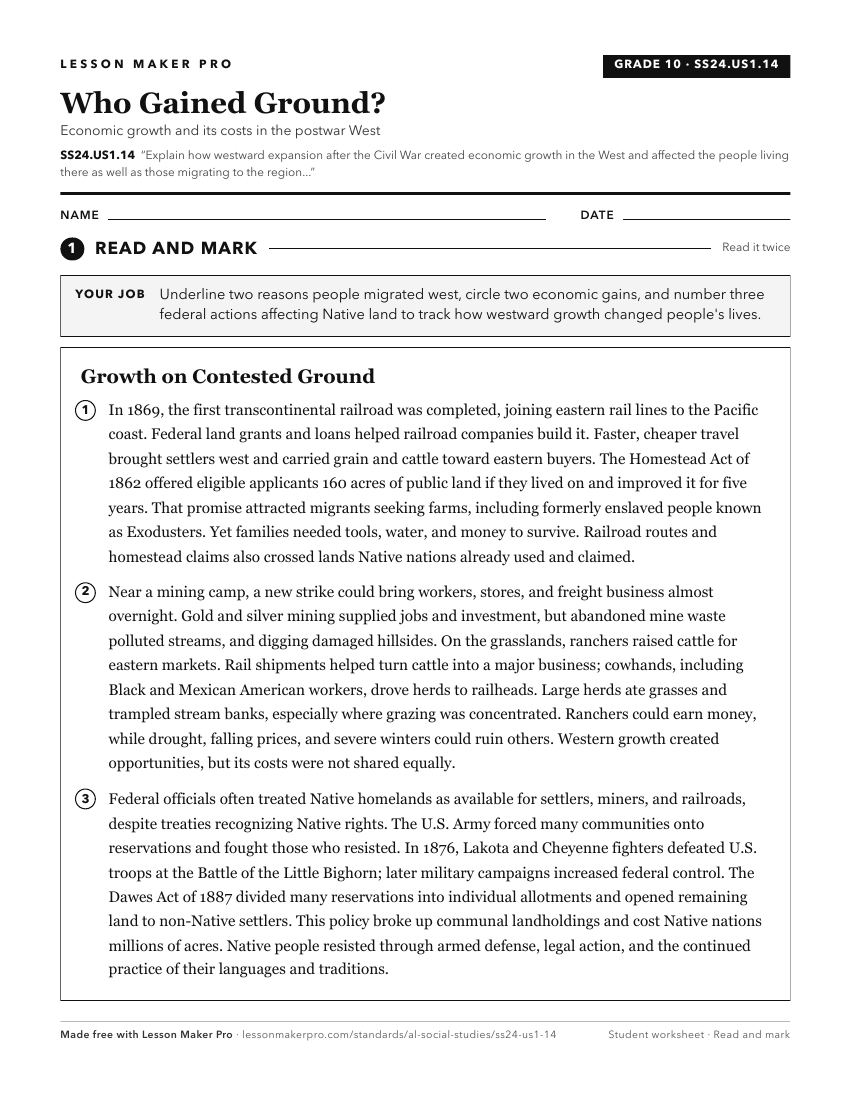
A ready-to-print activity worksheet aligned to SS24.US1.14, with an answer key for the teacher on its own page. No account needed.
PDF, US Letter, prints cleanly in black and white.
Download the worksheetKeep exploring
Related Standards
- SS24.US1.5d
Analyze reasons for migration via the western trails and the consequences of the rapid settlement of California, Oregon, Texas, and Utah on those migrating, tho...
- SS24.4.17a
Explain how territorial expansion and the construction of the transcontinental railroad affected immigrants and Native Americans, including how it led to the lo...
Turn this cluster into a lesson
Grade, subject, topic, and the complete cluster are prefilled. Create one free, no account needed.
Also for this cluster:Make a WorksheetMake a QuizMake a Sub Lesson