Alabama Social Studies SS24.US1.14c
The Standard
- SS24.US1.14
- Explain how westward expansion after the Civil War created economic growth in the West and affected the people living there as well as those migrating to the region.
Explain the effects of federal policies and military actions on Native Americans after the Civil War and describe Native American resistance to these actions.
2024 Alabama Course of Study: Social Studies
Teacher's field guide
What This Standard Means
What Students Need to Do
- Students explain how reservation policies, land allotment, and boarding schools changed Native land ownership and daily life. They describe how Native nations resisted land seizures and military campaigns through fighting, treaty claims, and cultural practices.
What Mastery Looks Like
- A student can link the Dawes Act to lost tribal land and boarding schools to forced separation from family and language. They can explain why Lakota and Cheyenne fighters resisted U.S. troops at Little Bighorn and distinguish that battle from the massacre at Wounded Knee.
Common Misconceptions
- Some students think the Dawes Act simply gave Native families land, missing the sale of tribal land to non-Native settlers. Others treat Native nations as one group or describe Wounded Knee as a battle between equal forces.
How to Assess It
- Exit ticket: Explain one effect of the Dawes Act on tribal land. Then name one way Lakota or Cheyenne people resisted U.S. expansion.
Lesson moves
Ways to Teach It
Have pairs place the 1868 Fort Laramie Treaty, Little Bighorn, the Dawes Act, and Wounded Knee on a timeline and label each effect.
Ask students to write why Lakota and Cheyenne fighters resisted U.S. troops at Little Bighorn, using two details from a textbook passage.
Play a card match: pair the Dawes Act with lost tribal land, Little Bighorn with armed resistance, and boarding schools with forced assimilation.
Compare an 1880 map of the Great Sioux Reservation with a current South Dakota reservation map; circle land no longer within reservation boundaries.
Free download
Printable SS24.US1.14c Worksheet
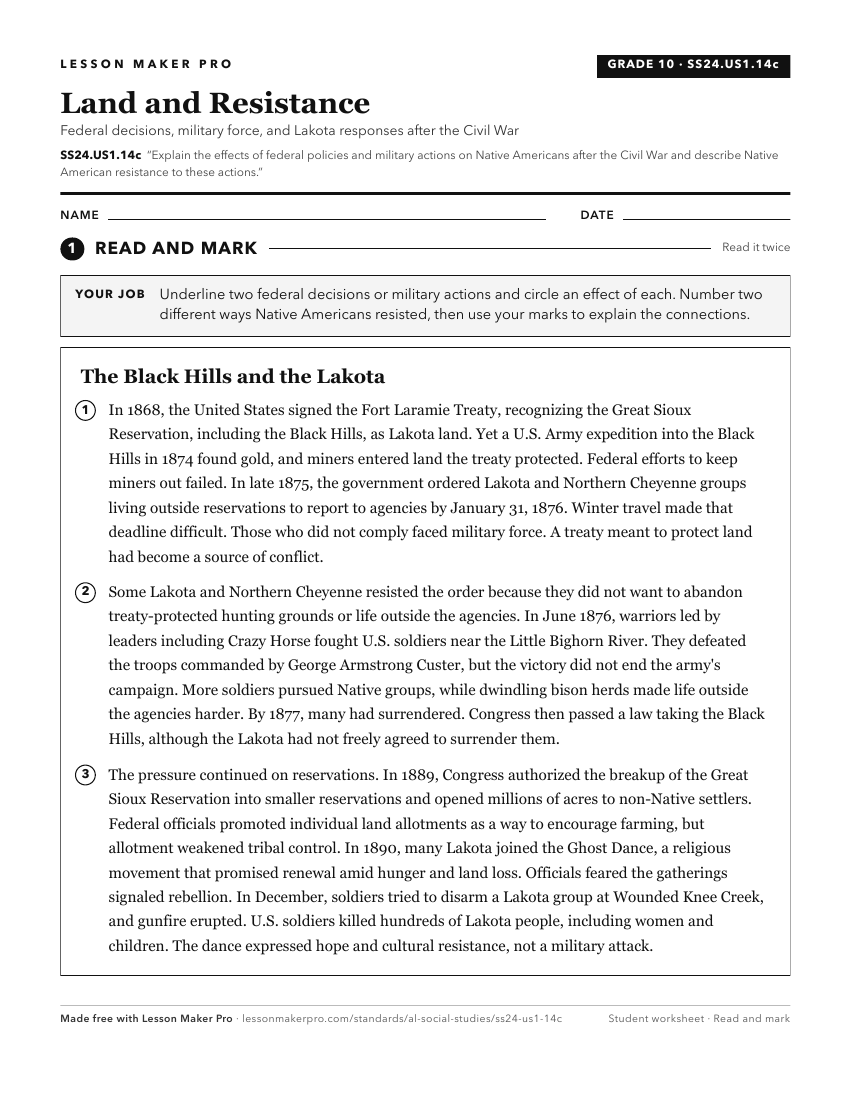
A ready-to-print activity worksheet aligned to SS24.US1.14c, with an answer key for the teacher on its own page. No account needed.
PDF, US Letter, prints cleanly in black and white.
Download the worksheetKeep exploring
Related Standards
- SS24.6.8c
Explain the involvement of Indigenous peoples in the War for Independence and the effects of the war on Indigenous societies.
- SS24.WH.6b
Summarize how the actions of imperialist nations affected cultures and peoples of Africa and Asia, and explain how these peoples resisted imperialization.
- SS24.US1.5b
Summarize the effects of the Indian Removal Act and the Trail of Tears on Native Americans, and describe the efforts by different nations to oppose removal.
- SS24.US1.3e
Analyze the political and economic causes and consequences of the War of 1812, including the impact on Native Americans.
Turn this exact standard into a lesson
Grade, subject, topic, and the complete standard are prefilled. Create one free, no account needed.
Also for this standard:Make a WorksheetMake a QuizMake a Sub Lesson