Alabama Social Studies SS24.S.9a
The Standard
- SS24.S.9
- Describe the structure and function of family units, including traditional, extended, nuclear, single-parent, and blended families, and describe the roles of parent, child, and spouse within each type.
Compare and contrast biological family with found or chosen family and develop an argument regarding why a person may select one over the other.
2024 Alabama Course of Study: Social Studies · Groups and Socialization
Teacher's field guide
What This Standard Means
What Students Need to Do
- Students compare relatives by birth with people someone treats as family through trust and care. They make an argument for why someone might rely more on one group in a given situation.
What Mastery Looks Like
- Given a fictional situation, students name what each group offers and use details to support a choice. They recognize that a biological relative can also be chosen family.
Common Misconceptions
- Students may assume biological relatives are always close or that any friend is chosen family. They may also think a person must choose one group and give up the other.
How to Assess It
- Exit ticket: Maya’s cousins live nearby but rarely check in. Two longtime friends bring her meals when she is ill. Explain whom she might ask for help, using two details, and give one reason she might still contact her cousins.
Lesson moves
Ways to Teach It
Give pairs six fictional relationship cards to sort as biological family, chosen family, or both, then defend one tricky choice.
Ask students to write: Can a cousin also be chosen family? Use a fictional example to explain your answer.
Play Evidence Swap: teams choose a claim about a fictional person’s support network, trade evidence cards, and revise their claim.
Give students a blank emergency contact form and a fictional person’s profile; ask them to choose a contact and explain why.
Free download
Printable SS24.S.9a Worksheet
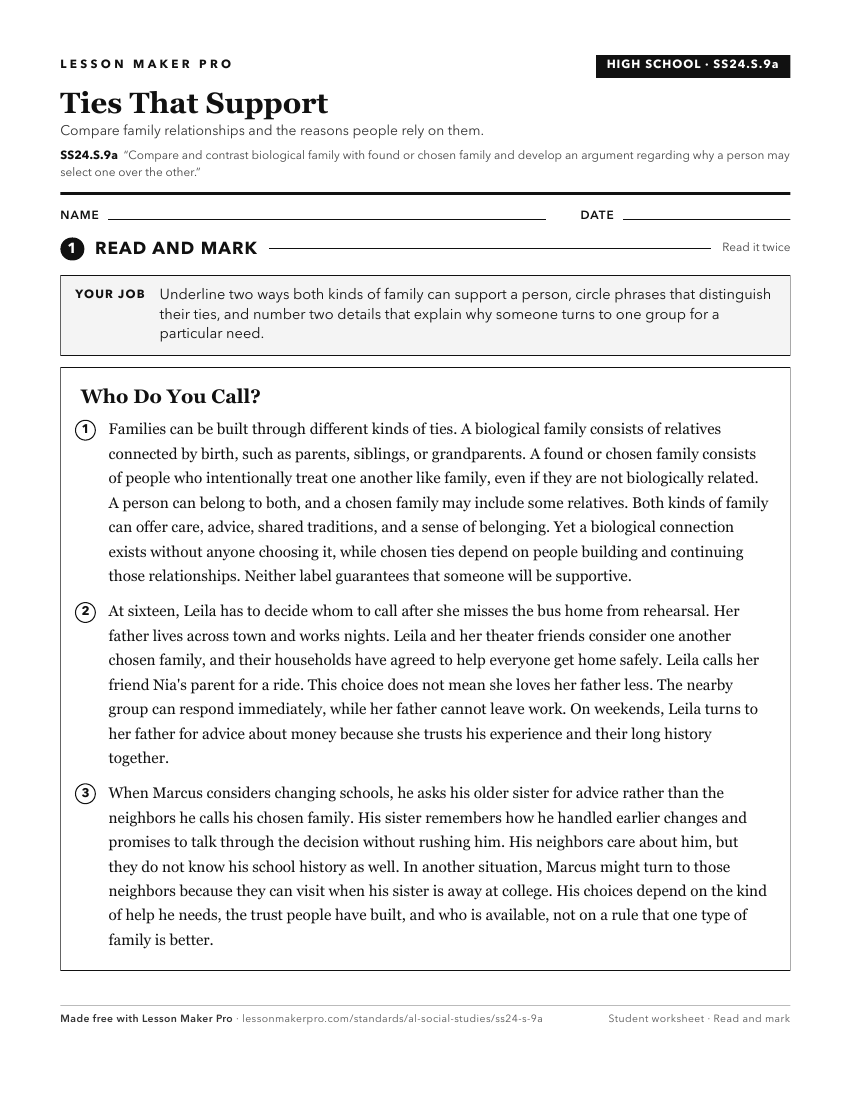
A ready-to-print activity worksheet aligned to SS24.S.9a, with an answer key for the teacher on its own page. No account needed.
PDF, US Letter, prints cleanly in black and white.
Download the worksheetKeep exploring
Related Standards
- SS24.S.7a
Compare and contrast types of groups and the reasons for group formation.*
- SS24.S.9
Describe the structure and function of family units, including traditional, extended, nuclear, single-parent, and blended families, and describe the roles of pa...
- SS24.P.4
Compare the effects of heredity and environment on development and behavior.*
- SS24.S.3
Compare and contrast the three major sociological theories: functionalism, conflict theory, and symbolic interaction.*
Turn this exact standard into a lesson
Grade, subject, topic, and the complete standard are prefilled. Create one free, no account needed.
Also for this standard:Make a WorksheetMake a QuizMake a Sub Lesson