Alabama Social Studies SS24.HG.3
The Standard
Research spatial patterns of world populations to discern population distribution and explain reasons for these patterns.
2024 Alabama Course of Study: Social Studies
Teacher's field guide
What This Standard Means
What Students Need to Do
- Use population density maps and data to find crowded and sparsely settled regions. Research how water, climate, landforms, farming, jobs, and migration help explain these patterns.
What Mastery Looks Like
- Students locate dense areas such as the Ganges Plain and sparse areas such as the Sahara. They use map clues and researched facts to explain how land and human activity shape each pattern.
Common Misconceptions
- Students may confuse total population with density and assume every part of a populous country is crowded. They may credit climate alone, overlooking rivers, farming, jobs, and migration.
How to Assess It
- Give students a population density map and a physical map. Ask: Why is the Ganges Plain denser than the Sahara? Use one map clue and one fact from your research notes.
Lesson moves
Ways to Teach It
Trace two dense and one sparse region from a population density map, then overlay a matching physical map and label rivers and deserts.
Discuss why the Ganges Plain is denser than the Sahara; cite one map clue and a farming fact from a source.
Give pairs cards labeled Nile Delta, Sahara, Ganges Plain, Himalayas, Java, and Siberia; sort by high or low density, then check a map.
Compare population density in your county and a nearby county using census.gov, then check highway maps for one possible reason.
Free download
Printable SS24.HG.3 Worksheet
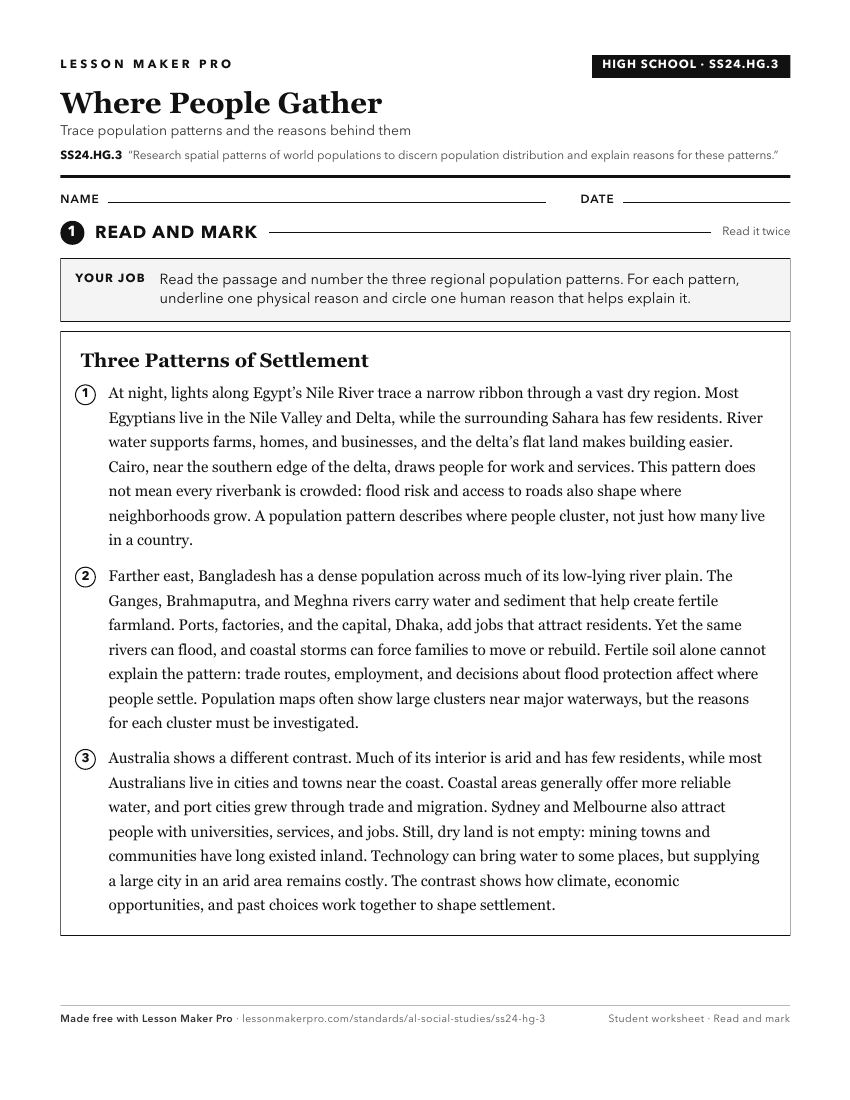
A ready-to-print activity worksheet aligned to SS24.HG.3, with an answer key for the teacher on its own page. No account needed.
PDF, US Letter, prints cleanly in black and white.
Download the worksheetKeep exploring
Related Standards
- SS24.WH.17
Analyze the effects of economic interdependence and globalization on places and their populations.
- SS24.7.1c
Utilize maps to explain relationships among people and places, including governmental alliances, immigration patterns, and trade patterns.
- SS24.CWI.9a
Identify recurring historical patterns in economic development around the world.
- SS24.HG.10
Describe patterns of settlement in different regions of the world.
Turn this exact standard into a lesson
Grade, subject, topic, and the complete standard are prefilled. Create one free, no account needed.
Also for this standard:Make a WorksheetMake a QuizMake a Sub Lesson