Alabama Social Studies SS24.E.6
Standard Cluster
Analyze data to describe the shifting demographics of the labor force of the United States in the twentieth and twenty-first centuries, including age, education, gender, race, regional specialization, and socioeconomic background. 6a Explain how the characteristics of the labor force influence wages and non-wage benefits and affect economic growth. 6b Explain how the supply and demand of labor influence wage and non-wage benefits and affect economic growth.
2024 Alabama Course of Study: Social Studies
Cluster contents
Standards in This Cluster
SS24.E.6 is a cluster heading. These are the individual standards under it.
Teacher's field guide
What This Cluster Means
What Students Need to Do
- Students compare labor force data from the 1900s and 2000s by age, education, gender, race, region, and economic background. They explain how worker skills, labor supply, and employer demand affect wages, benefits, and economic growth.
What Mastery Looks Like
- A student uses two data points to describe a change in who works, and names the group and years being compared. They explain how rising demand for nurses, with the supply of nurses unchanged, could raise pay and health benefits while increasing output.
Common Misconceptions
- Students confuse a group's share of workers with the percentage of that group who work. They may compare wages across decades without adjusting for inflation or assume that more workers always mean higher pay.
How to Assess It
- Exit ticket: Women's labor force participation rose from about 43% in 1970 to 56% in 2020. Describe the shift, then explain how greater worker supply and greater employer demand could each affect pay, health coverage, and output.
Lesson moves
Ways to Teach It
Give pairs prepared 1970 and 2020 workforce tables; have them graph women's and older workers' shares on graph paper.
Ask students to write how a local factory closure might change wages and health benefits for workers with different skills.
Run a card sort matching a new hospital, a factory closure, and a training program to changes in labor supply or demand.
Have students compare pay, required training, and health benefits in two local job ads, then write one reason the offers differ.
Free download
Printable SS24.E.6 Worksheet
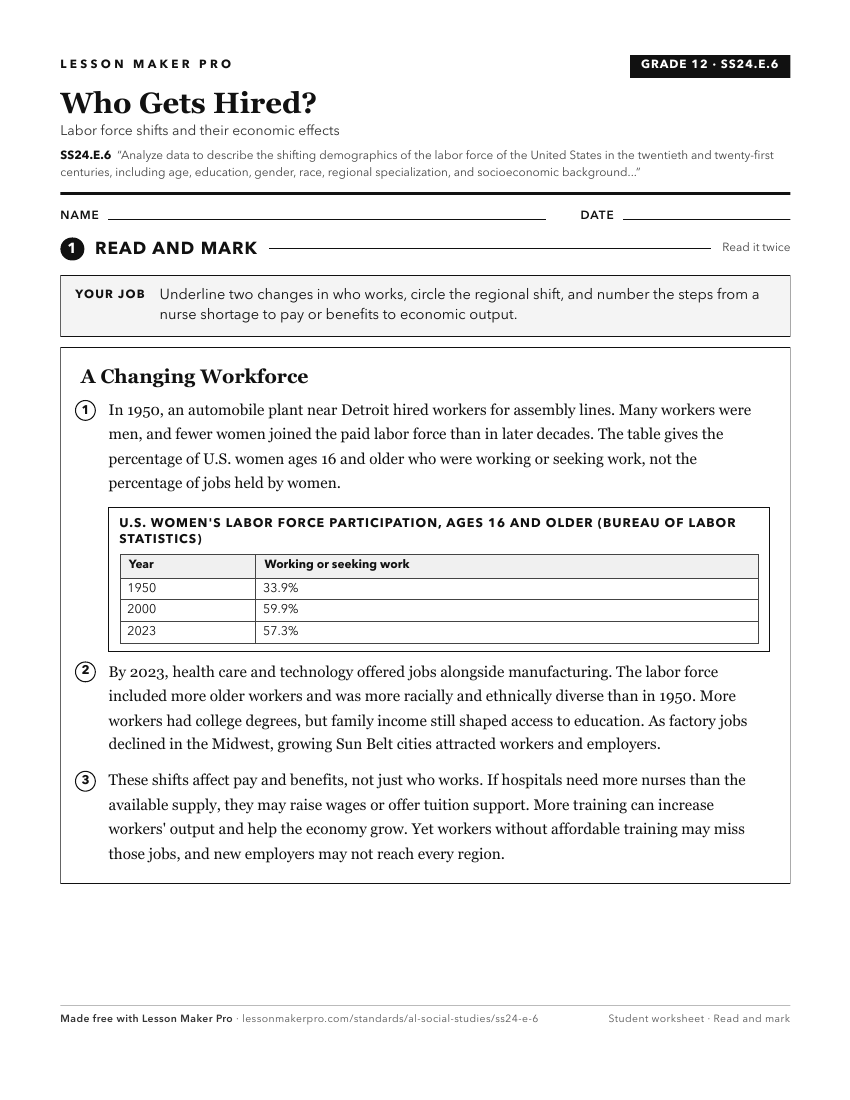
A ready-to-print activity worksheet aligned to SS24.E.6, with an answer key for the teacher on its own page. No account needed.
PDF, US Letter, prints cleanly in black and white.
Download the worksheetKeep exploring
Related Standards
- SS24.US1.8a
Analyze the domestic slave trade/forced migration, labor, and variations in the practice of slavery in different areas of the United States.
- SS24.US2.18
Analyze the shifts in United States foreign policy and challenges to it after the Cold War and into the twenty-first century.
- SS24.S.10a
Identify common patterns of social stratification in American society.
- SS24.US1.17a
Summarize social, economic, and cultural consequences of urbanization for American society, including changes in living and working conditions, the emergence of...
Turn this cluster into a lesson
Grade, subject, topic, and the complete cluster are prefilled. Create one free, no account needed.
Also for this cluster:Make a WorksheetMake a QuizMake a Sub Lesson