Alabama Social Studies SS24.AS.5
The Standard
Describe the cultures, economies, and governments of the first Indigenous peoples to inhabit Alabama.
2024 Alabama Course of Study: Social Studies
Teacher's field guide
What This Standard Means
What Students Need to Do
- Students use archaeological clues to describe how Indigenous communities in Alabama got food, lived, and organized group life. They track changes from early hunting and gathering to later farming towns and mound centers.
What Mastery Looks Like
- Students can explain that an early stone point shows evidence of hunting, but not how leaders were chosen. They can connect later corn farming and mound centers to organized communities without treating all Indigenous peoples as one group.
Common Misconceptions
- Students may think Alabama's first inhabitants grew corn, built mounds, and had chiefs. They may also assume an artifact tells us more about government than the evidence supports.
How to Assess It
- Show a labeled early stone point and a Moundville diagram with cornfields and a central plaza. Ask students to write one supported claim from each source and one question each source cannot answer.
Lesson moves
Ways to Teach It
Have pairs place picture cards of an early stone point, pottery, corn, and a mound on a floor timeline.
Ask students to write two sentences answering, 'What can a stone point tell us about food, and what can it not tell us about leaders?'
Play an evidence match game with dated artifact cards and claims about hunting, farming, or organized work.
Locate Russell Cave and Moundville on an Alabama map, then compare their dates and evidence of food and settlement.
Free download
Printable SS24.AS.5 Worksheet
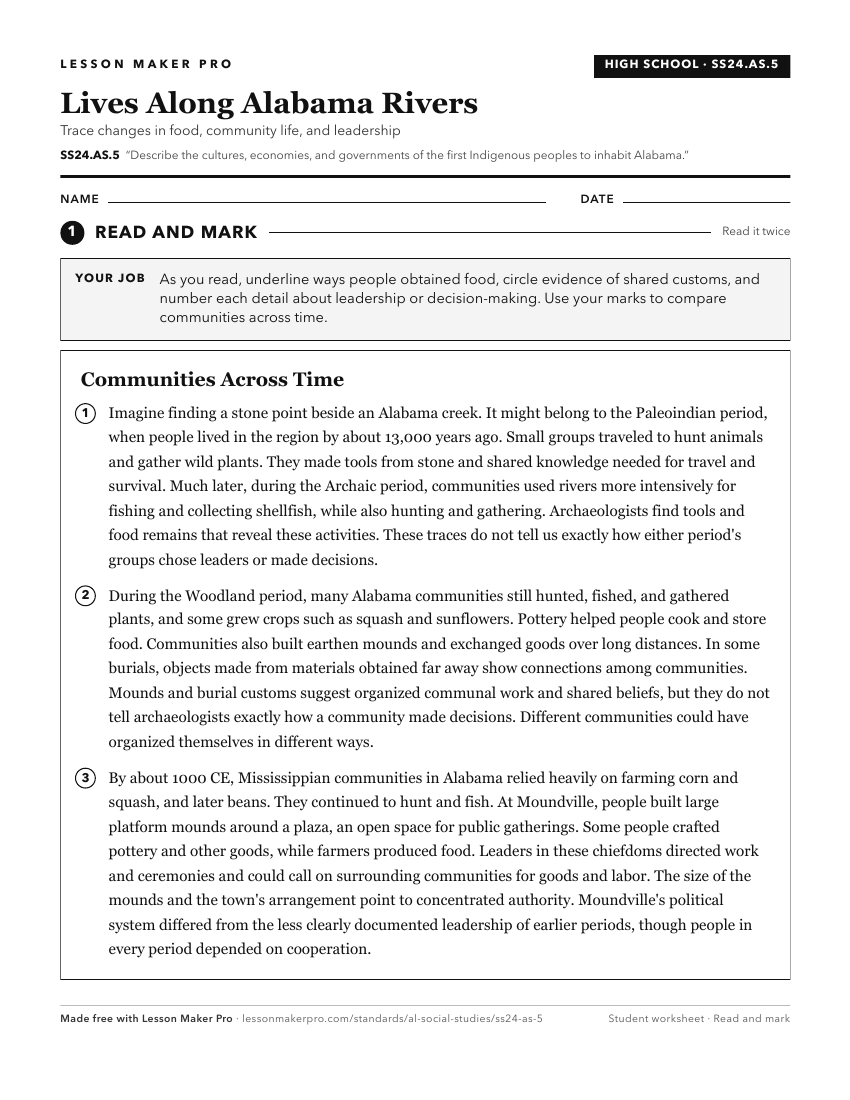
A ready-to-print activity worksheet aligned to SS24.AS.5, with an answer key for the teacher on its own page. No account needed.
PDF, US Letter, prints cleanly in black and white.
Download the worksheetKeep exploring
Related Standards
- SS24.3.8
Describe Indigenous cultures, governments, and economies in the Southeast prior to European colonization.
- SS24.AS.6a
Compare and contrast the major Native American tribes in Alabama of the colonial period and nineteenth century.
- SS24.AS.6
Identify the locations of the major Native American tribes of Alabama during the colonial period into the nineteenth century.
- SS24.AS.7
Outline the chronology of Alabama’s colonial history, identifying the shifting claims by imperial powers and Indigenous peoples engaged in colonial-era conflict...
Turn this exact standard into a lesson
Grade, subject, topic, and the complete standard are prefilled. Create one free, no account needed.
Also for this standard:Make a WorksheetMake a QuizMake a Sub Lesson