Alabama Social Studies SS24.3.8
Standard Cluster
Describe Indigenous cultures, governments, and economies in the Southeast prior to European colonization. 8a Identify changes that took place in prehistoric/pre-contact cultures in the Southeast between the Paleo, Archaic, Woodland, and Mississippian periods. 8b Describe key characteristics of different tribes in Alabama in the Mississippian Period, contrasting social customs, political organization, and religious practices.
2024 Alabama Course of Study: Social Studies
Cluster contents
Standards in This Cluster
SS24.3.8 is a cluster heading. These are the individual standards under it.
- SS24.3.8a
Identify changes that took place in prehistoric/pre-contact cultures in the Southeast between the Paleo, Archaic, Woodland, and Mississippian periods.
- SS24.3.8b
Describe key characteristics of different tribes in Alabama in the Mississippian Period, contrasting social customs, political organization, and religious pract...
Teacher's field guide
What This Cluster Means
What Students Need to Do
- Students put four periods in order and explain how food, tools, and settlements changed. They describe how people farmed and traded. They compare leaders, customs, and ceremonies in Alabama Mississippian communities.
What Mastery Looks Like
- A student can place spear points, fishing tools, pottery, and cornfields on a timeline and explain what each clue shows. They can compare Moundville’s mound center with Coosa’s network of towns. They use evidence when describing chiefs and ceremonies.
Common Misconceptions
- Students may think farming replaced hunting all at once. They may assume every mound was a grave or that Moundville was a tribe. Some assume every community had the same leaders and ceremonies.
How to Assess It
- On an exit slip, have students order Paleo, Archaic, Woodland, and Mississippian. Ask them to name one change in food and one difference between Moundville and Coosa from the class clues.
Lesson moves
Ways to Teach It
Give groups four cards labeled Paleo spear point, Archaic fishing net, Woodland pot, and Mississippian corn; have them build a timeline.
Write 'Moundville held mound ceremonies' and 'Coosa chiefs led many towns' on the board; ask what each tells us and what remains unknown.
Play four-corner clues: call out 'cornfields and large towns' or 'mobile hunting camps'; students move to a period and explain their choice.
Mark Moundville and the Coosa River on an Alabama map; ask students how rivers helped people find food, travel, and trade.
Free download
Printable SS24.3.8 Worksheet
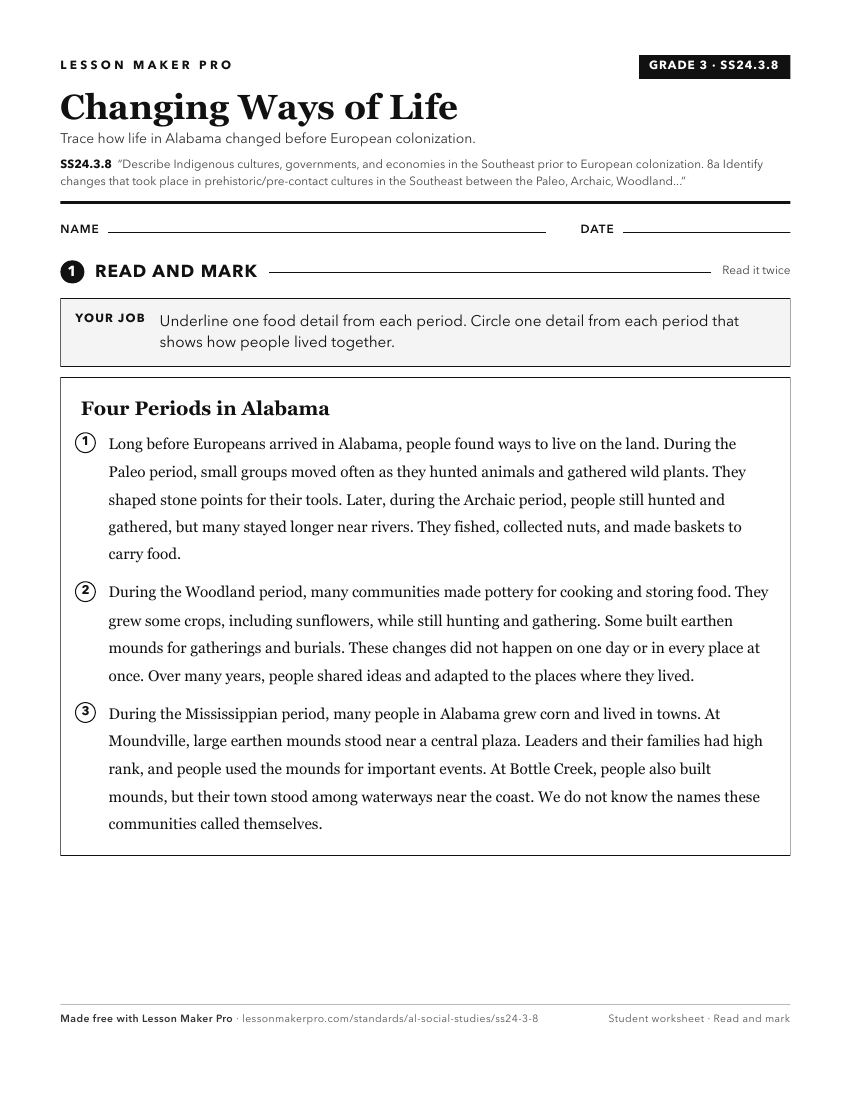
A ready-to-print activity worksheet aligned to SS24.3.8, with an answer key for the teacher on its own page. No account needed.
PDF, US Letter, prints cleanly in black and white.
Download the worksheetKeep exploring
Related Standards
- SS24.3.10
Explain why interactions and conflicts occurred between Europeans and Indigenous peoples in the Southeast from 1519 to the early 1700s, including differing beli...
- SS24.6.1
Describe major Indigenous societies in North America prior to European contact.
- SS24.AS.5
Describe the cultures, economies, and governments of the first Indigenous peoples to inhabit Alabama.
Turn this cluster into a lesson
Grade, subject, topic, and the complete cluster are prefilled. Create one free, no account needed.
Also for this cluster:Make a WorksheetMake a QuizMake a Sub Lesson