Alabama Social Studies SS24.8.1
Standard Cluster
Analyze the economic, political, and social consequences of the collapse of the Western Roman Empire. 1a Trace the spread of Christianity in Europe and the wider Mediterranean region and outline the organizational structure of the early Catholic Church, including the roles of the Bishop of Rome and Councils of Carthage. 1b Explain the rise of Germanic kingdoms, the migration of their peoples, and the effect on political boundaries in Europe.
2024 Alabama Course of Study: Social Studies
Cluster contents
Standards in This Cluster
SS24.8.1 is a cluster heading. These are the individual standards under it.
- SS24.8.1a
Trace the spread of Christianity in Europe and the wider Mediterranean region and outline the organizational structure of the early Catholic Church, including t...
- SS24.8.1b
Explain the rise of Germanic kingdoms, the migration of their peoples, and the effect on political boundaries in Europe.
Teacher's field guide
What This Cluster Means
What Students Need to Do
- Students explain how trade, towns, and government changed after western Roman rule ended. They map Germanic migrations and the kingdoms that formed. They trace Christianity's spread and explain the roles of the bishop of Rome and the councils at Carthage.
What Mastery Looks Like
- A student can link disrupted trade to changes in western towns and identify Frankish and Visigothic kingdoms on a map. They can trace Christianity across the Mediterranean and into Europe. They can explain that the bishop of Rome was a church leader, while the councils at Carthage were meetings where bishops made church decisions.
Common Misconceptions
- Students may think trade stopped everywhere and Roman life vanished overnight. They may treat Germanic peoples as one group that moved all at once. They may think Christianity began after Rome fell or mistake the Carthage councils for one church leader.
How to Assess It
- Give students a map labeled Rome, Carthage, and western Europe. Ask them to mark one Germanic migration and its resulting kingdom, trace one route of Christianity's spread, and write one sentence each about a trade change and the Carthage councils.
Lesson moves
Ways to Teach It
Give pairs an outline map and colored pencils to trace Germanic migrations, new kingdoms, and Christianity's spread around the Mediterranean.
Ask students to write: Why might a town lose traders but keep its bishop after western Roman officials leave?
Run a card sort matching migration routes to kingdoms and church roles to the bishop of Rome or the Carthage councils.
Compare maps of modern France and Spain with maps of Frankish and Visigothic kingdoms; have students mark two boundary differences.
Free download
Printable SS24.8.1 Worksheet
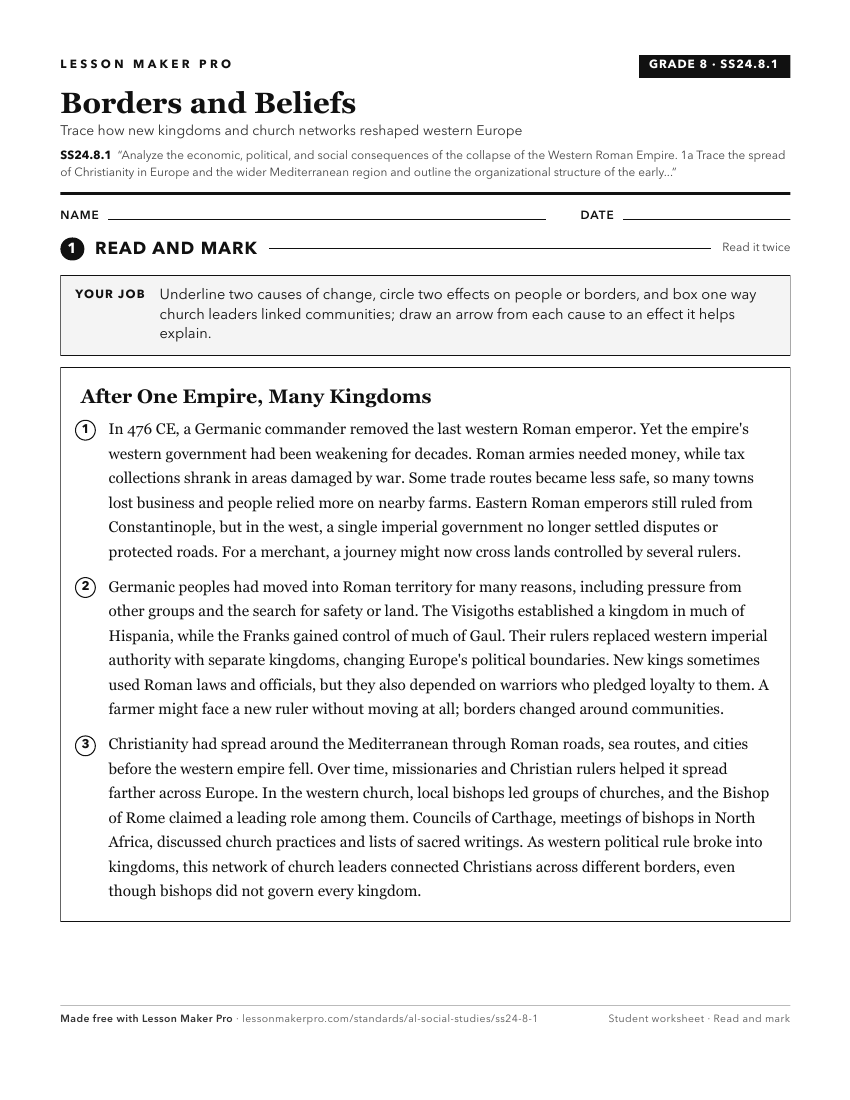
A ready-to-print activity worksheet aligned to SS24.8.1, with an answer key for the teacher on its own page. No account needed.
PDF, US Letter, prints cleanly in black and white.
Download the worksheetKeep exploring
Related Standards
- SS24.7.15c
Analyze the social, political, and economic effects of the Punic Wars.
- SS24.7.16c
Summarize the economic, political, and social factors that led to the split and eventual fall of the Western Roman Empire.
- SS24.7.16a
Explain Rome’s shift from Republic to Empire, including economic, political, and geographic causes.
- SS24.8.8
Analyze the social, political, and economic changes leading up to the Renaissance and Reformation in later medieval Europe and surrounding regions.
Turn this cluster into a lesson
Grade, subject, topic, and the complete cluster are prefilled. Create one free, no account needed.
Also for this cluster:Make a WorksheetMake a QuizMake a Sub Lesson