Alabama Social Studies SS24.7.15
Standard Cluster
Outline the key geographic, political, economic, and cultural elements of the Roman Republic. 15a Trace the growth of the Roman Republic, using a variety of thematic and political maps. 15b Explain the social and cultural outcomes of economic activities within the Mediterranean region, including the establishment of colonies that influenced each other culturally. 15c Analyze the social, political, and economic effects of the Punic Wars. 15d Summarize the influence of Roman legal and political systems on later societies. 15e Describe the internal and external factors that led to the eventual collapse of the Roman Republic.
2024 Alabama Course of Study: Social Studies
Cluster contents
Standards in This Cluster
SS24.7.15 is a cluster heading. These are the individual standards under it.
- SS24.7.15a
Trace the growth of the Roman Republic, using a variety of thematic and political maps.
- SS24.7.15b
Explain the social and cultural outcomes of economic activities within the Mediterranean region, including the establishment of colonies that influenced each ot...
- SS24.7.15c
Analyze the social, political, and economic effects of the Punic Wars.
- SS24.7.15d
Summarize the influence of Roman legal and political systems on later societies.
- SS24.7.15e
Describe the internal and external factors that led to the eventual collapse of the Roman Republic.
Teacher's field guide
What This Cluster Means
What Students Need to Do
- Students use maps to track Rome’s growth around the Mediterranean. They explain how trade, colonies, and the Punic Wars changed Roman life and politics. They describe how Roman law influenced later societies and why the republic ended.
What Mastery Looks Like
- A student can compare two dated maps and identify land Rome gained after fighting Carthage. They can explain how conquest brought wealth and enslaved workers, widened gaps between rich and poor, and fueled conflict. They can name a later use of written public law and explain how disputes in the Senate and armies loyal to generals weakened the republic.
Common Misconceptions
- Students often mix up the republic with the later empire. Some think Rome fought Greece in the Punic Wars, rather than Carthage. Others blame one invasion for the republic’s end and miss the role of inequality and civil wars.
How to Assess It
- Give students maps of Rome in 264 and 146 BCE. Ask them to mark one territory Rome gained and write one political or economic effect of the Punic Wars.
Lesson moves
Ways to Teach It
Give pairs printed maps from 264 and 146 BCE; have them shade new Roman territory and label Carthage, Sicily, and the Mediterranean.
Ask students to write how trade between Roman settlements and their neighbors could spread both goods and customs, with one example of each.
Run a card sort matching debt, enslaved labor, Senate disputes, and armies loyal to generals with their effects on the republic.
Give students a Twelve Tables excerpt and a modern posted law; have them underline how each makes a rule public.
Free download
Printable SS24.7.15 Worksheet
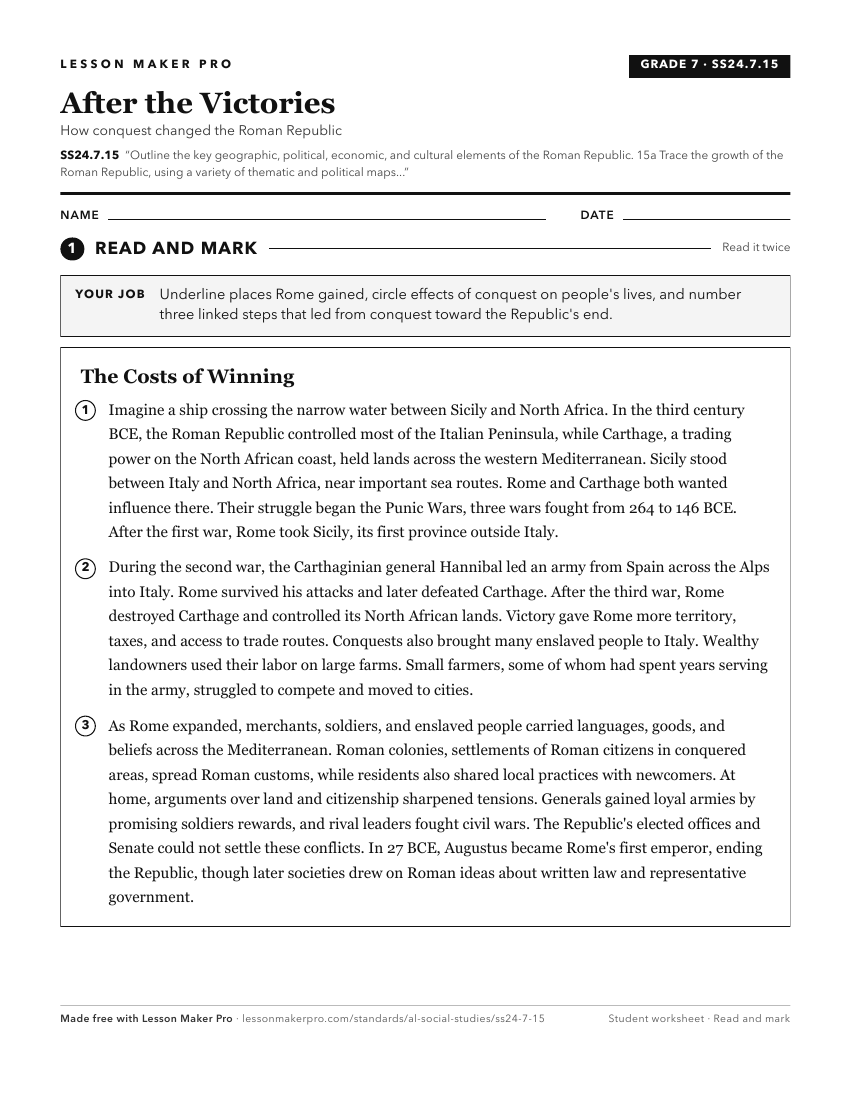
A ready-to-print activity worksheet aligned to SS24.7.15, with an answer key for the teacher on its own page. No account needed.
PDF, US Letter, prints cleanly in black and white.
Download the worksheetKeep exploring
Related Standards
Turn this cluster into a lesson
Grade, subject, topic, and the complete cluster are prefilled. Create one free, no account needed.
Also for this cluster:Make a WorksheetMake a QuizMake a Sub Lesson