Alabama Social Studies SS24.7.12
Standard Cluster
Analyze the development of civilization in South Asia from the settling of the Indus River Valley to the beginning of the Gupta Empire. 12a Summarize how Hinduism as well as a caste system emerged from different religious beliefs and schools of philosophy. 12b Describe how geographic conditions in South Asia, including monsoons, and trade with neighboring regions contributed to the growth of civilization in the region. 12c Trace the development of Buddhism, including the contributions of Emperor Ashoka, and explain how Buddhism influenced society in Classical India.
2024 Alabama Course of Study: Social Studies
Cluster contents
Standards in This Cluster
SS24.7.12 is a cluster heading. These are the individual standards under it.
- SS24.7.12a
Summarize how Hinduism as well as a caste system emerged from different religious beliefs and schools of philosophy.
- SS24.7.12b
Describe how geographic conditions in South Asia, including monsoons, and trade with neighboring regions contributed to the growth of civilization in the region...
- SS24.7.12c
Trace the development of Buddhism, including the contributions of Emperor Ashoka, and explain how Buddhism influenced society in Classical India.
Teacher's field guide
What This Cluster Means
What Students Need to Do
- Students put Indus cities, Vedic traditions, Buddhism, Mauryan rule, and the start of Gupta rule in order. They explain how Vedic beliefs and later ideas shaped Hinduism while social ranks developed into a caste system. They connect monsoons and trade to growth, then explain how Ashoka helped Buddhism spread.
What Mastery Looks Like
- Students can name one change at each stage, from Indus cities to early Gupta rule. They connect monsoon rain to crops, seasonal winds to trade, and Vedic ideas to Hindu beliefs and social ranks. They explain a teaching of the Buddha and how Ashoka's support helped Buddhist monasteries grow.
Common Misconceptions
- Students may think Indus cities practiced modern Hinduism or that one ruler created the caste system. They may mistake Ashoka for the Buddha and assume monsoons brought only floods, not rain for crops and winds for sailing.
How to Assess It
- On an exit ticket, have students order Indus cities, Vedic traditions, the Buddha, Ashoka, and early Gupta rule. Ask for one sentence each on Hindu beliefs and caste, monsoons and trade, and Ashoka's support for Buddhism.
Lesson moves
Ways to Teach It
Give pairs event cards and a South Asia map; have them order the cards and mark the Indus River, Ganges River, and Pataliputra.
Ask students to write: How did ideas about karma and dharma relate to caste, and why might the Buddha's teachings appeal to people?
Run a card sort matching monsoon rains, seasonal winds, trade routes, Ashoka's edicts, and monasteries to farming, exchange, or Buddhist spread.
Compare today's monsoon forecast with an ancient Indian Ocean trade map; ask which ports and farms depended on seasonal rain and winds.
Free download
Printable SS24.7.12 Worksheet
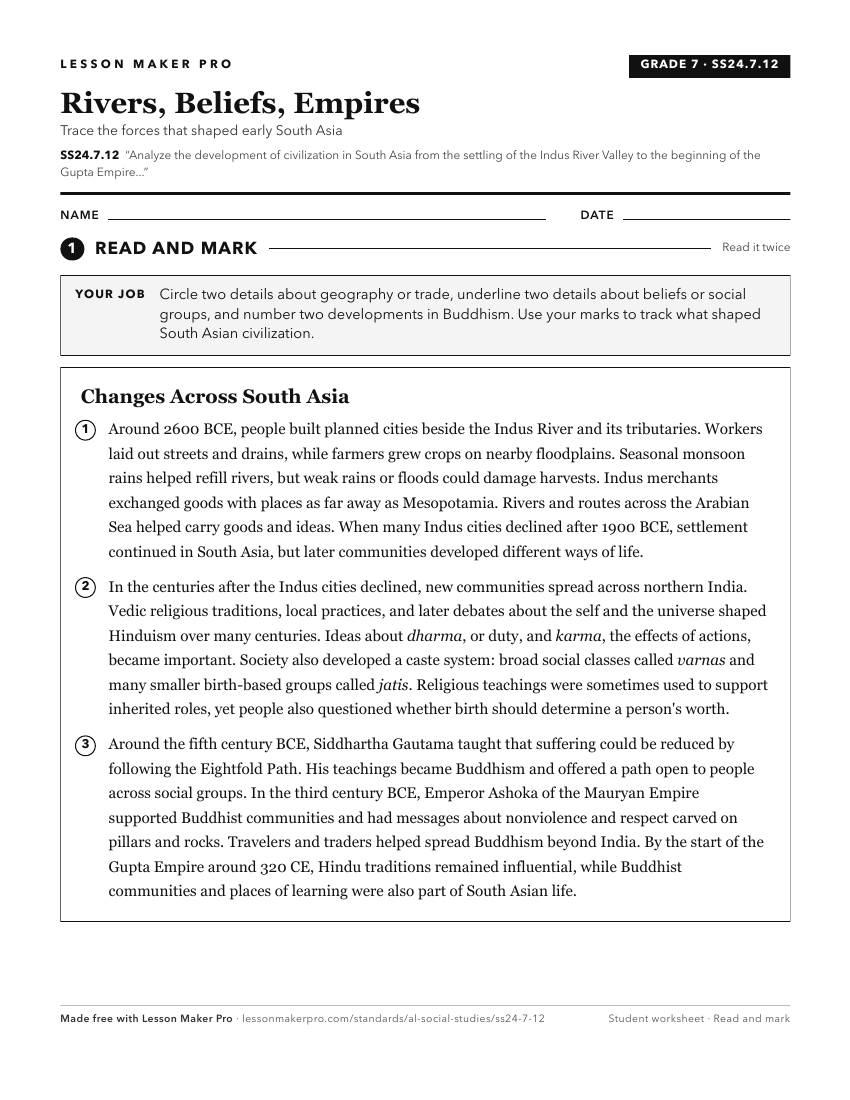
A ready-to-print activity worksheet aligned to SS24.7.12, with an answer key for the teacher on its own page. No account needed.
PDF, US Letter, prints cleanly in black and white.
Download the worksheetKeep exploring
Related Standards
Turn this cluster into a lesson
Grade, subject, topic, and the complete cluster are prefilled. Create one free, no account needed.
Also for this cluster:Make a WorksheetMake a QuizMake a Sub Lesson