Alabama Social Studies SS24.7.12a
The Standard
- SS24.7.12
- Analyze the development of civilization in South Asia from the settling of the Indus River Valley to the beginning of the Gupta Empire.
Summarize how Hinduism as well as a caste system emerged from different religious beliefs and schools of philosophy.
2024 Alabama Course of Study: Social Studies
Teacher's field guide
What This Standard Means
What Students Need to Do
- Students explain how Vedic rituals and later ideas about karma and rebirth shaped Hinduism. They describe how religious ideas about duty became linked to social rank, while distinguishing broad varna groups from birth-based jati groups.
What Mastery Looks Like
- A student can name a Vedic tradition and an idea from the Upanishads that influenced Hinduism. They can explain the difference between varna and jati, and how some people used ideas about duty and karma to defend inherited rank.
Common Misconceptions
- Some students think Hinduism began with one founder or one book. Others treat varna and jati as the same thing, or assume karma alone created birth-based groups.
How to Assess It
- Exit ticket: Write three sentences explaining one Vedic influence, one idea from the Upanishads, and how varna differed from jati.
Lesson moves
Ways to Teach It
Give pairs cards labeled Vedic rituals, rebirth, varna, and jati. Have them sort the cards into religious ideas and social groups, then draw two connections.
Ask: Did beliefs about karma create social rank, or were they also used to defend existing ranks? Use two facts from class.
Play a quick matching game with Vedic hymns, Upanishads, varna, and jati on one set of cards and their meanings on another.
Post that India's constitution bans caste discrimination. Have students write two sentences comparing that law with historical birth-based restrictions.
Free download
Printable SS24.7.12a Worksheet
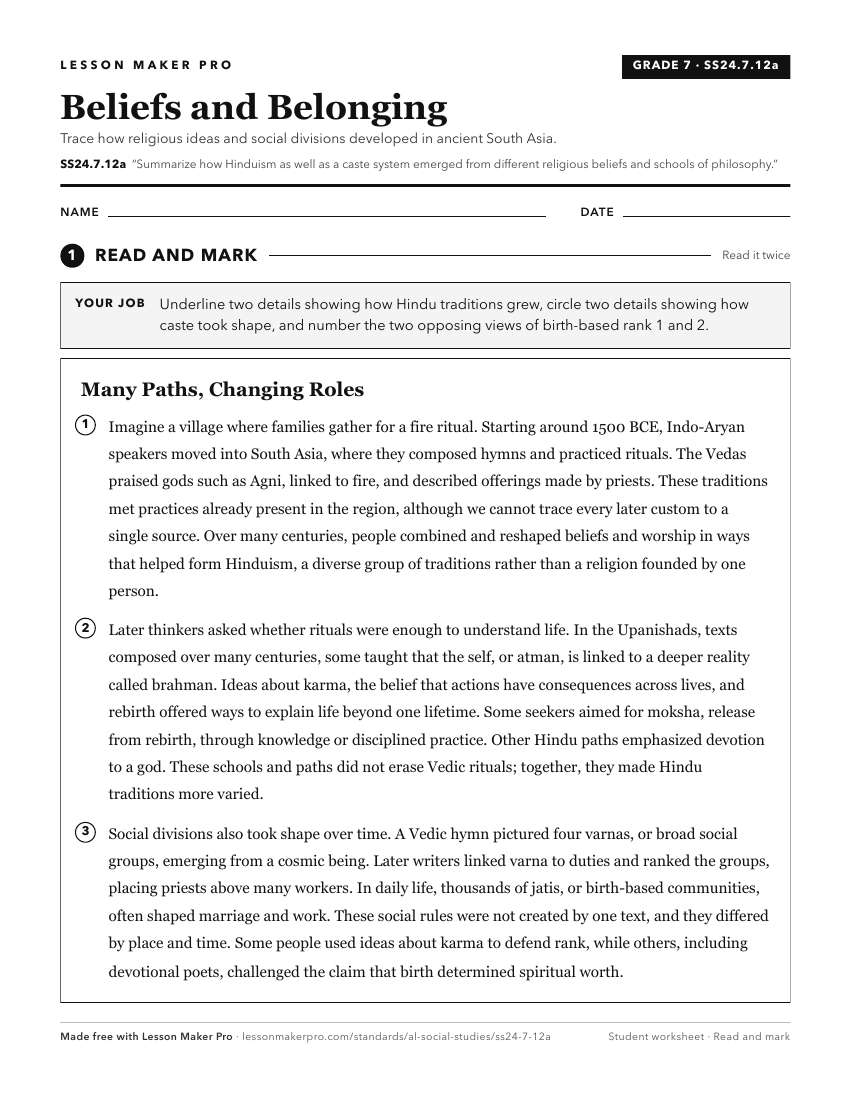
A ready-to-print activity worksheet aligned to SS24.7.12a, with an answer key for the teacher on its own page. No account needed.
PDF, US Letter, prints cleanly in black and white.
Download the worksheetKeep exploring
Related Standards
- SS24.7.15d
Summarize the influence of Roman legal and political systems on later societies.
- SS24.8.4c
Analyze the evolution of religion in Asia, including the growth of Buddhism, Hinduism, Jainism, and Sikhism.
- SS24.7.12c
Trace the development of Buddhism, including the contributions of Emperor Ashoka, and explain how Buddhism influenced society in Classical India.
- SS24.HG.7
Describe ways religion influences cultures, citing examples from around the globe.
Turn this exact standard into a lesson
Grade, subject, topic, and the complete standard are prefilled. Create one free, no account needed.
Also for this standard:Make a WorksheetMake a QuizMake a Sub Lesson