Alabama Social Studies SS24.7.11
The Standard
Trace the development and growth of societies in Southwest Asia, including the Assyrians, Phoenicians, and Persian Empire.
2024 Alabama Course of Study: Social Studies
Teacher's field guide
What This Standard Means
What Students Need to Do
- Students place the Phoenicians, Assyrians, and Persians on a timeline and map. They explain how trade, conquest, and government shaped each society's growth.
What Mastery Looks Like
- A student locates Phoenician ports, Assyrian territory, and the Persian Empire on a map. They explain how Phoenician ships linked ports, Assyrian armies took land, and Persian roads and governors helped manage conquered regions.
Common Misconceptions
- Students may picture Phoenicia as one land empire rather than separate coastal cities linked by sea trade. They may assume these societies took turns, rather than recognizing that their histories overlapped.
How to Assess It
- On an exit ticket, ask students to put Phoenician port cities, the Assyrian Empire, and the Persian Empire in order of their rise. Have them name one way each grew.
Lesson moves
Ways to Teach It
Give pairs a reference map, blank map, and three pencils; trace Phoenician sea routes, Assyrian territory, and Persian roads.
Ask: Why did Phoenician cities spread by sea while Assyrian rulers gained land through conquest? Support your answer with two map details.
Match picture cards of merchant ships, siege ramps, and the Royal Road to the three societies, then explain each match.
Compare maps of Phoenician and modern Mediterranean ports; circle one shared location and explain why ships stop there.
Free download
Printable SS24.7.11 Worksheet
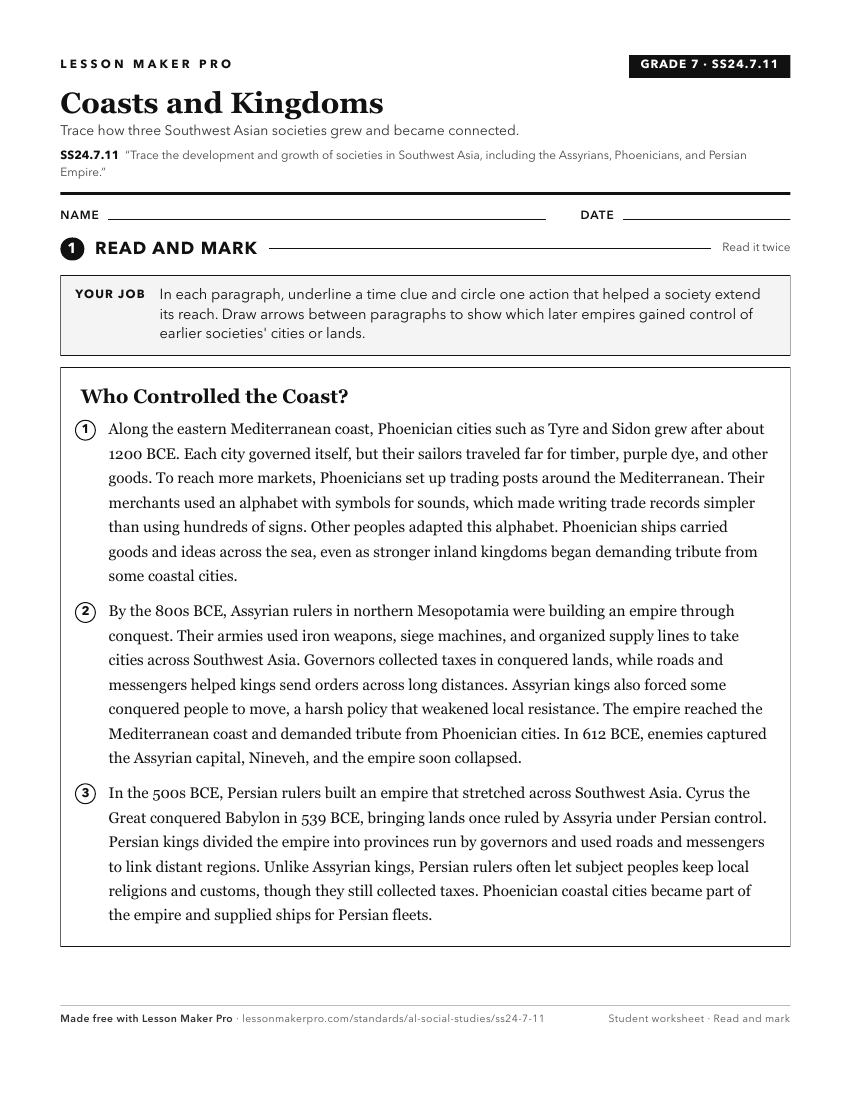
A ready-to-print activity worksheet aligned to SS24.7.11, with an answer key for the teacher on its own page. No account needed.
PDF, US Letter, prints cleanly in black and white.
Download the worksheetKeep exploring
Related Standards
- SS24.7.14b
Trace the development of Greek city-states' political systems, including democracy, that influenced the governments of modern nations.
- SS24.7.12
Analyze the development of civilization in South Asia from the settling of the Indus River Valley to the beginning of the Gupta Empire.
- SS24.7.6a
Describe how agriculture, domestication of animals, inventions, irrigation, metalsmithing, and mining contributed to the settlement and growth of Mesopotamian c...
- SS24.8.5b
Trace the spread of culture, language, and religion among African civilizations.
Turn this exact standard into a lesson
Grade, subject, topic, and the complete standard are prefilled. Create one free, no account needed.
Also for this standard:Make a WorksheetMake a QuizMake a Sub Lesson