Alabama Social Studies SS24.6.10
Standard Cluster
Explain how events and issues of the Critical Period (1783-1789) exposed limitations of the Articles of Confederation and contributed to calls for a stronger national government. 10a Compare and contrast the division of power among levels of government in unitary, federal, and confederate styles of governance. 10b Describe how the Northwest Land Ordinances of 1785 and 1787 established a foundation for future territorial growth of the United States and restricted the growth of slavery. 10c Identify innovative ideas for democratic governance and the expansion of citizen rights that were included in state constitutions during the Critical Period.
2024 Alabama Course of Study: Social Studies
Cluster contents
Standards in This Cluster
SS24.6.10 is a cluster heading. These are the individual standards under it.
- SS24.6.10a
Compare and contrast the division of power among levels of government in unitary, federal, and confederate styles of governance.
- SS24.6.10b
Describe how the Northwest Land Ordinances of 1785 and 1787 established a foundation for future territorial growth of the United States and restricted the growt...
- SS24.6.10c
Identify innovative ideas for democratic governance and the expansion of citizen rights that were included in state constitutions during the Critical Period.
Teacher's field guide
What This Cluster Means
What Students Need to Do
- Students explain why debt, trade disputes, and Shays' Rebellion led people to question the national government. They compare where power sits in unitary, federal, and confederate systems. They explain how two land laws shaped western settlement and how state constitutions changed rights and voting.
What Mastery Looks Like
- A student can link Shays' Rebellion to Congress's trouble raising money and troops. They can distinguish the 1785 land survey from the 1787 statehood plan and slavery ban in the Northwest Territory. They can name a right in a state constitution and identify who still could not vote.
Common Misconceptions
- Students may think Congress could collect taxes under the Articles, or that federal and confederate systems divide power the same way. They may mix up the 1785 land survey with the 1787 statehood rules, or think the slavery ban covered every state. Some assume new voting rights included women and enslaved people.
How to Assess It
- Use a four-box exit ticket. Ask students to name one weakness exposed by Shays' Rebellion, label three power diagrams, match each land law to its result, and mark who could vote in a state constitution excerpt.
Lesson moves
Ways to Teach It
Build three power maps with sticky notes for taxes, defense, and local laws; label where authority sits in each system.
Read a short account of Shays' Rebellion, then ask: "Why could Massachusetts raise a militia while Congress struggled to fund troops?"
Play a card match: pair the 1785 law with land surveys and school lots, and the 1787 law with statehood and slavery limits.
Put Pennsylvania's 1776 voting rule, still in force in 1785, beside today's voting rules; students circle who gained access.
Free download
Printable SS24.6.10 Worksheet
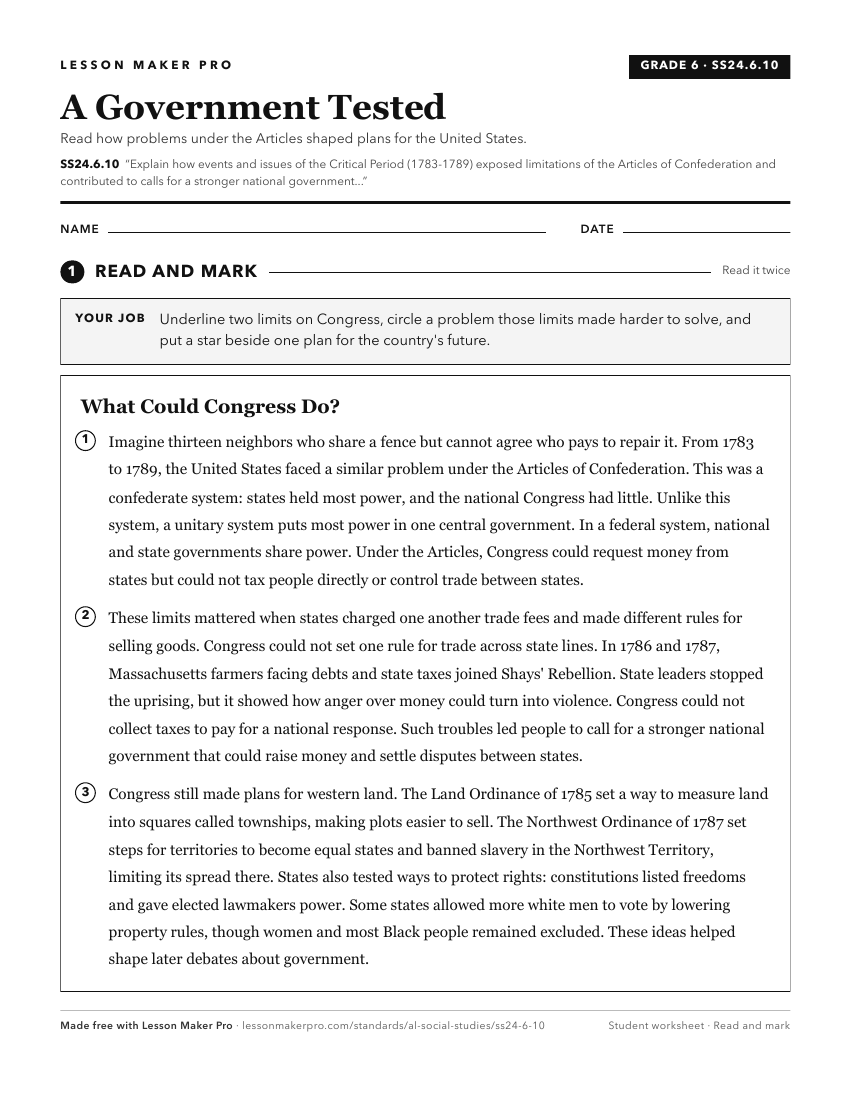
A ready-to-print activity worksheet aligned to SS24.6.10, with an answer key for the teacher on its own page. No account needed.
PDF, US Letter, prints cleanly in black and white.
Download the worksheetKeep exploring
Related Standards
- SS24.4.7
Summarize the key factors leading to the ratification of the Constitution, including the weaknesses of the Articles of Confederation, Shays’ Rebellion, and the ...
- SS24.USG.2
Describe how the Declaration of Independence, the Articles of Confederation, and events of the American Revolution influenced the drafting and ratification of t...
- SS24.US1.2a
Identify the strengths and weaknesses of the Articles of Confederation, and describe how Shays’ Rebellion generated sentiment favoring a strong central governme...
- SS24.US1.2
Evaluate how events and issues from the signing of the Treaty of Paris (1783) to the ratification of the Constitution of the United States affected the developm...
Turn this cluster into a lesson
Grade, subject, topic, and the complete cluster are prefilled. Create one free, no account needed.
Also for this cluster:Make a WorksheetMake a QuizMake a Sub Lesson