Alabama Science PS.5
Standard Cluster
Analyze and interpret data to justify the selection of a specific material for a practical application, considering a range of constraints. a. Carry out investigations and use results to compare and contrast the physical and chemical properties of matter. b. Analyze and interpret data to predict changes in the phase of a material based on changes in particle motion, temperature, pressure, or thermal energy. c. Use mathematical and computational thinking to determine the quantitative relationships among temperature, pressure, and volume of confined gases. d. Utilize multiple types of models to support and verify the claim that matter is conserved during a simple chemical reaction.
2023 Alabama Course of Study: Science · Matter and Its Interactions
Cluster contents
Standards in This Cluster
PS.5 is a cluster heading. These are the individual standards under it.
- PS.5.a
Carry out investigations and use results to compare and contrast the physical and chemical properties of matter.
- PS.5.b
Analyze and interpret data to predict changes in the phase of a material based on changes in particle motion, temperature, pressure, or thermal energy.
- PS.5.c
Use mathematical and computational thinking to determine the quantitative relationships among temperature, pressure, and volume of confined gases.
- PS.5.d
Utilize multiple types of models to support and verify the claim that matter is conserved during a simple chemical reaction.
Teacher's field guide
What This Cluster Means
What Students Need to Do
- Students test physical and chemical properties, then use the results to choose a material for a job. They explain phase changes using particle motion, temperature, and pressure. They calculate gas changes and use models to show that atoms remain after a reaction.
What Mastery Looks Like
- Given a bottle design brief, a student chooses a material using measurements and tradeoffs. They predict a phase change and solve a gas problem using kelvins. They use a balanced equation and particle diagram to show the same atoms before and after a reaction.
Common Misconceptions
- Students may label melting as a chemical change or assume water always boils at 100°C. They may think gas leaving an open reaction means matter vanished. They may use Celsius in gas calculations or expect pressure and volume to rise together at constant temperature.
How to Assess It
- Exit ticket: A plastic cup softens at 80°C and costs $1; a glass cup softens at 600°C and costs $3. Pick one for 95°C tea and defend the tradeoff.
Lesson moves
Ways to Teach It
Seal baking soda and vinegar in a bag, weigh it before and after mixing, then count atoms on reaction cards.
Give students glass, aluminum, and plastic property cards; ask which makes the best hot-drink bottle and what tradeoff matters most.
Give pairs syringe data at constant temperature; ask them to predict pressure when volume halves and explain particle collisions.
Show a pressure cooker label and boiling-point chart; ask why water stays liquid above 100°C inside the cooker.
Free download
Printable PS.5 Worksheet
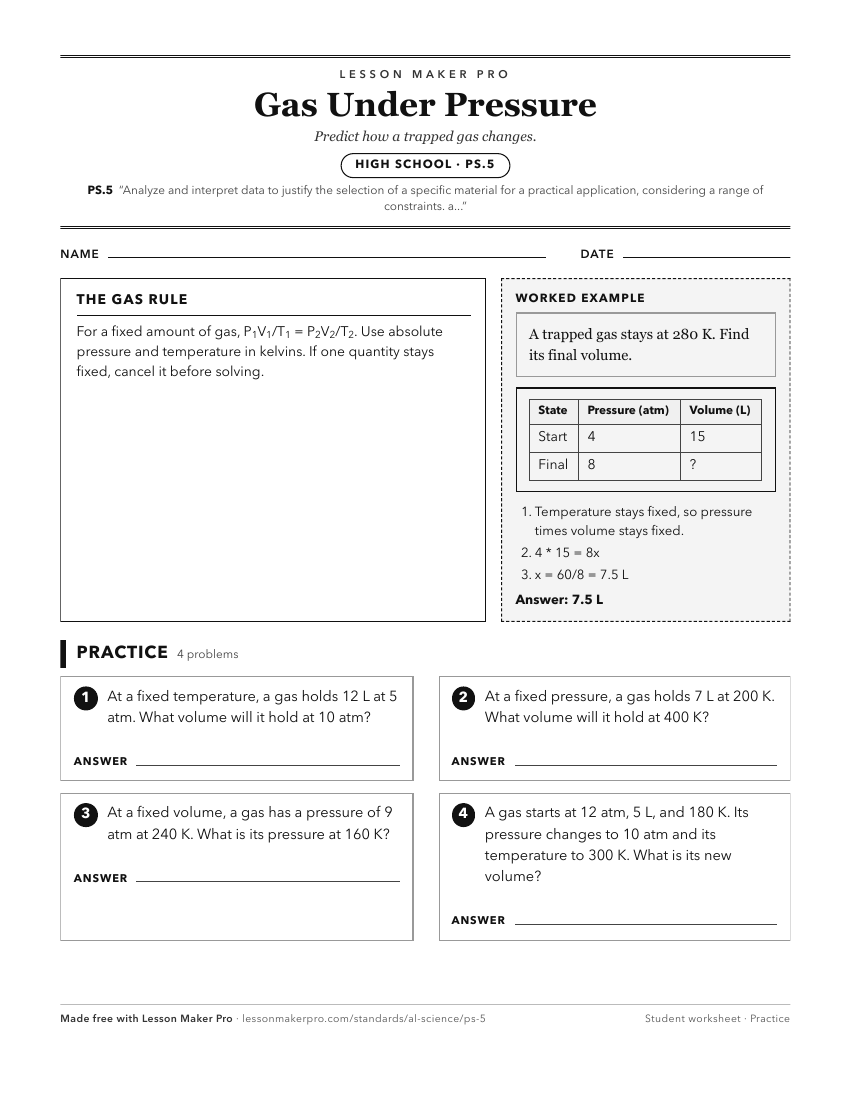
A ready-to-print activity worksheet aligned to PS.5, with an answer key for the teacher on its own page. No account needed.
PDF, US Letter, prints cleanly in black and white.
Download the worksheetKeep exploring
Related Standards
- PS.1.c
Construct explanations to justify the selection of materials for specific applications based on the materials’ specific heat values.
- 5.2
Analyze data collected through observations and measurements to identify materials based on their properties, including color, hardness, and reflectivity.
- 2.2
Conduct investigations to determine suitable uses of natural and manufactured materials based on their observable properties, including strength, flexibility, h...
- 2.1
Plan and carry out investigations to compare, contrast, and classify various solid and liquid materials according to physical properties, including color and te...
Turn this cluster into a lesson
Grade, subject, topic, and the complete cluster are prefilled. Create one free, no account needed.
Also for this cluster:Make a WorksheetMake a QuizMake a Sub Lesson