Alabama Science PS.3
Standard Cluster
Construct an explanation of the ways in which modern science uses both magnetic and electric concepts to create usable products. a. Construct an argument using evidence to support the claim that field forces exist between objects and act on the objects even when the objects are not in contact. b. Plan and carry out investigations to identify the factors that affect the strength of the electric and magnetic forces between objects. c. Use mathematics and computational thinking to represent and determine the quantitative relationships between voltage, current, and resistance in series and parallel circuits in terms of Ohm’s law. d. Develop and use models to determine the relationships among voltage, current, and resistance at specific loads in series and parallel circuits. e. Plan and carry out investigations to determine the relationships between magnetism and electrical charge in common devices. f. Analyze and interpret data concerning the advantages and disadvantages of the energy sources used to produce electricity.
2023 Alabama Course of Study: Science · Waves and Their Applications in Technologies for Information Transfer
Cluster contents
Standards in This Cluster
PS.3 is a cluster heading. These are the individual standards under it.
- PS.3.a
Construct an argument using evidence to support the claim that field forces exist between objects and act on the objects even when the objects are not in contac...
- PS.3.b
Plan and carry out investigations to identify the factors that affect the strength of the electric and magnetic forces between objects.
- PS.3.c
Use mathematics and computational thinking to represent and determine the quantitative relationships between voltage, current, and resistance in series and para...
- PS.3.d
Develop and use models to determine the relationships among voltage, current, and resistance at specific loads in series and parallel circuits.
- PS.3.e
Plan and carry out investigations to determine the relationships between magnetism and electrical charge in common devices.
- PS.3.f
Analyze and interpret data concerning the advantages and disadvantages of the energy sources used to produce electricity.
Teacher's field guide
What This Cluster Means
What Students Need to Do
- Students test how electric and magnetic forces act across a gap and change with distance. They draw series and parallel circuits and calculate voltage, current, and resistance at each load. They investigate an electromagnet and use data to compare sources of electricity.
What Mastery Looks Like
- They use balloon or magnet tests to show that a force can act without contact. With two 6 Ω resistors on a 12 V battery, they calculate 1 A and 6 V per load in series, versus 2 A and 12 V per load in parallel. They explain how current makes a doorbell coil magnetic and use output and emissions data to compare electricity sources.
Common Misconceptions
- Students may think a force needs contact or that magnets attract every metal. They may think each load uses up current, or that loads get the same voltage in series and parallel circuits. They may expect an open circuit to make an electromagnet work or assume solar panels produce the same output all day.
How to Assess It
- Exit ticket: Draw a 12 V battery connected to two 6 Ω resistors in parallel. Label each load's voltage and current, then explain how a wire coil in that circuit could pull a paper clip without touching it.
Lesson moves
Ways to Teach It
Hang two wool-rubbed balloons on string and measure repulsion at set gaps; compare paper-clip attraction at those gaps with one and two magnets.
Give pairs a chart of coal, solar, and wind costs, emissions, and hourly output; ask which source should power a town and why.
Draw circuits with a 12 V battery and two 6 Ω resistors in series and parallel; calculate each load's voltage and current.
Show a doorbell diagram, then briefly power a wire-wrapped nail and use paper clips to model its moving striker.
Free download
Printable PS.3 Worksheet
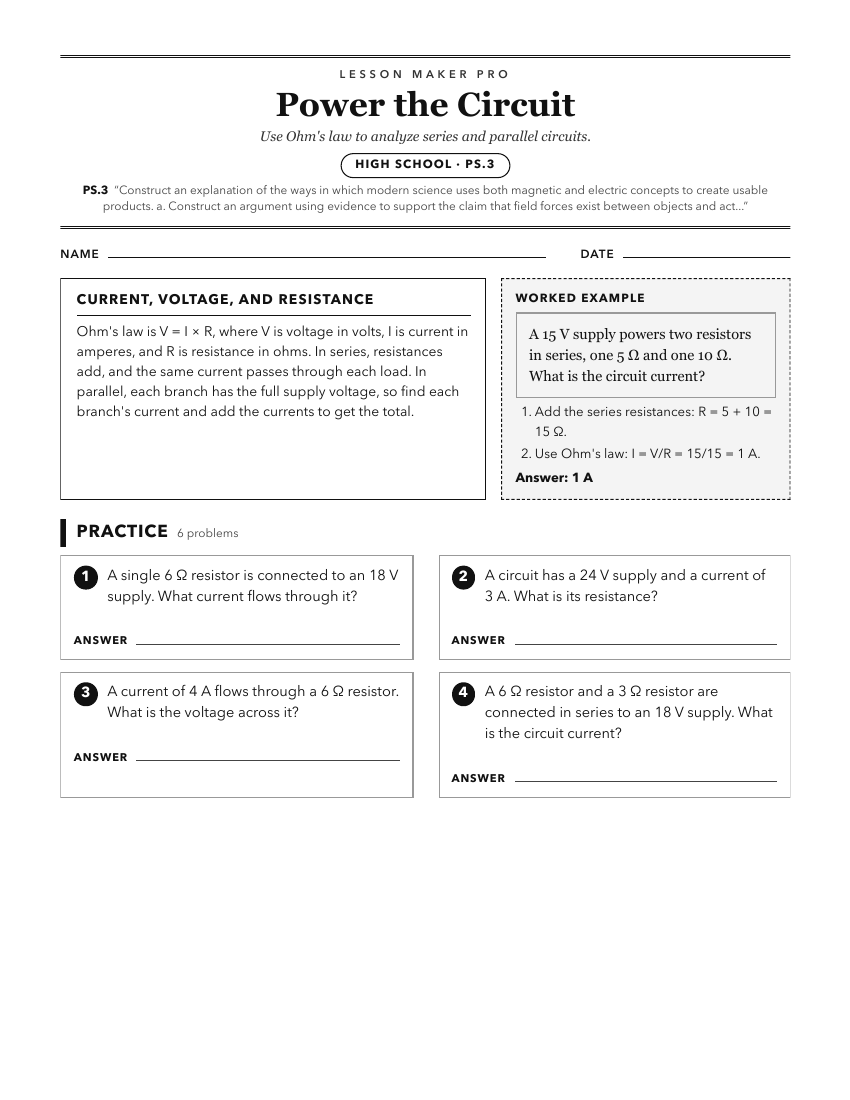
A ready-to-print activity worksheet aligned to PS.3, with an answer key for the teacher on its own page. No account needed.
PDF, US Letter, prints cleanly in black and white.
Download the worksheetKeep exploring
Related Standards
- 3.4
Apply scientific ideas about magnetic interactions to solve a problem using the engineering design process.
- 8.16
Develop and use a model to construct an explanation of how electrical energy is transferred and transformed.
- 8.12
Use a model to identify factors affecting the strength of noncontact forces, including magnetic, gravitational, and electrical forces, and demonstrate that fiel...
Turn this cluster into a lesson
Grade, subject, topic, and the complete cluster are prefilled. Create one free, no account needed.
Also for this cluster:Make a WorksheetMake a QuizMake a Sub Lesson