Alabama Science PS.3.d
The Standard
- PS.3
- Construct an explanation of the ways in which modern science uses both magnetic and electric concepts to create usable products.
Develop and use models to determine the relationships among voltage, current, and resistance at specific loads in series and parallel circuits.
2023 Alabama Course of Study: Science · Waves and Their Applications in Technologies for Information Transfer
Teacher's field guide
What This Standard Means
What Students Need to Do
- Draw circuit diagrams that show how each load connects to a power source. Use V = IR to find voltage and current at each load in series and parallel circuits.
What Mastery Looks Like
- A student labels each load with its resistance, voltage, and current. They show that current stays the same through series loads, while voltage stays the same across parallel loads.
Common Misconceptions
- Students may think current gets used up as it passes through a resistor. They may also think voltage splits between parallel branches or that adding a parallel branch raises total resistance.
How to Assess It
- Ask students to draw two 6 Ω resistors on a 12 V source, first in series, then in parallel. Have them label the voltage and current at each resistor.
Lesson moves
Ways to Teach It
Wire two 100 Ω resistors to a 6 V battery pack in series, then parallel; measure voltage across and current through each resistor.
Sketch a 6 V battery with two unequal resistors in parallel; ask students why their currents differ even though their voltages match.
Give pairs 12 V circuit cards with two resistors; have them race to label voltage and current at each load.
Show two room lamps on separate outlets; students draw parallel paths and predict what happens when one bulb burns out.
Free download
Printable PS.3.d Worksheet
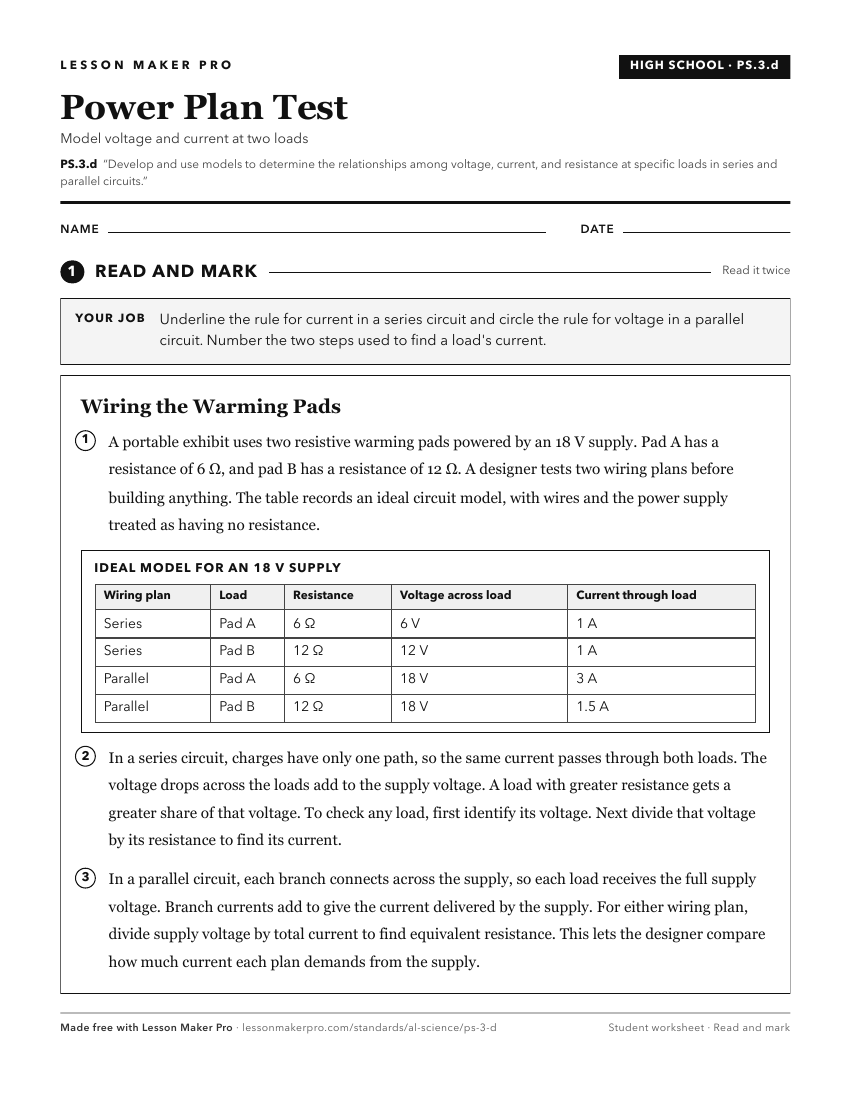
A ready-to-print activity worksheet aligned to PS.3.d, with an answer key for the teacher on its own page. No account needed.
PDF, US Letter, prints cleanly in black and white.
Download the worksheetKeep exploring
Related Standards
- PS.3.c
Use mathematics and computational thinking to represent and determine the quantitative relationships between voltage, current, and resistance in series and para...
- P.6.d
Use mathematics and computational thinking to determine the voltage, current, and resistance for an entire circuit and at each resistor or load.
- P.6.c
Create models of series, parallel, and mixed direct current circuits.
- P.6.b
Obtain, evaluate, and communicate information regarding the relationship among voltage, current, and power for direct current circuits.
Turn this exact standard into a lesson
Grade, subject, topic, and the complete standard are prefilled. Create one free, no account needed.
Also for this standard:Make a WorksheetMake a QuizMake a Sub Lesson