Alabama Science PS.3.c
The Standard
- PS.3
- Construct an explanation of the ways in which modern science uses both magnetic and electric concepts to create usable products.
Use mathematics and computational thinking to represent and determine the quantitative relationships between voltage, current, and resistance in series and parallel circuits in terms of Ohm’s law.
2023 Alabama Course of Study: Science · Waves and Their Applications in Technologies for Information Transfer
Teacher's field guide
What This Standard Means
What Students Need to Do
- Students read series and parallel circuit diagrams. They use Ohm’s law to calculate voltage, current, and total resistance, and check how those values relate across the circuit.
What Mastery Looks Like
- With a 3 V battery and two 100-ohm resistors, a student finds 200 ohms and 0.015 A in series, or 50 ohms and 0.06 A total in parallel. They can also find the voltage and current at each resistor.
Common Misconceptions
- Students may add resistances in a parallel circuit or add branch voltages as if the branches were in series. Some assume current stays the same when it splits between parallel branches.
How to Assess It
- Exit ticket: Draw 100-ohm and 200-ohm resistors in series, then in parallel, with a 6 V source. For each circuit, find total resistance, total current, and the voltage across each resistor.
Lesson moves
Ways to Teach It
Build both circuits with two AA batteries and two 100-ohm resistors; use a meter to record voltage and current at each resistor.
Ask: Why does adding a resistor lower total current in series but raise it in parallel? Support both answers with calculations.
Give pairs circuit cards and total-current cards; have students calculate and match each circuit to its current.
Model two 120-ohm dashboard lights connected in parallel to a 12 V car battery on paper; calculate each branch current and total current.
Free download
Printable PS.3.c Worksheet
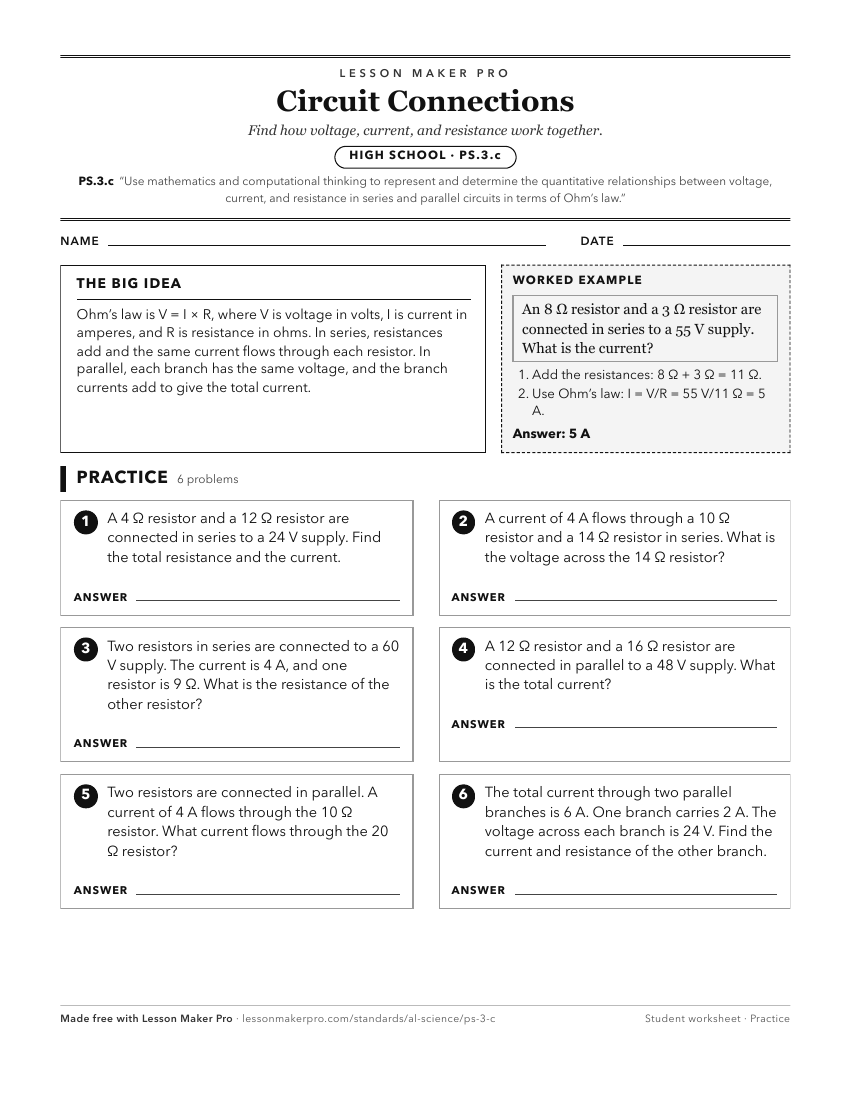
A ready-to-print activity worksheet aligned to PS.3.c, with an answer key for the teacher on its own page. No account needed.
PDF, US Letter, prints cleanly in black and white.
Download the worksheetKeep exploring
Related Standards
- P.6.d
Use mathematics and computational thinking to determine the voltage, current, and resistance for an entire circuit and at each resistor or load.
- PS.3.d
Develop and use models to determine the relationships among voltage, current, and resistance at specific loads in series and parallel circuits.
- P.6.b
Obtain, evaluate, and communicate information regarding the relationship among voltage, current, and power for direct current circuits.
- P.3.a
Use mathematical and computational thinking to explain the relationships among work, power, and time.
Turn this exact standard into a lesson
Grade, subject, topic, and the complete standard are prefilled. Create one free, no account needed.
Also for this standard:Make a WorksheetMake a QuizMake a Sub Lesson