Alabama Science P.3
Standard Cluster
Design and carry out experiments to verify that energy and momentum are conserved in closed systems. a. Use mathematical and computational thinking to explain the relationships among work, power, and time. b. Create mathematical and graphical representations to depict the transformation of energy from one form to another, including kinetic energy, gravitational potential energy, elastic potential energy, and work due to friction. c. Use models to illustrate the relationship between the work performed on an object and the object’s total mechanical energy. d. Qualitatively and quantitatively evaluate the relationship among the force acting on an object, the time of interaction, and the change in linear momentum (impulse) of the object. e. Obtain, evaluate, and interpret data related to collisions (both elastic and inelastic) and their effects on both linear momentum and energy conservation.
2023 Alabama Course of Study: Science · Energy
Cluster contents
Standards in This Cluster
P.3 is a cluster heading. These are the individual standards under it.
- P.3.a
Use mathematical and computational thinking to explain the relationships among work, power, and time.
- P.3.b
Create mathematical and graphical representations to depict the transformation of energy from one form to another, including kinetic energy, gravitational poten...
- P.3.c
Use models to illustrate the relationship between the work performed on an object and the object’s total mechanical energy.
- P.3.d
Qualitatively and quantitatively evaluate the relationship among the force acting on an object, the time of interaction, and the change in linear momentum (impu...
- P.3.e
Obtain, evaluate, and interpret data related to collisions (both elastic and inelastic) and their effects on both linear momentum and energy conservation.
Teacher's field guide
What This Cluster Means
What Students Need to Do
- Students measure cart motion, ramp height, and spring compression to test energy and momentum conservation when outside forces are small. They calculate work, power, and impulse from force, distance, and time data. They graph energy changes and account for friction, sound, and heat.
What Mastery Looks Like
- Students calculate work, power, and impulse with correct units. Their graphs track kinetic, gravitational, and elastic energy and show how frictional work reduces mechanical energy. They use collision data to show that momentum stays nearly constant even when kinetic energy drops.
Common Misconceptions
- Students often think kinetic energy stays constant when carts stick together. They leave heat and sound out of energy diagrams and say energy disappeared. They may assume a larger force always means a larger impulse without checking contact time.
How to Assess It
- Exit ticket: A 0.5 kg cart moving at 2 m/s sticks to an identical cart at rest. With negligible outside forces, find their shared speed, compare kinetic energy before and after, and explain the difference.
Lesson moves
Ways to Teach It
Roll a toy cart down a ramp, measure its speed at two heights with phone video, and draw energy bars for each point.
Ask: If two carts stick after impact, did energy disappear? Have students support their answers with sound, heat, and deformation.
Give pairs force, travel distance, and elapsed time cards; have them calculate work and power, then check units.
Compare a passenger stopping against a dashboard versus an airbag; calculate average force using the same momentum change and two stopping times.
Free download
Printable P.3 Worksheet
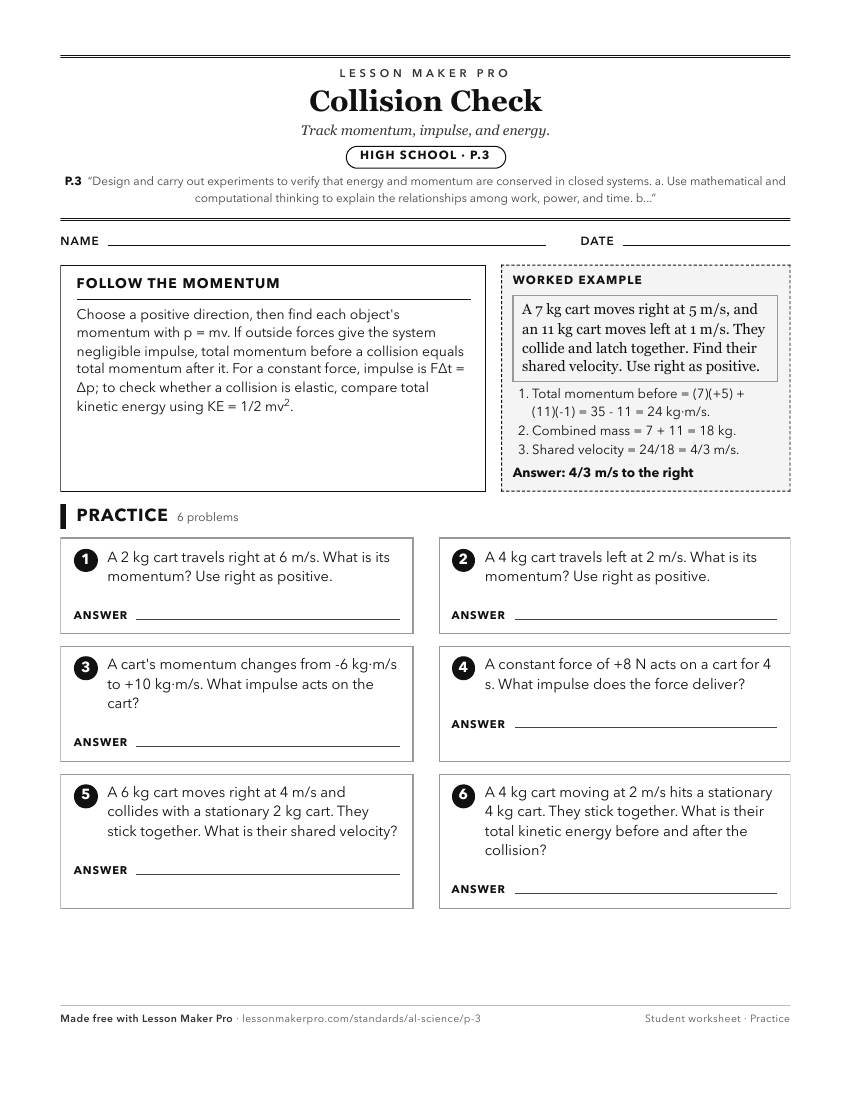
A ready-to-print activity worksheet aligned to P.3, with an answer key for the teacher on its own page. No account needed.
PDF, US Letter, prints cleanly in black and white.
Download the worksheetKeep exploring
Related Standards
- 8.15
Use models to construct an explanation of how energy is transformed but still conserved.
- PS.1.a
Plan and carry out investigations to explore how mechanical energy is transformed within a system, including kinetic energy, gravitational potential energy, ela...
- PS.1
Evaluate sources of information concerning the law of conservation of energy to illustrate energy transformations in practical applications and natural systems.
- 4.2
Plan and carry out investigations to answer questions regarding changes in energy when objects collide, and predict reasonable outcomes based on observed patter...
Turn this cluster into a lesson
Grade, subject, topic, and the complete cluster are prefilled. Create one free, no account needed.
Also for this cluster:Make a WorksheetMake a QuizMake a Sub Lesson