Alabama Science ESS.3
Standard Cluster
Research, evaluate, and communicate information about how the findings of early astronomers, including Aristotle, Ptolemy, Copernicus, Galileo, Brahe, Kepler, Newton, and Einstein, challenged the thinking of their time, allowed for academic advancements, and built a foundation for space exploration. a. Obtain and evaluate scientific information that explains how the application of new knowledge and technological advances has improved human understanding of the universe. b. Construct an evidence-based explanation of the connections among various cosmic phenomena, citing leading scientific theories. c. Obtain and communicate information about Alabama's contributions to space exploration.
2023 Alabama Course of Study: Science · Earth’s Place in the Universe
Cluster contents
Standards in This Cluster
ESS.3 is a cluster heading. These are the individual standards under it.
- ESS.3.a
Obtain and evaluate scientific information that explains how the application of new knowledge and technological advances has improved human understanding of the...
- ESS.3.b
Construct an evidence-based explanation of the connections among various cosmic phenomena, citing leading scientific theories.
- ESS.3.c
Obtain and communicate information about Alabama's contributions to space exploration.
Teacher's field guide
What This Cluster Means
What Students Need to Do
- Students compare the ideas and evidence of Aristotle, Ptolemy, Copernicus, Brahe, Galileo, Kepler, Newton, and Einstein. They use reliable sources to explain how new observations and technology changed our understanding of orbits and gravity. They report Alabama’s role in space exploration.
What Mastery Looks Like
- A student can explain how Galileo’s observations challenged an Earth-centered model and how Brahe’s measurements helped Kepler describe elliptical orbits. They can use Newton’s gravity to explain a spacecraft’s orbit, identify Marshall Space Flight Center’s work on the Saturn V, and cite sources.
Common Misconceptions
- Students may think Copernicus used a telescope to prove his model, but Galileo’s telescope observations came later. They may draw Kepler’s orbits as circles or assume Einstein’s work made Newton’s laws useless.
How to Assess It
- Exit ticket: Using short NASA excerpts on Galileo’s observations and Marshall’s Saturn V work, explain what Galileo’s evidence challenged, how gravity helps explain an orbit, and what Marshall contributed. Cite both excerpts.
Lesson moves
Ways to Teach It
Use two pushpins and a string loop to draw an ellipse; mark the Sun at one focus and compare the shape with a circle.
Show Galileo’s sketches of Jupiter’s moons; ask which Earth-centered claim they challenge and what the sketches cannot prove.
Give pairs eight astronomer cards and eight finding cards; have them match the cards and build a timeline of changing ideas.
Read NASA’s history of Marshall’s Saturn V work; students write how Alabama’s rocket engineers put Newton’s laws to use.
Free download
Printable ESS.3 Worksheet
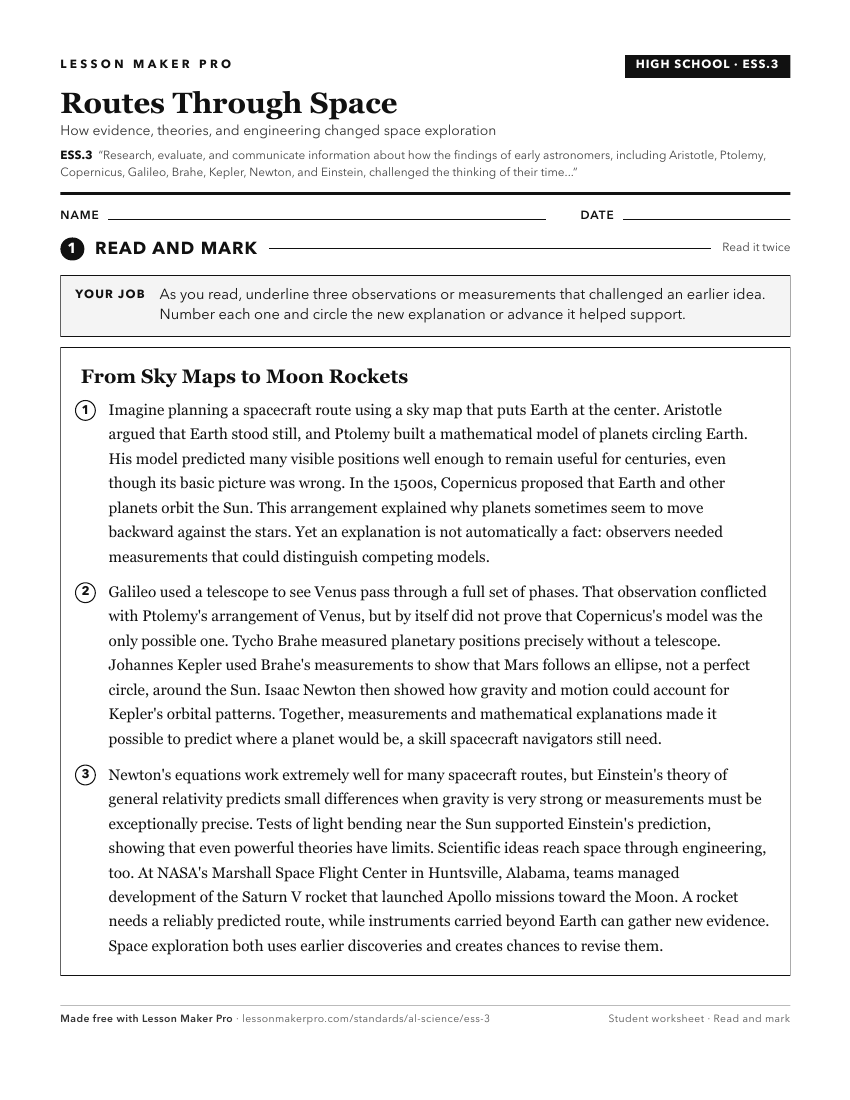
A ready-to-print activity worksheet aligned to ESS.3, with an answer key for the teacher on its own page. No account needed.
PDF, US Letter, prints cleanly in black and white.
Download the worksheetKeep exploring
Related Standards
- ESS.2
Obtain, evaluate, and communicate information about the structure and motion of components of the universe and solar system.
- 6.2
Evaluate information to compare and contrast past and current views about the structure of the universe and show how these views have changed over time.
- ESS.2.b
Use mathematics and computational thinking to explain the relationships between the properties of light and distances in the solar system and universe, includin...
Turn this cluster into a lesson
Grade, subject, topic, and the complete cluster are prefilled. Create one free, no account needed.
Also for this cluster:Make a WorksheetMake a QuizMake a Sub Lesson