Alabama Science 7.1.b
The Standard
- 7.1
- Develop and use a model to explain the functions of specific cell structures necessary for maintaining a stable environment, including the cell membrane, cell wall, chloroplasts, endoplasmic reticulum, golgi apparatus, mitochondria, nucleus, ribosomes, and vacuoles.
Construct an explanation of how prokaryotic and eukaryotic cells differ in structure and function.
2023 Alabama Course of Study: Science
Teacher's field guide
What This Standard Means
What Students Need to Do
- Students compare where DNA is found in two kinds of cells. They explain that eukaryotic cells have a nucleus and other membrane-bound organelles, while prokaryotic cells do not. Both kinds still carry out the work needed to live.
What Mastery Looks Like
- Given two cell diagrams, students identify each cell type using DNA location and organelles. They explain that mitochondria provide a separate place for energy release in eukaryotic cells, while prokaryotes use their cell membrane.
Common Misconceptions
- Students may think prokaryotes have no DNA because they have no nucleus. They may think all eukaryotes are multicellular, or that prokaryotes cannot release energy without mitochondria.
How to Assess It
- Show one cell diagram with DNA in a nucleus and mitochondria, and another with DNA in the cytoplasm. Ask students to identify each cell and explain one difference in how they release energy.
Lesson moves
Ways to Teach It
Use paper circles and yarn to build both cells; put yarn DNA inside a paper nucleus only in the eukaryote.
Ask: How can a bacterium release energy without mitochondria? Have pairs write one sentence about its cell membrane.
Play a diagram sort: students place six cell cards under prokaryote or eukaryote, then defend each choice using DNA location.
Show a yogurt carton listing live bacteria and a cheek cell image; ask where each cell keeps its DNA.
Free download
Printable 7.1.b Worksheet
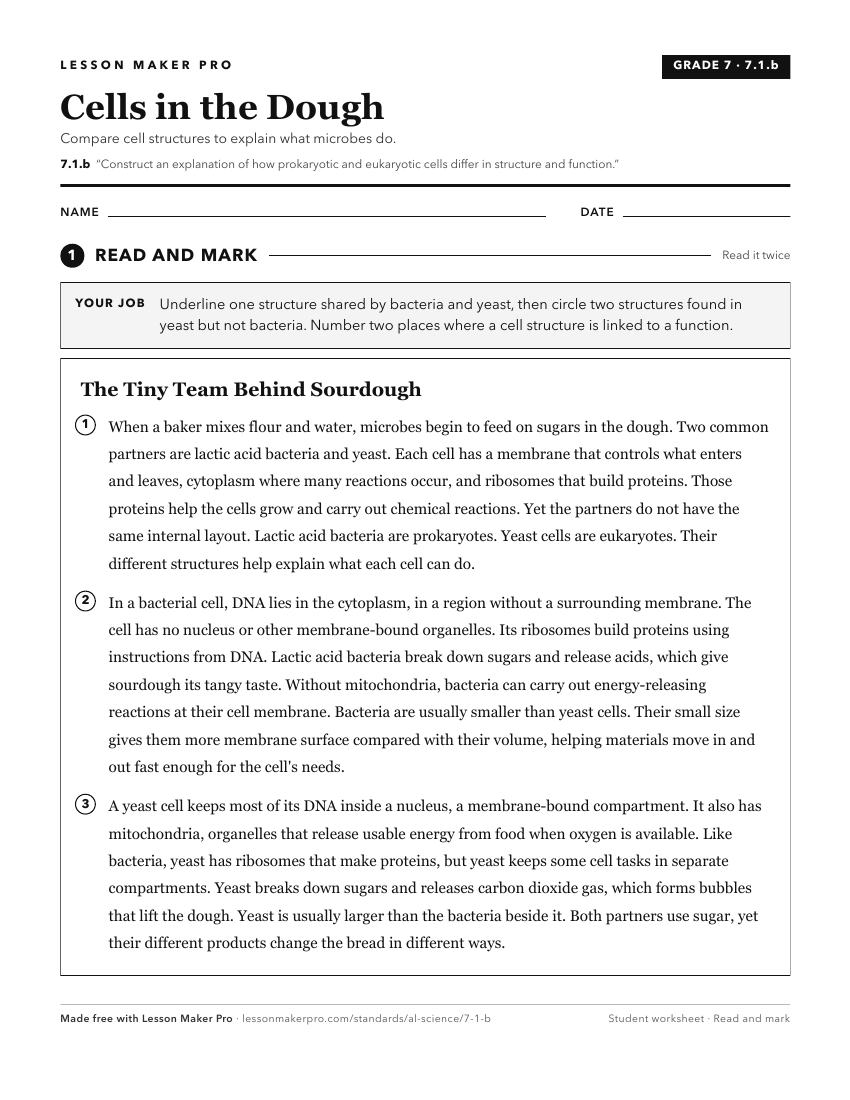
A ready-to-print activity worksheet aligned to 7.1.b, with an answer key for the teacher on its own page. No account needed.
PDF, US Letter, prints cleanly in black and white.
Download the worksheetKeep exploring
Related Standards
- BIO.1
Engage in evidence-based argument to relate a cell’s function to the structure, function, and diversity of its components.
- HAP.1
Obtain, evaluate, and communicate information to explain how differences in cellular structure (mitochondria, cytoskeletal structure, endoplasmic reticulum, cel...
- 7.1
Develop and use a model to explain the functions of specific cell structures necessary for maintaining a stable environment, including the cell membrane, cell w...
- 7.3
Construct an explanation of how the process of mitosis maintains complex organisms and ensures new cells with identical genetic information.
Turn this exact standard into a lesson
Grade, subject, topic, and the complete standard are prefilled. Create one free, no account needed.
Also for this standard:Make a WorksheetMake a QuizMake a Sub Lesson