Alabama Science BIO.1
The Standard
Engage in evidence-based argument to relate a cell’s function to the structure, function, and diversity of its components.
2023 Alabama Course of Study: Science · From Molecules to Organisms: Structures and Processes
Teacher's field guide
What This Standard Means
What Students Need to Do
- Students explain how a cell's parts help it do its job. They compare different cells and use observations or data to support their claims.
What Mastery Looks Like
- Given images of a muscle cell and a digestive enzyme producing cell, a student can identify which is which. They point to many mitochondria as evidence for contraction, and abundant rough ER and Golgi as evidence for making and shipping enzymes.
Common Misconceptions
- Students may think all cells have the same parts in the same amounts. They may name an organelle without explaining how its work helps the whole cell.
How to Assess It
- Exit ticket: A cell releases large amounts of digestive enzymes and has extensive rough ER and Golgi. Explain how each part helps the cell do its job.
Lesson moves
Ways to Teach It
Give pairs organelle cutouts and two cell outlines; have them build a muscle cell and a digestive enzyme producing cell, then label their choices.
Show two cell images and ask students to write which cell makes digestive enzymes, citing two visible features.
Hand out cell job cards and organelle profile cards; have teams match them and defend each match with one sentence.
Give students a clinic note about muscle weakness caused by faulty mitochondria; ask them to explain why exercise becomes harder.
Free download
Printable BIO.1 Worksheet
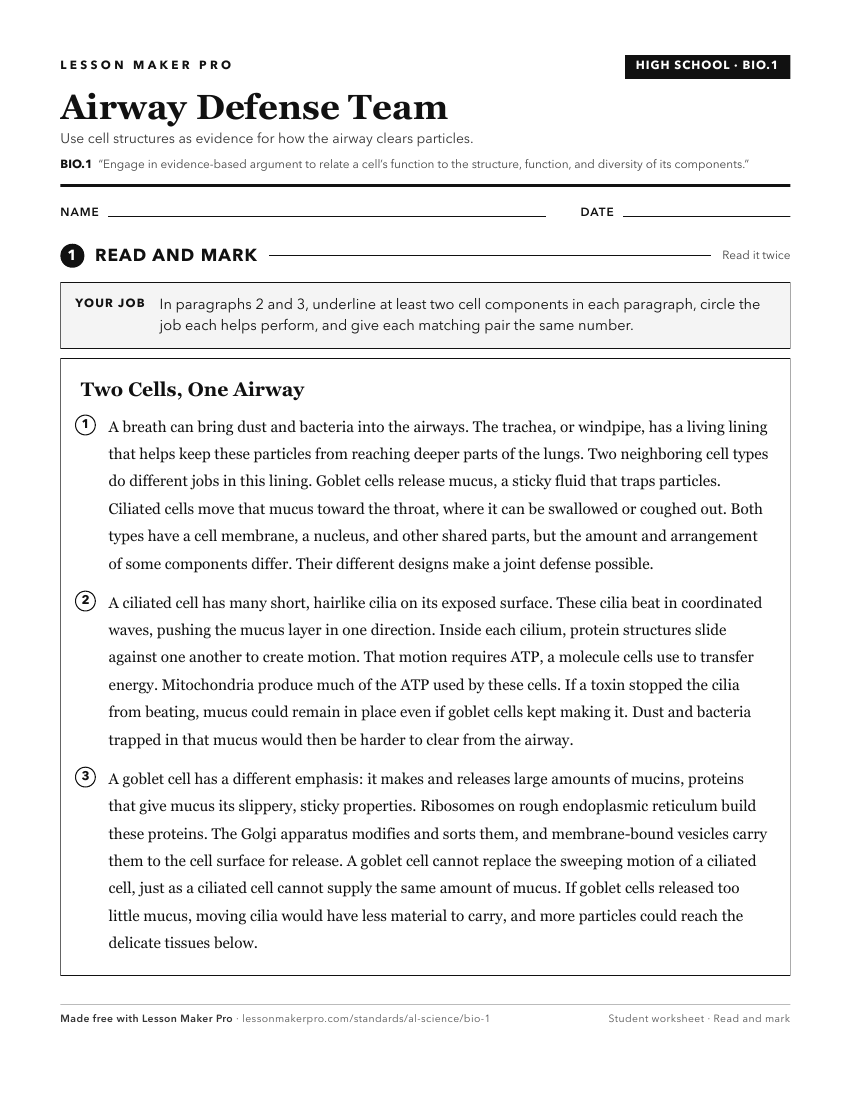
A ready-to-print activity worksheet aligned to BIO.1, with an answer key for the teacher on its own page. No account needed.
PDF, US Letter, prints cleanly in black and white.
Download the worksheetKeep exploring
Related Standards
- 7.1.a
Engage in argument from evidence to support claims of cell theory.
- BIO.4
Engage in argument from evidence to explain the regulation of cellular processes that maintain homeostasis, including active and passive transport.
- HAP.1
Obtain, evaluate, and communicate information to explain how differences in cellular structure (mitochondria, cytoskeletal structure, endoplasmic reticulum, cel...
- 7.1
Develop and use a model to explain the functions of specific cell structures necessary for maintaining a stable environment, including the cell membrane, cell w...
Turn this exact standard into a lesson
Grade, subject, topic, and the complete standard are prefilled. Create one free, no account needed.
Also for this standard:Make a WorksheetMake a QuizMake a Sub Lesson