Alabama Science 5.13
The Standard
Construct a model to represent the distribution of freshwater and saltwater on Earth.
2023 Alabama Course of Study: Science · Earth’s Systems
Teacher's field guide
What This Standard Means
What Students Need to Do
- Students make a scaled model of Earth's water, with about 97 parts saltwater and 3 parts freshwater. They show that freshwater is found in ice, underground, and in lakes and rivers.
What Mastery Looks Like
- A student can use 100 squares to show 97 parts saltwater and 3 parts freshwater. They can explain that most freshwater is frozen or underground, not in lakes and rivers.
Common Misconceptions
- Students may picture freshwater and saltwater as equal amounts. Some count only lakes and rivers as freshwater, leaving out ice and groundwater. Others think all freshwater is ready to drink.
How to Assess It
- Give students a blank 100-square grid. Ask them to shade and label Earth's saltwater and freshwater, then name two places freshwater is stored.
Lesson moves
Ways to Teach It
Give pairs 100 counters to sort into 97 saltwater and 3 freshwater, then add ice and groundwater labels beside the freshwater group.
Ask partners, 'Does freshwater mean ready to drink?' Have them use examples of ice, groundwater, and lakes to explain their answers.
Give pairs two 100-square grids, one shaded 97 to 3 and one shaded 50 to 50; have them choose the accurate model.
Show photos of an ocean and a reservoir; ask which could supply tap water without removing salt, and why.
Free download
Printable 5.13 Worksheet
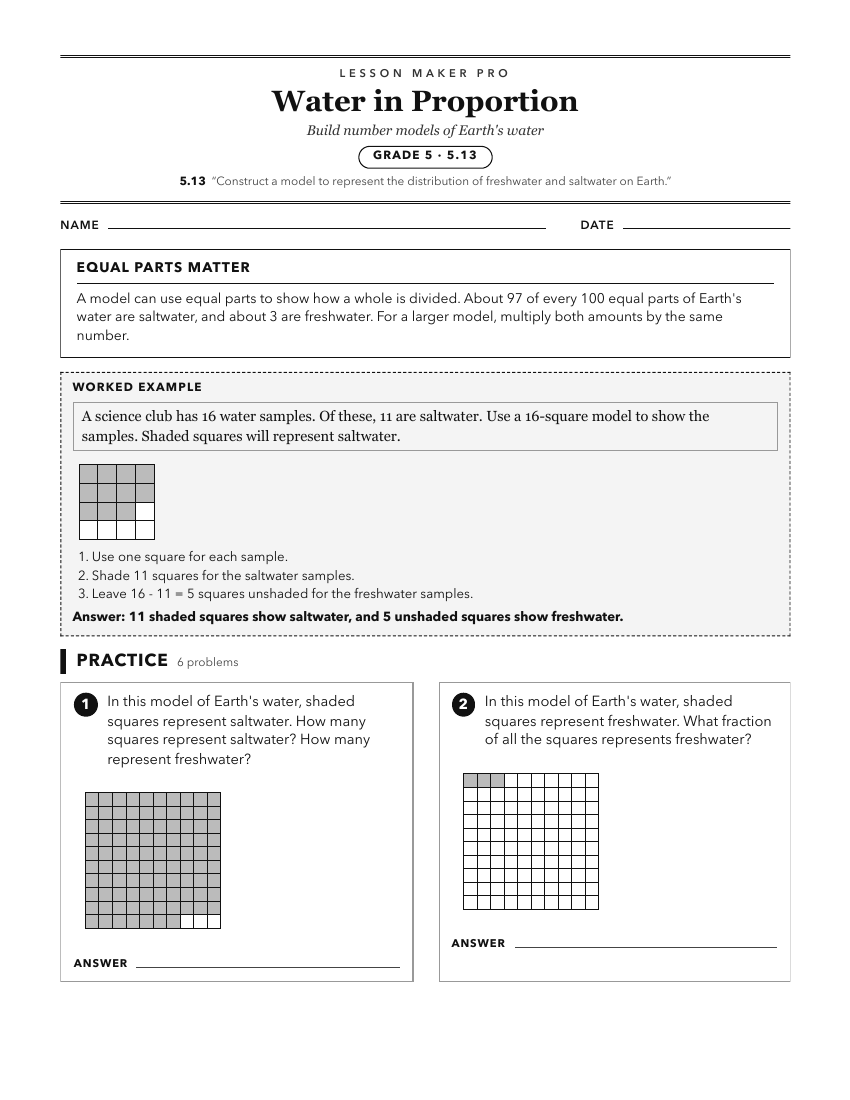
A ready-to-print activity worksheet aligned to 5.13, with an answer key for the teacher on its own page. No account needed.
PDF, US Letter, prints cleanly in black and white.
Download the worksheetKeep exploring
Related Standards
- 2.8
Use models to distinguish between the shapes and kinds of land and water on Earth.
- 4.10
Develop and use a model to describe how water moves through Earth’s systems by the processes of evaporation, condensation, and precipitation.
- 5.12
Use a model to represent how any two of Earth's systems (atmosphere, biosphere, geosphere, and hydrosphere) interact and support life.
- 6.10.a
Develop models demonstrating how unequal heating and the rotation of the Earth cause local and global wind systems and oceanic currents.
Turn this exact standard into a lesson
Grade, subject, topic, and the complete standard are prefilled. Create one free, no account needed.
Also for this standard:Make a WorksheetMake a QuizMake a Sub Lesson