Alabama Science 2.9
The Standard
Obtain information to identify where water is found on Earth and determine whether it is a solid or a liquid.
2023 Alabama Course of Study: Science · Earth’s Systems
Teacher's field guide
What This Standard Means
What Students Need to Do
- Students use photos, maps, or short texts to find water on Earth. They tell whether the water they find is solid or liquid.
What Mastery Looks Like
- A student identifies water in oceans and rivers as liquid, and snow and glaciers as solid. They point to a detail in a photo or text that supports each answer.
Common Misconceptions
- Some students do not think snow and ice are water. Others call all water liquid, even when a photo shows a glacier or frozen pond.
How to Assess It
- Give students four captioned photos: an ocean, a river, a glacier, and a snowfield. Ask them to label the water in each photo as solid or liquid.
Lesson moves
Ways to Teach It
Place an ice cube and liquid water in clear cups; have students match each cup to a photo of a glacier or lake.
Show a snowy mountain beside a river; ask, 'Where is the water, and what tells you its state?'
Give pairs picture cards of oceans, rivers, glaciers, and snowfields; have them sort the cards by solid or liquid water.
Read a weather forecast showing rain and snow; have students name each water state and where it might collect.
Free download
Printable 2.9 Worksheet
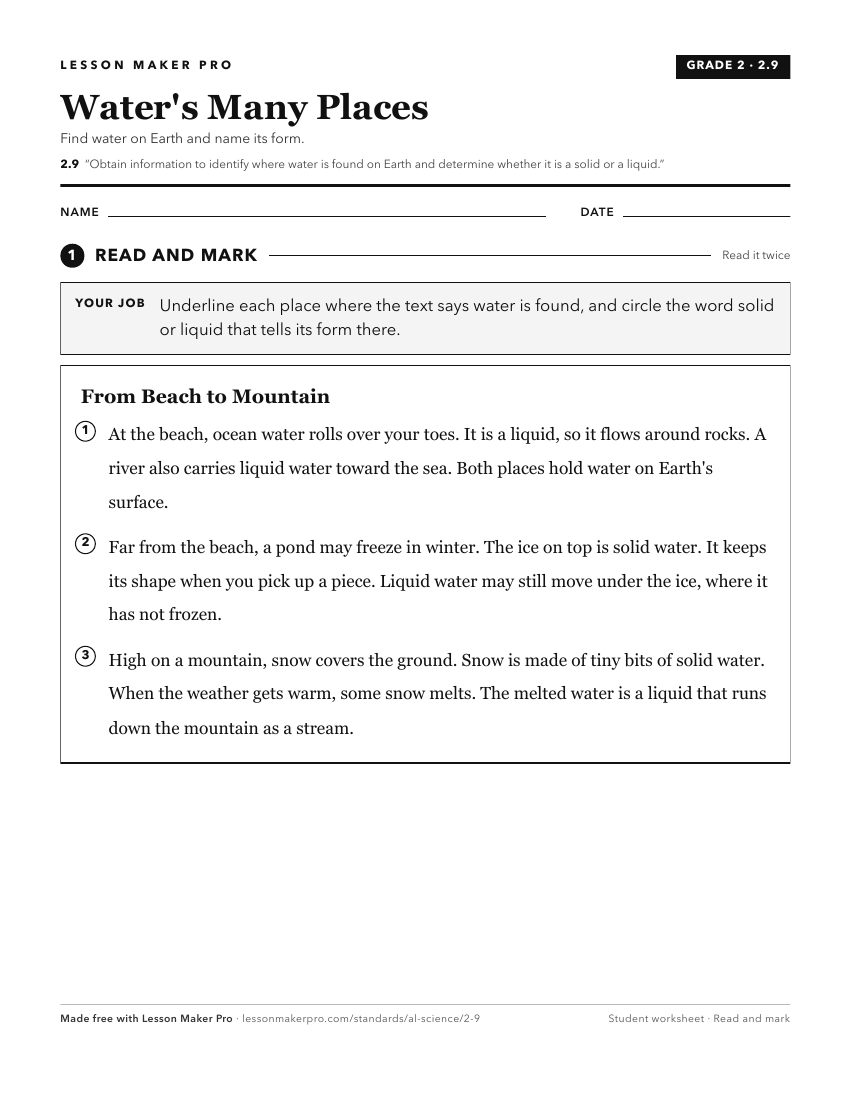
A ready-to-print activity worksheet aligned to 2.9, with an answer key for the teacher on its own page. No account needed.
PDF, US Letter, prints cleanly in black and white.
Download the worksheetKeep exploring
Related Standards
- ESS.4
Obtain, evaluate, and communicate information about the geologic conditions and processes that form different Earth materials.
- 2.8
Use models to distinguish between the shapes and kinds of land and water on Earth.
- CHE.5
Obtain, evaluate, and communicate information concerning factors that affect solubility and the properties of solutions.
- ESS.4.d
Plan and conduct an investigation on water’s effect on surface and subsurface processes.
Turn this exact standard into a lesson
Grade, subject, topic, and the complete standard are prefilled. Create one free, no account needed.
Also for this standard:Make a WorksheetMake a QuizMake a Sub Lesson