Alabama Math MM.FPM.A
Standard Cluster
Mathematical models involving growth and decay are useful in solving real-world problems involving borrowing and investing; spreadsheets are a frequently-used and powerful tool to assist with modeling financial situations.
2019 Alabama Course of Study: Mathematics · Mathematical Modeling
Cluster contents
Standards in This Cluster
MM.FPM.A is a cluster heading. These are the individual standards under it.
- MM.FPM.A.2
Use elements of the Mathematical Modeling Cycle to solve real-world problems involving finances.
- MM.FPM.A.3
Organize and display financial information using arithmetic sequences to represent simple interest and straight-line depreciation.
- MM.FPM.A.4
Organize and display financial information using geometric sequences to represent compound interest and proportional depreciation, including periodic (yearly, m...
- MM.FPM.A.4.a
Explain the relationship between annual percentage yield (APY) and annual percentage rate (APR) as values for r in the formulas A=P(1+r)ᵗ and A=Peʳᵗ.
- MM.FPM.A.5
Compare simple and compound interest, and straight-line and proportional depreciation.
- MM.FPM.A.6
Investigate growth and reduction of credit card debt using spreadsheets, including variables such as beginning balance, payment structures, credits, interest ra...
- MM.FPM.A.7
Compare and contrast housing finance options including renting, leasing to purchase, purchasing with a mortgage, and purchasing with cash.
- MM.FPM.A.7.a
Research and evaluate various mortgage products available to consumers.
- MM.FPM.A.7.b
Compare monthly mortgage payments for different terms, interest rates, and down payments.
- MM.FPM.A.7.c
Analyze the financial consequence of buying a home (mortgage payments vs. potentially increasing resale value) versus investing the money saved when renting, as...
- MM.FPM.A.8
Investigate the advantages and disadvantages of various means of paying for an automobile, including leasing, purchasing by cash, and purchasing by loan.
Teacher's field guide
What This Cluster Means
What Students Need to Do
- Students use spreadsheet rows to track savings that grow with interest and loans that change with interest and payments. They use the results to answer questions about future balances and borrowing costs.
What Mastery Looks Like
- A student converts an annual rate to a monthly rate when each row represents one month. They fill down the correct formula and explain why a loan payment reduces the balance by less than the payment amount.
Common Misconceptions
- Students often use the annual interest rate in every monthly row. Some subtract the full loan payment from the balance and forget to add interest. Others expect a loan balance to fall even when the payment is smaller than the interest.
How to Assess It
- Exit ticket: Put $500 in B2 and use a 6% annual rate, compounded monthly, to write the formula for B3 and fill it through B14. Report the month 12 balance and explain why it exceeds $530.
Lesson moves
Ways to Teach It
Have pairs fill 12 spreadsheet rows for $1,000 in savings at 4% and a $1,000 loan at 12% with $100 monthly payments.
Ask students why a $50 payment reduces a $1,000 loan at 12% annual interest by only $40 in month one.
Post three formulas for next month's loan balance; students vote for the one that adds monthly interest before subtracting the payment.
Give students two credit card offers with different APRs; have them model a $600 purchase with $50 monthly payments and compare balances after six months.
Free download
Printable MM.FPM.A Worksheet
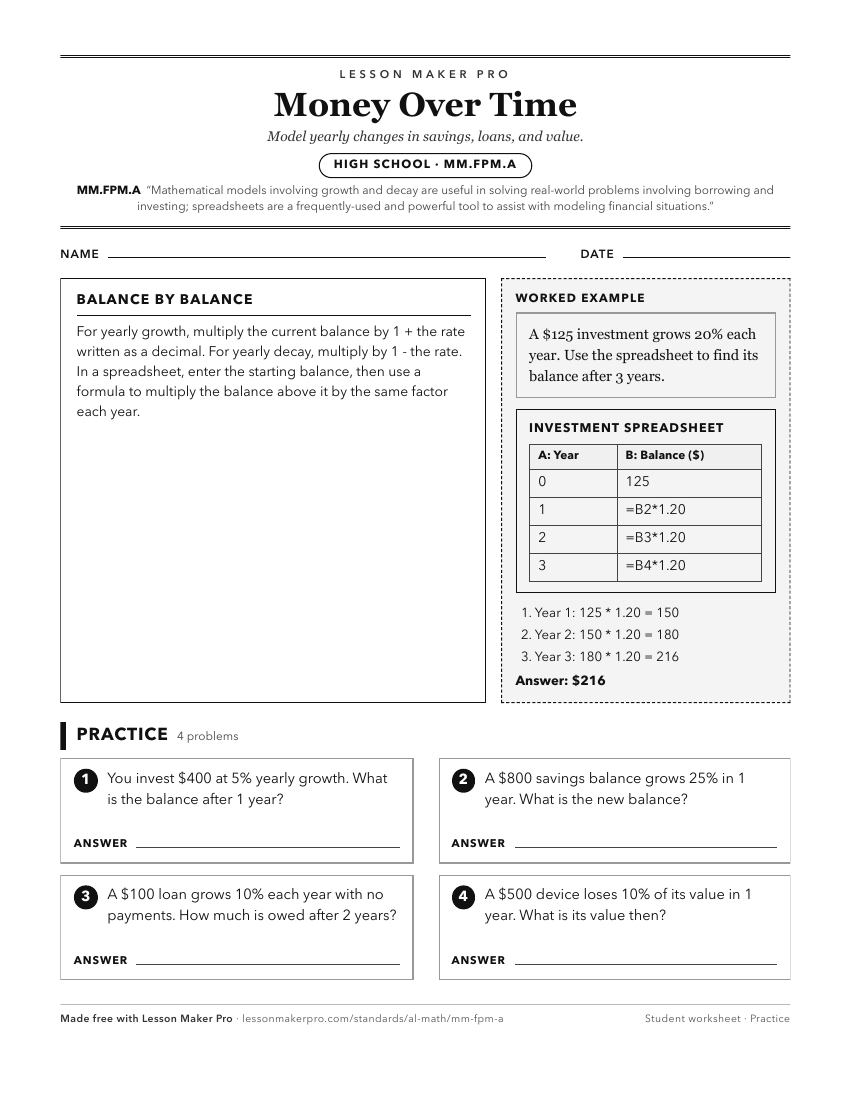
A ready-to-print activity worksheet aligned to MM.FPM.A, with an answer key for the teacher on its own page. No account needed.
PDF, US Letter, prints cleanly in black and white.
Download the worksheetKeep exploring
Related Standards
- MM.M.A
Mathematical modeling and statistical problem-solving are extensive, cyclical processes that can be used to answer significant real-world problems.
- MM.D3D.B.14
Use elements of the Mathematical Modeling Cycle to make predictions based on measurements that change over time, including motion, growth, decay, and cycling.
- 8A.AF.K.33
Use the mathematical modeling cycle to solve real-world problems involving linear, quadratic, exponential, absolute value, and linear piecewise functions.
Turn this cluster into a lesson
Grade, subject, topic, and the complete cluster are prefilled. Create one free, no account needed.
Also for this cluster:Make a WorksheetMake a QuizMake a Sub Lesson