Alabama Math MM.FPM.A.4.a
The Standard
- MM.FPM.A
- Mathematical models involving growth and decay are useful in solving real-world problems involving borrowing and investing; spreadsheets are a frequently-used and powerful tool to assist with modeling financial situations.
- MM.FPM.A.4
- Organize and display financial information using geometric sequences to represent compound interest and proportional depreciation, including periodic (yearly, monthly, weekly) and continuous compounding.
Explain the relationship between annual percentage yield (APY) and annual percentage rate (APR) as values for r in the formulas A=P(1+r)ᵗ and A=Peʳᵗ.
2019 Alabama Course of Study: Mathematics · Mathematical models involving growth and decay are useful in solving real-world problems involving borrowing and investing; spreadsheets are a frequently-used and powerful tool to assist with modeling financial situations.
Teacher's field guide
What This Standard Means
What Students Need to Do
- Students decide which rate belongs in each growth formula. In the annual growth formula, r is APY. In the continuous growth formula, r is the continuously compounded APR.
What Mastery Looks Like
- Given a 5% continuously compounded APR, a student finds the APY as e^0.05 − 1, or about 5.13%. They use either rate in the matching formula to get the same balance.
Common Misconceptions
- Students enter 5 instead of 0.05 for a 5% rate. They put APR into the annual growth formula when interest compounds more than once a year, or put APY into the continuous formula.
How to Assess It
- Exit ticket: A $1,000 deposit earns 5% APR with continuous compounding. Find its APY, then write both formulas for its balance after two years.
Lesson moves
Ways to Teach It
Build a spreadsheet with $1,000 and 6% APR; calculate year-end balances for annual, monthly, and continuous compounding.
Ask students to write why 6% APR with continuous compounding produces an APY above 6%, then name the rate that fits each formula.
Have pairs match cards labeled 5% continuous APR, e^0.05 − 1, 5.13% APY, and $1,051.27 after one year on $1,000.
Hand out two mock bank ads, 5% APR compounded monthly and 5.1% APY; compare their one-year returns on $1,000.
Free download
Printable MM.FPM.A.4.a Worksheet
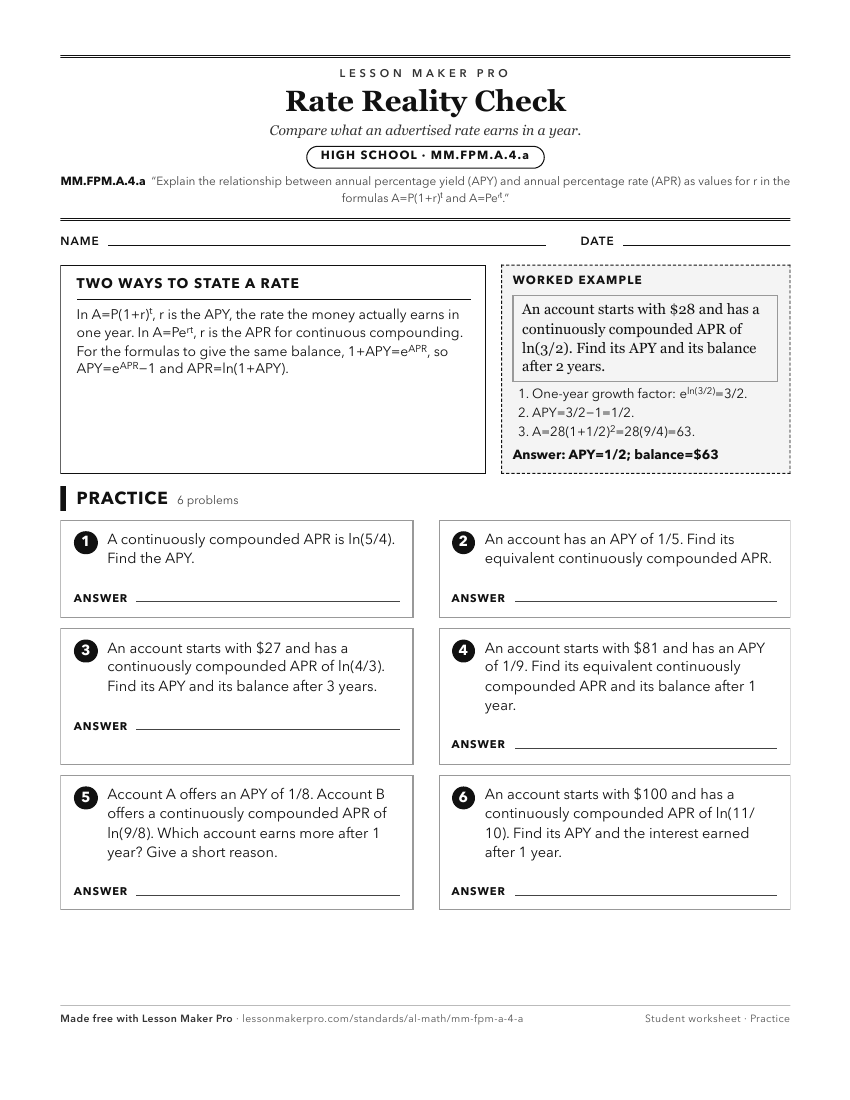
A ready-to-print activity worksheet aligned to MM.FPM.A.4.a, with an answer key for the teacher on its own page. No account needed.
PDF, US Letter, prints cleanly in black and white.
Download the worksheetKeep exploring
Related Standards
- 8A.AF.I.26.c
Define exponential functions to represent situations in which a quantity grows or decays by a constant percent rate per unit interval relative to another.
- A1P.AF.H.24.c
Define exponential functions to represent situations in which a quantity grows or decays by a constant percent rate per unit interval relative to another.
- MM.FPM.A.5
Compare simple and compound interest, and straight-line and proportional depreciation.
- 7A.GM.B.36
Explain the relationships among circumference, diameter, area, and radius of a circle to demonstrate understanding of formulas for the area and circumference of...
Turn this exact standard into a lesson
Grade, subject, topic, and the complete standard are prefilled. Create one free, no account needed.
Also for this standard:Make a WorksheetMake a QuizMake a Sub Lesson