Alabama Math MM.D3D.B.14
The Standard
- MM.D3D.B
- Functions can be used to represent general trends in conditions that change over time and to predict future conditions based on present observations.
Use elements of the Mathematical Modeling Cycle to make predictions based on measurements that change over time, including motion, growth, decay, and cycling.
2019 Alabama Course of Study: Mathematics
Teacher's field guide
What This Standard Means
What Students Need to Do
- Students graph measurements taken over time and choose a function that fits the pattern. They use it to predict a later value, then check the prediction against a measurement.
What Mastery Looks Like
- A student can explain why a line, a changing curve, or a repeating pattern fits the data. They can make a prediction with units and say whether new data supports their model.
Common Misconceptions
- Students may draw a straight line through data that speeds up, slows down, or repeats. They may treat a prediction far beyond the measured times as just as reliable as one nearby.
How to Assess It
- Exit ticket: A toy car travels 2, 5, and 8 feet at seconds 1, 2, and 3. Predict its distance at second 4, then compare your result with a measured 10 feet and say whether you would revise your model.
Lesson moves
Ways to Teach It
Measure a cup of warm water with a thermometer each minute for ten minutes, graph the temperatures, and predict the next reading.
Give students a graph of twelve months of daylight hours and ask where a straight-line prediction would fail and why.
Hand out data tables for a walker, bacteria, cooling water, and daylight hours; teams match each to a graph and predict one new value.
Show a three-day hourly electricity-use chart; students predict tomorrow's peak hour and name one factor that could shift it.
Free download
Printable MM.D3D.B.14 Worksheet
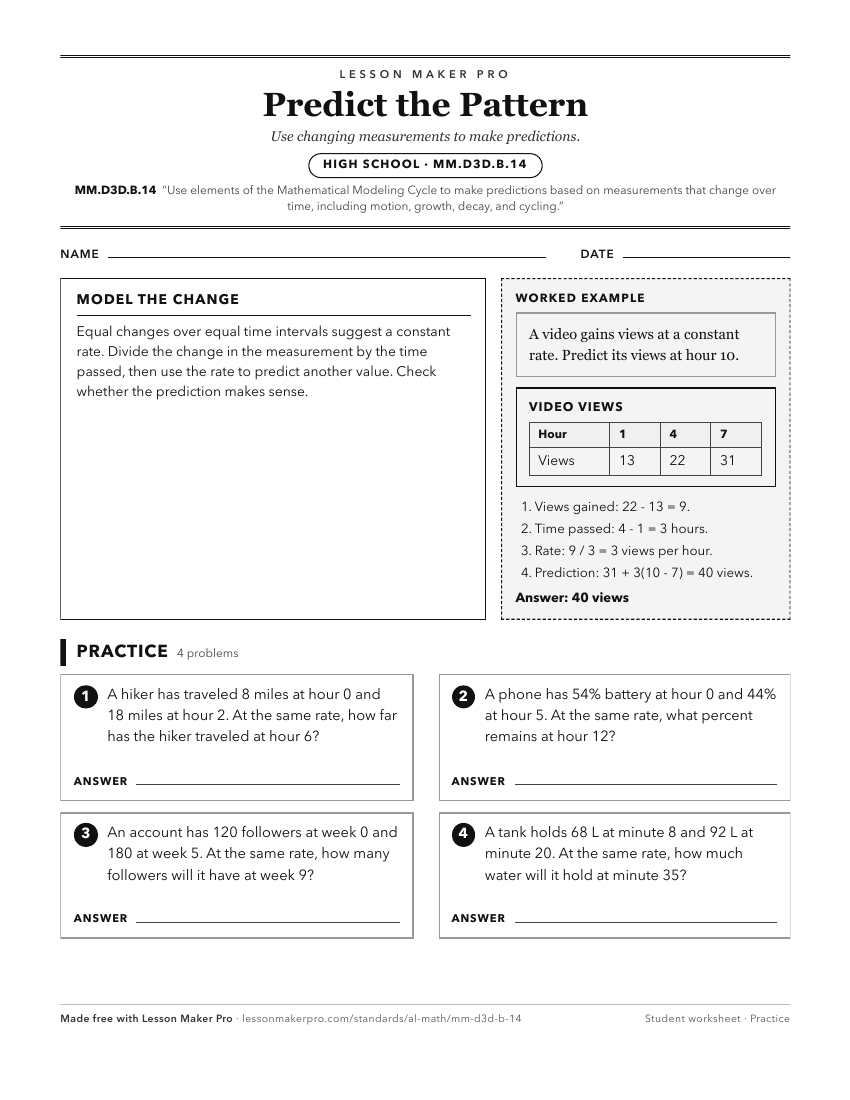
A ready-to-print activity worksheet aligned to MM.D3D.B.14, with an answer key for the teacher on its own page. No account needed.
PDF, US Letter, prints cleanly in black and white.
Download the worksheetKeep exploring
Related Standards
- MM.FPM.A.2
Use elements of the Mathematical Modeling Cycle to solve real-world problems involving finances.
- A1P.AF.I.31
Use the mathematical modeling cycle to solve real-world problems involving linear, quadratic, exponential, absolute value, and linear piecewise functions.
- 8A.AF.K.33
Use the mathematical modeling cycle to solve real-world problems involving linear, quadratic, exponential, absolute value, and linear piecewise functions.
- MM.D3D.A.9
Use the Mathematical Modeling Cycle to solve real-world problems involving the design of three-dimensional objects.
Turn this exact standard into a lesson
Grade, subject, topic, and the complete standard are prefilled. Create one free, no account needed.
Also for this standard:Make a WorksheetMake a QuizMake a Sub Lesson