Alabama Math MM.FPM.A.7
Standard Cluster
- MM.FPM.A
- Mathematical models involving growth and decay are useful in solving real-world problems involving borrowing and investing; spreadsheets are a frequently-used and powerful tool to assist with modeling financial situations.
Compare and contrast housing finance options including renting, leasing to purchase, purchasing with a mortgage, and purchasing with cash. a. Research and evaluate various mortgage products available to consumers. b. Compare monthly mortgage payments for different terms, interest rates, and down payments. c. Analyze the financial consequence of buying a home (mortgage payments vs. potentially increasing resale value) versus investing the money saved when renting, assuming that renting is the less expensive option.
2019 Alabama Course of Study: Mathematics
Cluster contents
Standards in This Cluster
MM.FPM.A.7 is a cluster heading. These are the individual standards under it.
- MM.FPM.A.7.a
Research and evaluate various mortgage products available to consumers.
- MM.FPM.A.7.b
Compare monthly mortgage payments for different terms, interest rates, and down payments.
- MM.FPM.A.7.c
Analyze the financial consequence of buying a home (mortgage payments vs. potentially increasing resale value) versus investing the money saved when renting, as...
Teacher's field guide
What This Cluster Means
What Students Need to Do
- Students compare upfront cash, monthly costs, and ownership rules for renting, leasing to purchase, buying with a mortgage, and paying cash. They compare mortgage offers and calculate how the loan term, interest rate, and down payment affect payments. They weigh a buyer's possible resale proceeds against money a renter could invest.
What Mastery Looks Like
- Given two mortgage offers, students calculate monthly payments and total interest, then explain the trade-offs. They compare a buyer's proceeds after paying off the loan with a renter's investment balance. They account for costs such as repairs, taxes, and selling fees.
Common Misconceptions
- Students may assume every mortgage payment builds the same amount of equity or that home prices always rise. They often leave out taxes, repairs, loan fees, and selling costs. They may also think a lease-to-purchase agreement guarantees a sale or refunds extra payments if they move.
How to Assess It
- Exit ticket: A buyer puts $30,000 down and pays $1,100 monthly; a renter pays $900 and invests $30,000 plus $200 monthly. After five years, the house sells for $220,000 with $160,000 owed, and the renter's account holds $48,000; compare their balances and name one omitted cost.
Lesson moves
Ways to Teach It
Give pairs play money and four housing-option cards; have them pay deposits or down payments and label who owns the home.
Ask students to write three questions they would ask before signing a lease-to-purchase agreement, including what happens to extra payments if they move.
Give teams three loan cards with different rates, terms, and down payments; use a mortgage calculator to rank payments and total interest.
Post a local rental listing and home listing; have students compare upfront cash, monthly costs, and five-year results using an assumed resale price.
Free download
Printable MM.FPM.A.7 Worksheet
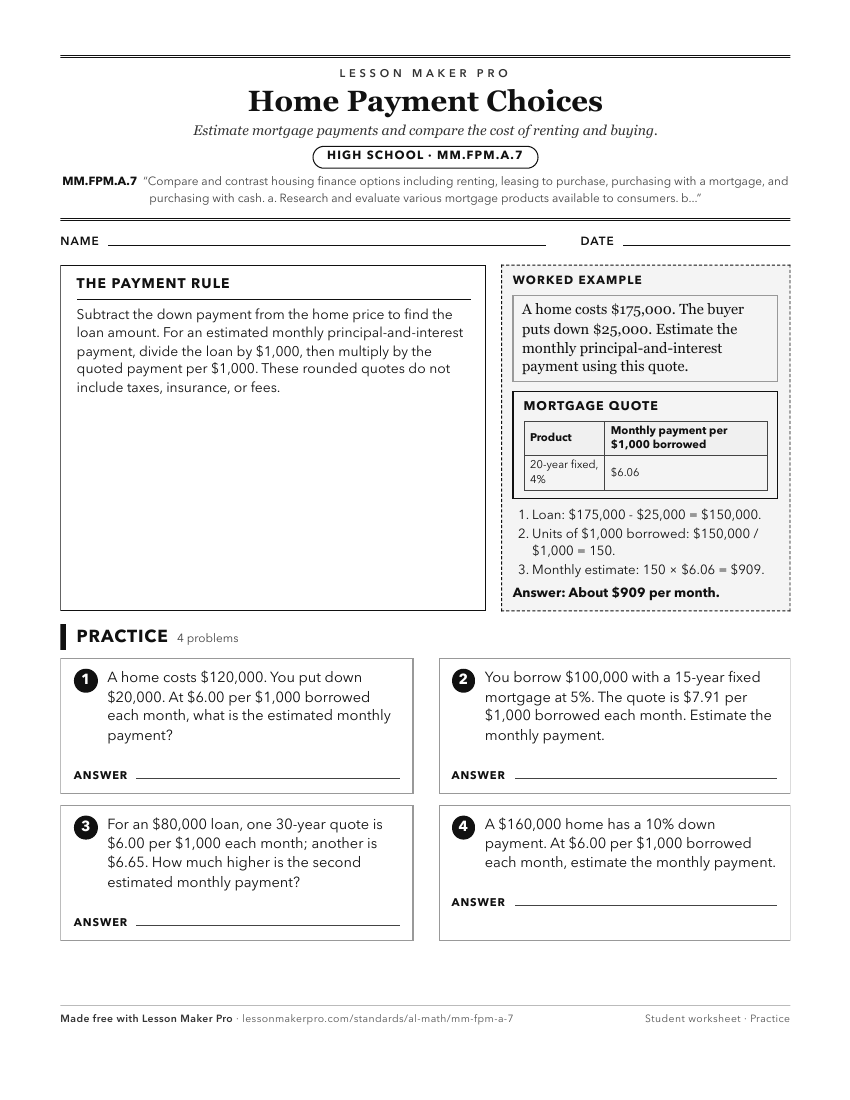
A ready-to-print activity worksheet aligned to MM.FPM.A.7, with an answer key for the teacher on its own page. No account needed.
PDF, US Letter, prints cleanly in black and white.
Download the worksheetKeep exploring
Related Standards
Turn this cluster into a lesson
Grade, subject, topic, and the complete cluster are prefilled. Create one free, no account needed.
Also for this cluster:Make a WorksheetMake a QuizMake a Sub Lesson