Alabama Math 8A.AF.F
Standard Cluster
Functions shift the emphasis from a point-by-point relationship between two variables (input/output) to considering an entire set of ordered pairs (where each first element is paired with exactly one second element) as an entity with its own features and characteristics.
2019 Alabama Course of Study: Mathematics · Grade 8 Accelerated Standards
Cluster contents
Standards in This Cluster
8A.AF.F is a cluster heading. These are the individual standards under it.
- 8A.AF.F.16
Define a function as a mapping from one set (called the domain) to another set (called the range) that assigns to each element of the domain exactly one element...
- 8A.AF.F.16.b
Relate the domain of a function to its graph and, where applicable, to the quantitative relationship it describes. Limit to linear, quadratic, exponential, and ...
- 8A.AF.F.18
Compare and contrast relations and functions represented by equations, graphs, or tables that show related values; determine whether a relation is a function. I...
- 8A.AF.F.19
Combine different types of standard functions to write, evaluate, and interpret functions in context. Limit to linear, quadratic, exponential, and absolute valu...
- 8A.AF.F.19.a
Use arithmetic operations to combine different types of standard functions to write and evaluate functions.
- 8A.AF.F.19.b
Use function composition to combine different types of standard functions to write and evaluate functions.
Teacher's field guide
What This Cluster Means
What Students Need to Do
- Students look at a whole set of input-output pairs, not just one pair at a time. They check that each input has exactly one output. Then they describe the inputs, outputs, and pattern across the set.
What Mastery Looks Like
- A student can spot an input paired with two different outputs and explain why the set is not a function. For a function, they can list its inputs and outputs and describe how the outputs change.
Common Misconceptions
- Some students think two inputs cannot share the same output. Others accept an input with two different outputs because each pair looks fine on its own. They may describe one pair instead of the pattern across the set.
How to Assess It
- Exit ticket: A = {(1, 2), (2, 4), (3, 6)} and B = {(1, 2), (2, 4), (2, 5)}. Which set is a function, why, and what pattern describes its pairs?
Lesson moves
Ways to Teach It
Give students input and output cards to connect with yarn; add a second link to one input and ask what breaks.
Show two tables, one with repeated outputs and one with an input paired with different outputs; ask which represents a function.
Deal three ordered-pair card sets; have students sort functions from nonfunctions and list each function's inputs and outputs.
Post a cafeteria menu with item prices; have students pair each item with its price and explain why two items can cost the same.
Free download
Printable 8A.AF.F Worksheet
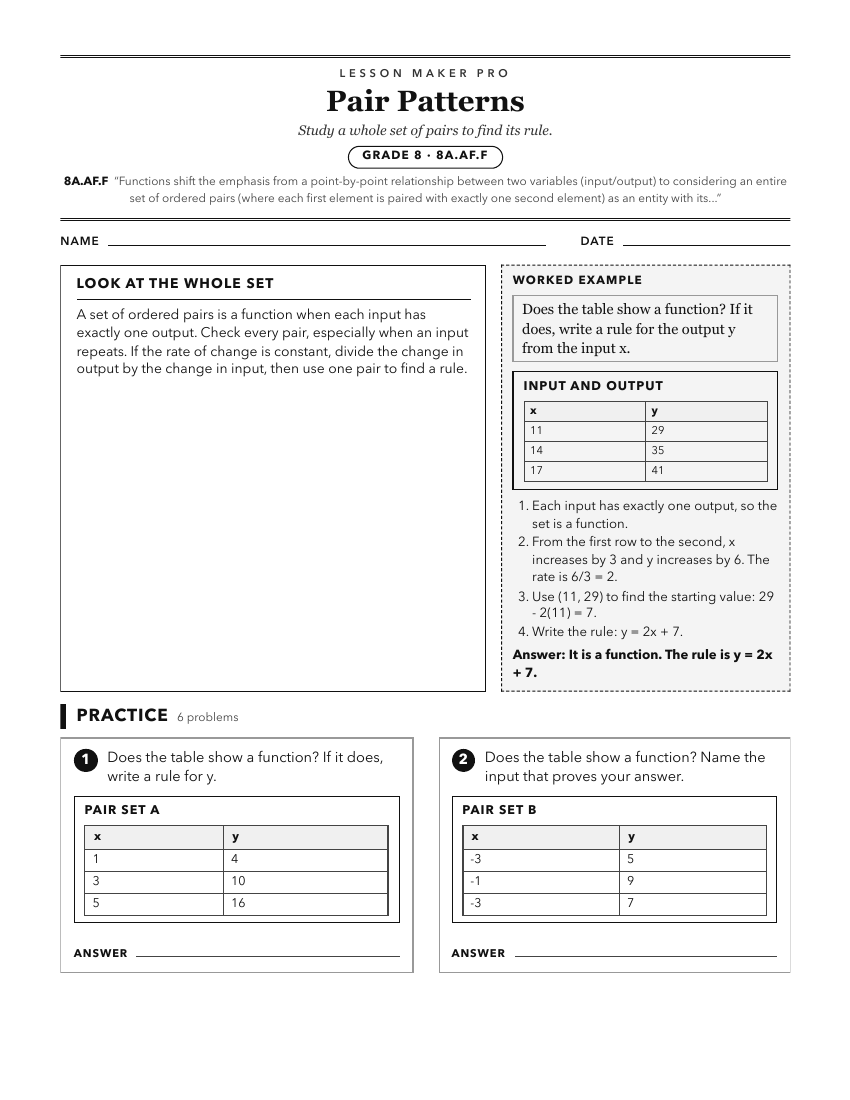
A ready-to-print activity worksheet aligned to 8A.AF.F, with an answer key for the teacher on its own page. No account needed.
PDF, US Letter, prints cleanly in black and white.
Download the worksheetKeep exploring
Related Standards
- A1P.AF.E
Functions shift the emphasis from a point-by-point relationship between two variables (input/output) to considering an entire set of ordered pairs (where each f...
- 5.OA.B.2.b
Form ordered pairs from values in an input/output table.
- A1P.AF.H.28
For a function that models a relationship between two quantities, interpret key features of graphs and tables in terms of the quantities, and sketch graphs show...
- MM.D3D.B.15.b
Describe the overall relationship between two quantitative variables (increase, decrease, linearity, concavity, extrema, inflection) or pattern of change.
Turn this cluster into a lesson
Grade, subject, topic, and the complete cluster are prefilled. Create one free, no account needed.
Also for this cluster:Make a WorksheetMake a QuizMake a Sub Lesson