Alabama ELA 7.CL.3
The Standard
Explain how the author’s choice of setting, plot, characters, theme, conflict, dialogue, and point of view contribute to and/or enhance the meaning and purpose of prose and poetry, using textual evidence from the writing.
2021 Alabama Course of Study: English Language Arts
Teacher's field guide
What This Standard Means
What Students Need to Do
- Students look at how a writer uses setting, events, characters, dialogue, and point of view to build meaning. They explain what those choices do in a story or poem and support their ideas with specific lines.
What Mastery Looks Like
- A student quotes a line and explains how a writer's choice shapes the message. They can show how two choices, such as dialogue and conflict, work together.
Common Misconceptions
- Students may name the setting or theme without explaining why it matters. They may treat a poem's speaker as the poet or choose a quote that does not support their claim.
How to Assess It
- Give students the first paragraph of 'The Tell-Tale Heart.' Ask them to quote one line that shows the narrator's point of view and explain how it affects their trust in the narrator.
Lesson moves
Ways to Teach It
Give pairs a printed page from 'The Tell-Tale Heart'; have them color-code setting and narrator clues, then write how each builds suspense.
Ask pairs to discuss how the speaker's view of the paths in 'The Road Not Taken' shapes its message, citing one line.
Give pairs plot, dialogue, and conflict cards to match with lines from a short story, then have them explain each line's effect.
Display a book jacket blurb; students underline its conflict, then rewrite two sentences from a character's viewpoint to change the sales pitch.
Free download
Printable 7.CL.3 Worksheet
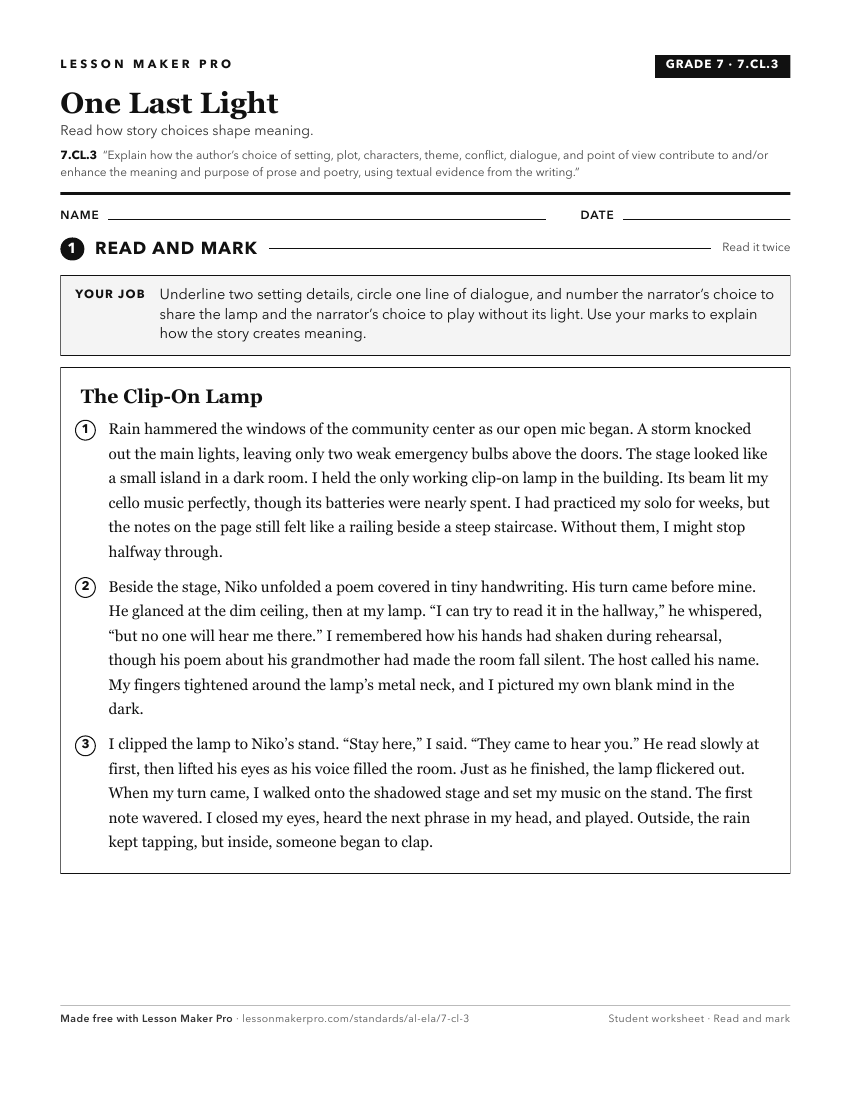
A ready-to-print activity worksheet aligned to 7.CL.3, with an answer key for the teacher on its own page. No account needed.
PDF, US Letter, prints cleanly in black and white.
Download the worksheetKeep exploring
Related Standards
- 6.CL.3
Explain how authors use setting, plot, characters, theme, conflict, dialogue, and point of view to contribute to the meaning and purpose of prose and poetry, us...
- 8.CL.3
Analyze how authors use key literary elements, including setting, plot, theme, characters, internal and external conflict, dialogue, and point of view, to contr...
- 4.LF.16
Describe how authors use literary devices and text features to convey meaning in prose, poetry, and drama.
- 6.CL.4
Describe the use of literary devices in prose and poetry, including simile, metaphor, personification, onomatopoeia, hyperbole, tone, imagery, irony, symbolism,...
Turn this exact standard into a lesson
Grade, subject, topic, and the complete standard are prefilled. Create one free, no account needed.
Also for this standard:Make a WorksheetMake a QuizMake a Sub Lesson