Alabama ELA 6.CL.4
The Standard
Describe the use of literary devices in prose and poetry, including simile, metaphor, personification, onomatopoeia, hyperbole, tone, imagery, irony, symbolism, and mood, and indicate how they support interpretations of the text.
2021 Alabama Course of Study: English Language Arts
Teacher's field guide
What This Standard Means
What Students Need to Do
- Students find literary devices in stories and poems. They explain what specific words suggest and how those words shape their reading of a speaker, setting, or event.
What Mastery Looks Like
- A student can point to a phrase, name the device, and explain its effect. They use details from the text to support their interpretation, rather than saying only that the language is vivid.
Common Misconceptions
- Students may call every comparison a simile, even without "like" or "as." They may mix up a speaker's tone with the mood a reader feels. They may call any surprise irony or name a symbol without saying what it represents.
How to Assess It
- Read: "The empty house groaned as the storm moved in." Name the device, explain what it suggests about the house, and describe the mood it creates.
Lesson moves
Ways to Teach It
Give pairs copies of Dickinson's "Hope is the thing with feathers" and colored pencils; circle two devices and annotate what they suggest about hope.
Ask: "If a poet calls rain a drummer, what does that metaphor suggest about the storm, and why?"
Play device match: students pair ten short excerpts with device cards, then explain one match and its effect to a partner.
Show a mock cereal ad saying "The best breakfast on Earth"; students label the hyperbole and explain what buyers are meant to believe.
Free download
Printable 6.CL.4 Worksheet
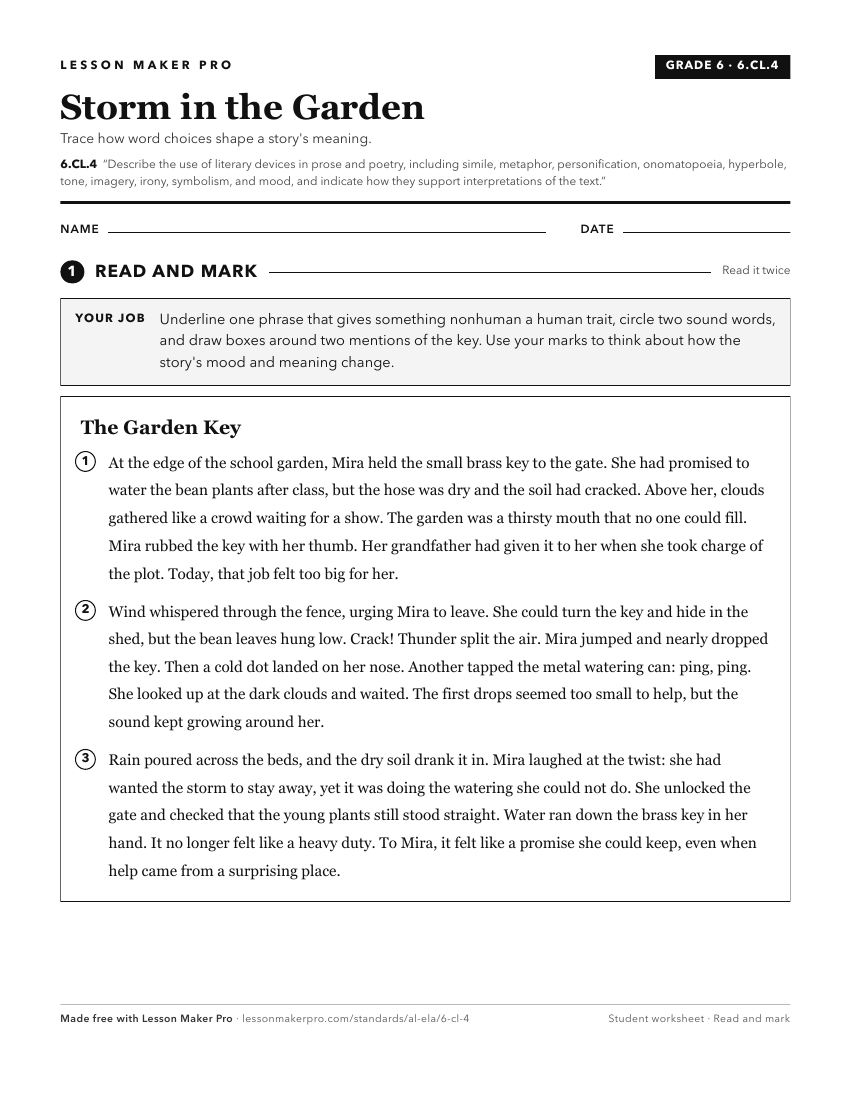
A ready-to-print activity worksheet aligned to 6.CL.4, with an answer key for the teacher on its own page. No account needed.
PDF, US Letter, prints cleanly in black and white.
Download the worksheetKeep exploring
Related Standards
- 8.CL.4
Analyze the use of literary devices, including simile, metaphor, personification, onomatopoeia, hyperbole, imagery, tone, symbolism, irony, mood, and allusion, ...
- 7.CL.4
Evaluate literary devices to support interpretations of literary texts using textual evidence, including simile, metaphor, personification, onomatopoeia, hyperb...
- 4.LF.16
Describe how authors use literary devices and text features to convey meaning in prose, poetry, and drama.
- 4-5.R5
Identify and explain literary devices in prose and poetry.
Turn this exact standard into a lesson
Grade, subject, topic, and the complete standard are prefilled. Create one free, no account needed.
Also for this standard:Make a WorksheetMake a QuizMake a Sub Lesson