Alabama ELA 4.LF.16
Standard Cluster
Describe how authors use literary devices and text features to convey meaning in prose, poetry, and drama. a. Identify clues in the text to recognize implicit meanings. b. Apply prior knowledge to textual clues to draw conclusions about the author’s meaning. c. Make an inference about the meaning of a text and support it with textual evidence.
2021 Alabama Course of Study: English Language Arts · Literacy Foundations 4-5
Cluster contents
Standards in This Cluster
4.LF.16 is a cluster heading. These are the individual standards under it.
Teacher's field guide
What This Cluster Means
What Students Need to Do
- Students notice repeated words, titles, line breaks, and stage directions in stories, poems, and plays. They use those clues and what they already know to figure out ideas the author does not say directly.
What Mastery Looks Like
- A student can explain what a repeated line or stage direction suggests. They can point to a specific line that supports their reading and explain how their own knowledge helped them understand it.
Common Misconceptions
- Students may offer a guess without pointing to a clue in the text. They may treat stage directions as spoken words or miss how repetition changes the feeling of a poem. Some let what they already know override what the text says.
How to Assess It
- Put this poem on the board: 'Last Bell / The hallway is quiet. / Still, I wait. / Footsteps pass my door. / Still, I wait.' Ask: What feeling does the repeated line suggest? Use another line and what you know about waiting to explain.
Lesson moves
Ways to Teach It
Give pairs a printed poem and two highlighters; mark repeated words and stanza breaks, then write what each choice makes readers notice.
Show this play line, 'Jo: Come in. [Hides a letter.]' Ask: What might Jo fear? Use the stage direction and what you know about secrets.
Hand groups story passages and possible inference cards; have them sort claims into supported and unsupported piles and underline proof.
At a class play rehearsal, give actors a script marked '[avoids eye contact]'; have them show the feeling and explain their choice.
Free download
Printable 4.LF.16 Worksheet
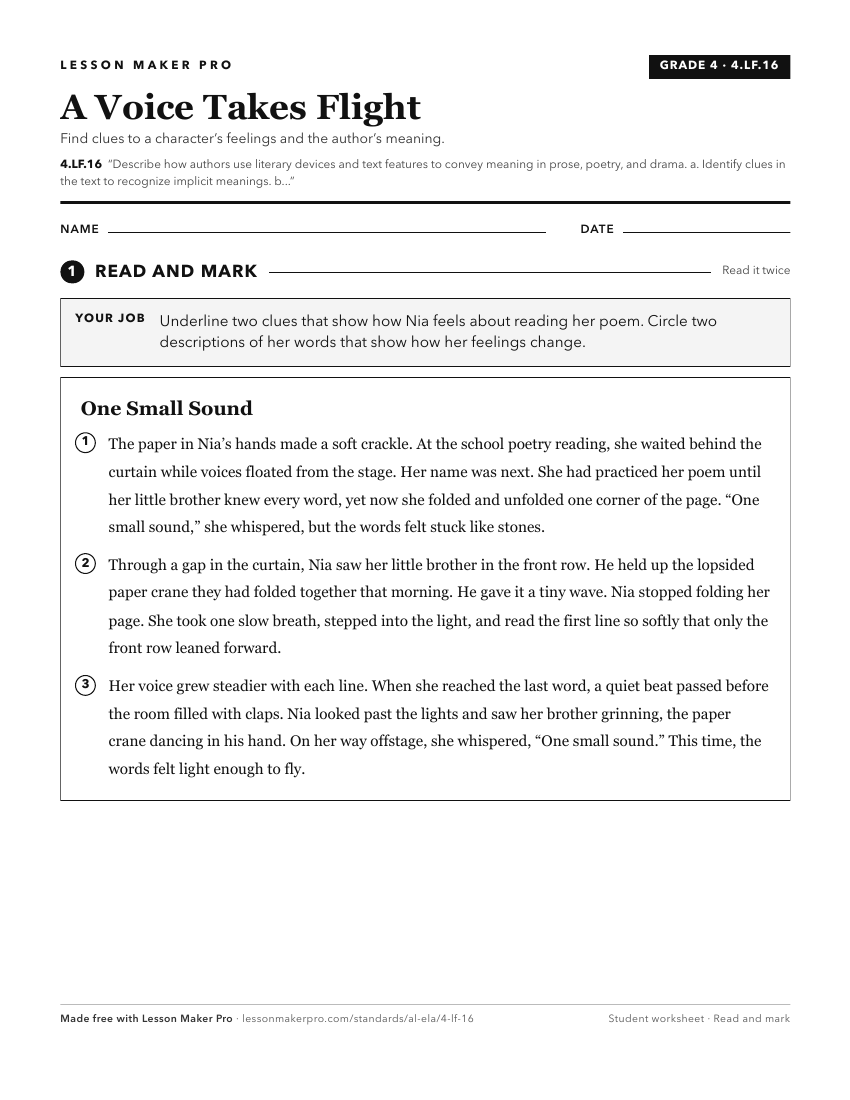
A ready-to-print activity worksheet aligned to 4.LF.16, with an answer key for the teacher on its own page. No account needed.
PDF, US Letter, prints cleanly in black and white.
Download the worksheetKeep exploring
Related Standards
- 6.CL.4
Describe the use of literary devices in prose and poetry, including simile, metaphor, personification, onomatopoeia, hyperbole, tone, imagery, irony, symbolism,...
- 3.LF.27
Read prose, poetry, and dramas, identifying the literary devices used by the author to convey meaning.
- 4-5.R5
Identify and explain literary devices in prose and poetry.
- 9.CL.4
Analyze how authors use characterization, connotation, denotation, figurative language, literary elements, and point of view to create and convey meaning in a v...
Turn this cluster into a lesson
Grade, subject, topic, and the complete cluster are prefilled. Create one free, no account needed.
Also for this cluster:Make a WorksheetMake a QuizMake a Sub Lesson