Alabama ELA 8.CL.4
The Standard
Analyze the use of literary devices, including simile, metaphor, personification, onomatopoeia, hyperbole, imagery, tone, symbolism, irony, mood, and allusion, to support interpretations of literary texts, using textual evidence to support the analysis.
2021 Alabama Course of Study: English Language Arts
Teacher's field guide
What This Standard Means
What Students Need to Do
- Students find language choices in stories and poems, such as comparisons, sound words, and symbols. They explain how those choices shape meaning, tone, or mood, using exact words from the text.
What Mastery Looks Like
- When a story says 'the wind whispered,' a student can name personification and explain why the setting feels secretive. With a new passage, they can quote a phrase and explain how it supports their reading.
Common Misconceptions
- Some students call every comparison a simile, even without 'like' or 'as.' Others name a device but never explain its effect. They may give a symbol one fixed meaning without checking the story.
How to Assess It
- Use this story opening: 'The hallway swallowed my footsteps as the bell screamed.' Ask students to name one device, quote its words, and explain what mood it creates.
Lesson moves
Ways to Teach It
Give pairs a printed story paragraph to underline language choices, label them, and write what one phrase suggests in the margin.
Ask pairs whether 'The hallway swallowed my footsteps' makes school seem safe or threatening, and require one word from the line as evidence.
Sort cards reading 'buzz,' 'the wind whispered,' and 'a sea of faces'; teams label each device and explain one effect.
Show a movie poster with a stormy sky; have students explain its mood, then find a line in a class story with a similar effect.
Free download
Printable 8.CL.4 Worksheet
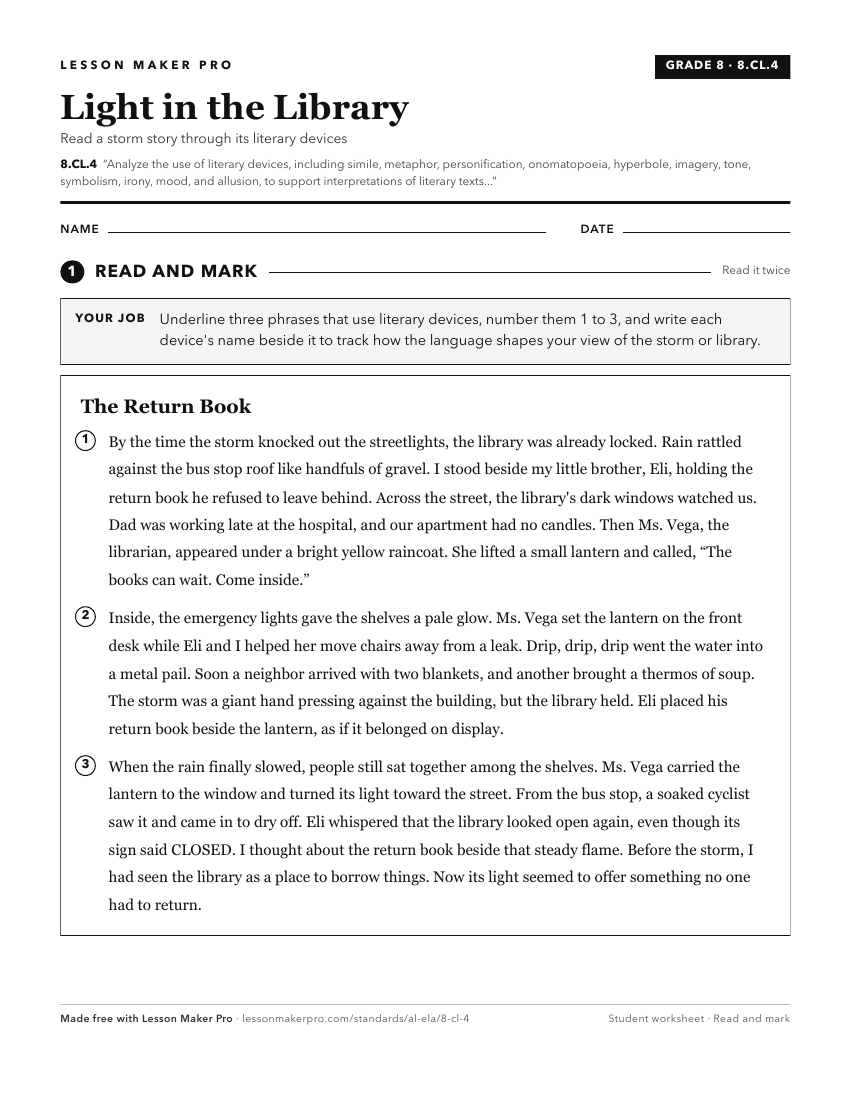
A ready-to-print activity worksheet aligned to 8.CL.4, with an answer key for the teacher on its own page. No account needed.
PDF, US Letter, prints cleanly in black and white.
Download the worksheetKeep exploring
Related Standards
- 7.CL.4
Evaluate literary devices to support interpretations of literary texts using textual evidence, including simile, metaphor, personification, onomatopoeia, hyperb...
- 6.CL.4
Describe the use of literary devices in prose and poetry, including simile, metaphor, personification, onomatopoeia, hyperbole, tone, imagery, irony, symbolism,...
- 8.CL.3
Analyze how authors use key literary elements, including setting, plot, theme, characters, internal and external conflict, dialogue, and point of view, to contr...
- 5.LF.12.a
Locate similes, metaphors, personification, hyperbole, imagery, alliteration, onomatopoeia, and idioms and interpret their meanings in context.
Turn this exact standard into a lesson
Grade, subject, topic, and the complete standard are prefilled. Create one free, no account needed.
Also for this standard:Make a WorksheetMake a QuizMake a Sub Lesson