Alabama ELA 5.LF.12.a
The Standard
- 5.LF.12
- Interpret the meaning of words, phrases, and patterns as they are used in texts, including domain-specific and academic vocabulary and figurative language.
Locate similes, metaphors, personification, hyperbole, imagery, alliteration, onomatopoeia, and idioms and interpret their meanings in context.
2021 Alabama Course of Study: English Language Arts
Teacher's field guide
What This Standard Means
What Students Need to Do
- Students find comparisons, human actions given to things, exaggeration, sensory details, repeated first sounds, sound words, and idioms in a passage. They use nearby sentences to explain what each phrase means.
What Mastery Looks Like
- A student can tell a simile from a metaphor and explain why 'the wind whispered' suggests a soft sound, not a talking wind. They can name other devices and use passage clues to explain their meanings.
Common Misconceptions
- Students may call every comparison a simile, even when it does not use 'like' or 'as.' They may read idioms and exaggerations as facts. They may confuse alliteration with rhyming.
How to Assess It
- Give students: 'After recess, the classroom was a beehive. Pencils scratched as everyone rushed to finish.' Ask them to name the device in 'the classroom was a beehive' and explain its meaning using a clue from the passage.
Lesson moves
Ways to Teach It
Give pairs sentence strips with 'The sun smiled' and 'The bell went clang'; they sort them by device and write each meaning.
Ask: 'What does "My backpack weighs a ton" mean, and how can you tell the speaker is not being literal?'
Play device bingo: read short lines aloud; students mark a square only after naming a clue and explaining the line to a partner.
Show a cereal box slogan that says 'a mountain of flavor'; students name the device and explain what buyers are meant to imagine.
Free download
Printable 5.LF.12.a Worksheet
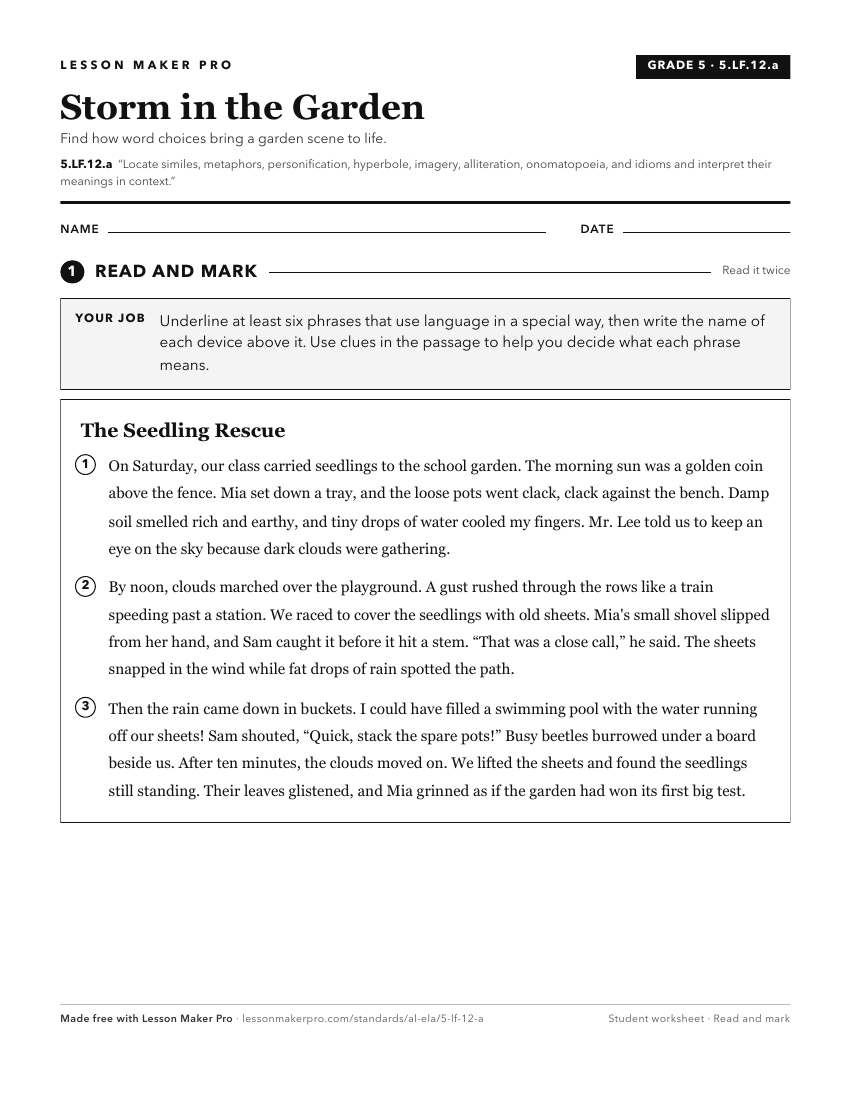
A ready-to-print activity worksheet aligned to 5.LF.12.a, with an answer key for the teacher on its own page. No account needed.
PDF, US Letter, prints cleanly in black and white.
Download the worksheetKeep exploring
Related Standards
- 7.CL.4
Evaluate literary devices to support interpretations of literary texts using textual evidence, including simile, metaphor, personification, onomatopoeia, hyperb...
- 8.CL.4
Analyze the use of literary devices, including simile, metaphor, personification, onomatopoeia, hyperbole, imagery, tone, symbolism, irony, mood, and allusion, ...
- 4.LF.10.b
Explain how figurative language contributes to the meaning of text, including simile, metaphor, alliteration, personification, hyperbole, and idioms.
- 6.CL.4
Describe the use of literary devices in prose and poetry, including simile, metaphor, personification, onomatopoeia, hyperbole, tone, imagery, irony, symbolism,...
Turn this exact standard into a lesson
Grade, subject, topic, and the complete standard are prefilled. Create one free, no account needed.
Also for this standard:Make a WorksheetMake a QuizMake a Sub Lesson