Alabama ELA 6.CL.3
The Standard
Explain how authors use setting, plot, characters, theme, conflict, dialogue, and point of view to contribute to the meaning and purpose of prose and poetry, using textual evidence from the writing.
2021 Alabama Course of Study: English Language Arts
Teacher's field guide
What This Standard Means
What Students Need to Do
- Students explain how details in a story or poem shape its message and the writer's purpose. They use a line or event from the text to support their explanation.
What Mastery Looks Like
- A student can explain how a character's words change a story's conflict or how a poem's speaker shapes its message. They point to a specific line and explain its effect, rather than just naming a feature.
Common Misconceptions
- Students often retell events instead of explaining why a detail matters. They may mistake a topic for a theme, assume a poem's speaker is the author, or quote a line without explaining it.
How to Assess It
- After reading Langston Hughes's 'Dreams,' ask: 'Which line shows what happens when dreams are lost, and how does it support the speaker's warning?' Require a quoted line and an explanation.
Lesson moves
Ways to Teach It
Give pairs event cards from 'The Three Little Pigs'; swap the ending, then cite an original event to explain how the message changes.
Read 'Dreams' aloud, then ask: 'How does the speaker's warning shape the poem's message? Which line supports your answer?'
Play evidence match with cards from 'The Three Little Pigs': pair the wolf's dialogue or the brick-house scene with a claim about its effect.
Print a one-star and a five-star restaurant review; have students circle details that push readers toward opposite judgments.
Free download
Printable 6.CL.3 Worksheet
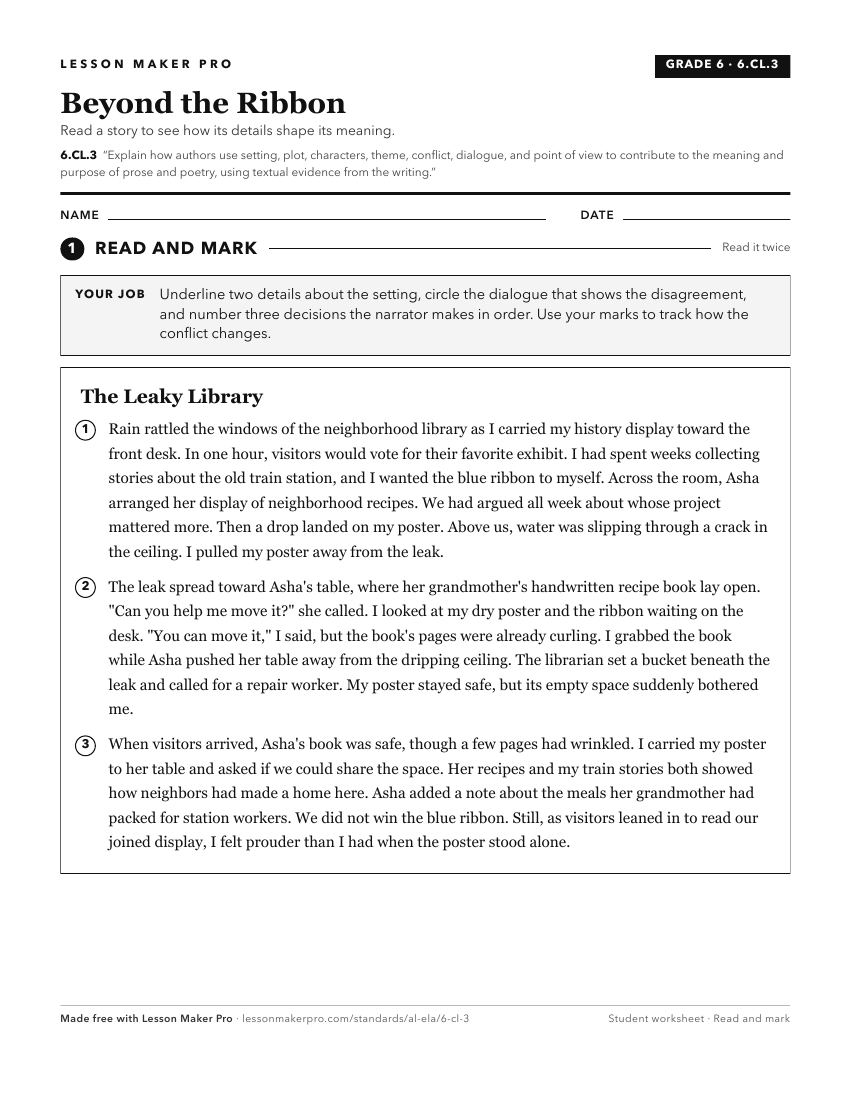
A ready-to-print activity worksheet aligned to 6.CL.3, with an answer key for the teacher on its own page. No account needed.
PDF, US Letter, prints cleanly in black and white.
Download the worksheetKeep exploring
Related Standards
- 7.CL.3
Explain how the author's choice of setting, plot, characters, theme, conflict, dialogue, and point of view contribute to and/or enhance the meaning and purpose ...
- 8.CL.3
Analyze how authors use key literary elements, including setting, plot, theme, characters, internal and external conflict, dialogue, and point of view, to contr...
- 4.LF.16
Describe how authors use literary devices and text features to convey meaning in prose, poetry, and drama.
- 9.CL.4
Analyze how authors use characterization, connotation, denotation, figurative language, literary elements, and point of view to create and convey meaning in a v...
Turn this exact standard into a lesson
Grade, subject, topic, and the complete standard are prefilled. Create one free, no account needed.
Also for this standard:Make a WorksheetMake a QuizMake a Sub Lesson