Alabama ELA 1.LF.24.a
The Standard
- 1.LF.24
- Identify who is telling the story, using evidence from the text.
Use the term narrator to refer to the speaker who is telling the story.
2021 Alabama Course of Study: English Language Arts
Teacher's field guide
What This Standard Means
What Students Need to Do
- Students listen for the voice that tells what happens in a story. They call that voice the narrator and tell it apart from a character's spoken words.
What Mastery Looks Like
- A student hears 'Sam dropped his hat' and says the narrator told that part. When Sam says 'Oh no,' the student names Sam as the one speaking.
Common Misconceptions
- Students may call the author the narrator because the author's name is on the cover. They may also call any character who speaks the narrator.
How to Assess It
- Read aloud, 'Lena found a shell. "Look!" she said.' Ask, 'Who tells us Lena found a shell, and who says "Look"? Use the word narrator.'
Lesson moves
Ways to Teach It
Give pairs a strip reading 'Pip ran. "Stop!" yelled Ann'; have them place narrator and Ann tokens beside the words each says.
Read 'The dog ran. "Come back!" yelled Max.' Ask, 'Who tells us the dog ran, and who calls the dog back?'
Read lines from The Three Little Pigs; students raise narrator cards for story lines and character cards for spoken lines.
Tell a short story about finding a pencil under your desk; ask students to name you as narrator, even though you were there.
Free download
Printable 1.LF.24.a Worksheet
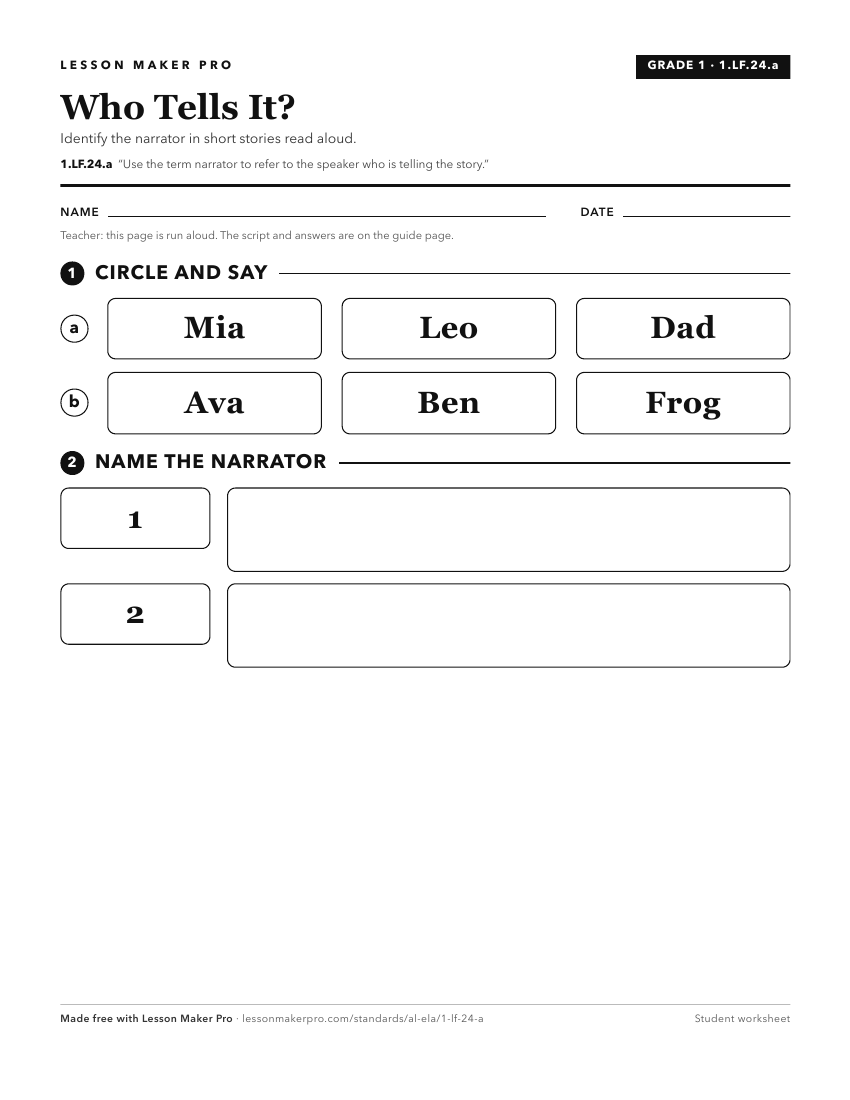
A ready-to-print activity worksheet aligned to 1.LF.24.a, with an answer key for the teacher on its own page. No account needed.
PDF, US Letter, prints cleanly in black and white.
Download the worksheetKeep exploring
Related Standards
- 3.LF.28
Identify the narration of a literary text as first person or third person.
- 1.LF.24
Identify who is telling the story, using evidence from the text.
- 4.LF.17
Identify the narrator's point of view in a literary text and explain how it differs from a character's perspective.
- 4.LF.17.b
State an opinion of the author's use of narration, supporting reasoning with examples from the text.
Turn this exact standard into a lesson
Grade, subject, topic, and the complete standard are prefilled. Create one free, no account needed.
Also for this standard:Make a WorksheetMake a QuizMake a Sub Lesson