Alabama ELA 1.LF.24
Standard Cluster
Identify who is telling the story, using evidence from the text. a. Use the term narrator to refer to the speaker who is telling the story.
2021 Alabama Course of Study: English Language Arts · Literacy Foundations K-3
Cluster contents
Standards in This Cluster
1.LF.24 is a cluster heading. These are the individual standards under it.
Teacher's field guide
What This Cluster Means
What Students Need to Do
- Students figure out who is telling a story and call that speaker the narrator. They use words in the story, such as “I” or a character’s name, to explain their answer.
What Mastery Looks Like
- A student can name a character as the narrator when the story says, “I, Maya, lost my mitten.” They can point to “I, Maya” as proof and tell when quoted speech belongs to a character who is not the narrator.
Common Misconceptions
- Students may name the author instead of the narrator. They may also think any character who speaks in quotation marks is telling the whole story.
How to Assess It
- Read: “I, Maya, lost my mitten on the playground. Ben found it.” Ask, “Who is the narrator? Which words tell you?”
Lesson moves
Ways to Teach It
Give pairs two short story strips, one with “I” and one with “she”; have them highlight clues and label each narrator.
Ask students to write about a lost pencil twice, once as the child who lost it and once as someone watching.
Play narrator detective with story cards; students point to a clue before naming the narrator.
Compare two notes about a lost backpack, one from the student and one from the teacher; circle words that show who tells each account.
Free download
Printable 1.LF.24 Worksheet
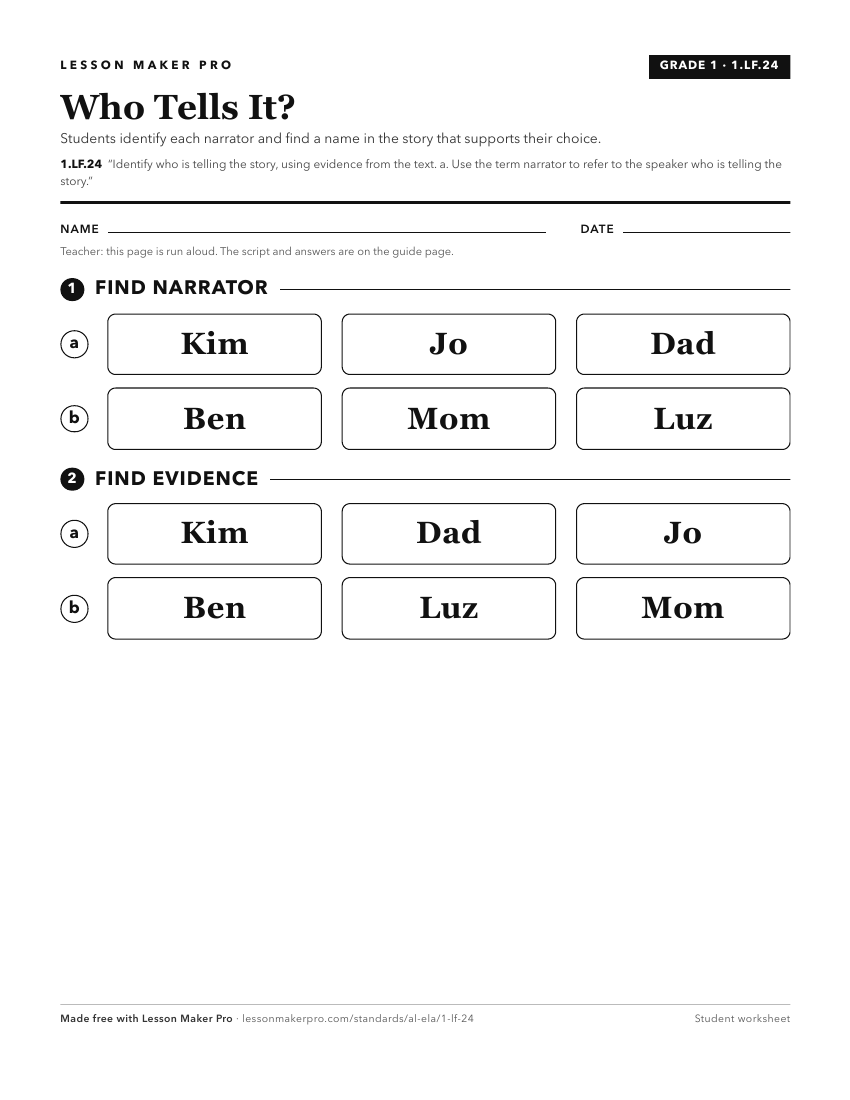
A ready-to-print activity worksheet aligned to 1.LF.24, with an answer key for the teacher on its own page. No account needed.
PDF, US Letter, prints cleanly in black and white.
Download the worksheetKeep exploring
Related Standards
- 1.LF.23.a
Describe the characters and settings, using illustrations and textual evidence from a story.
- 2.LF.23.c
Describe the setting of a narrative, using textual evidence.
- 3.LF.28
Identify the narration of a literary text as first person or third person.
- 2.LF.23.a
Explain the plot of a narrative, using textual evidence to list the major events in sequence.
Turn this cluster into a lesson
Grade, subject, topic, and the complete cluster are prefilled. Create one free, no account needed.
Also for this cluster:Make a WorksheetMake a QuizMake a Sub Lesson