Alabama ELA 3.LF.28
The Standard
Identify the narration of a literary text as first person or third person.
2021 Alabama Course of Study: English Language Arts · Literacy Foundations K-3
Teacher's field guide
What This Standard Means
What Students Need to Do
- Students decide whether a story is told by a character or by an outside narrator. They look at the narrator's words, not just what characters say aloud.
What Mastery Looks Like
- A student can label narration as first person or third person and point to a line that proves it. They can still do this when a character says “I” in dialogue.
Common Misconceptions
- Students may treat an “I” in dialogue as proof of first-person narration. They may also see “he” or “she” and miss that a character is telling the story about someone else.
How to Assess It
- Print this exit ticket: Ava said, “I found it!” Then she lifted the box. Ask students to label the narration and underline the words that prove their answer.
Lesson moves
Ways to Teach It
Give pairs a printed story strip. Have them highlight narration blue and dialogue yellow, then label who tells the story.
Ask: Why does “I” in Ava’s speech not make Ava the narrator?
Play narrator switch: students change “I found the key” to “Ava found the key,” then trade papers and label each version.
Show two notes about a class game, “I scored” and “Jada scored”; ask which is told by a player and which by an observer.
Free download
Printable 3.LF.28 Worksheet
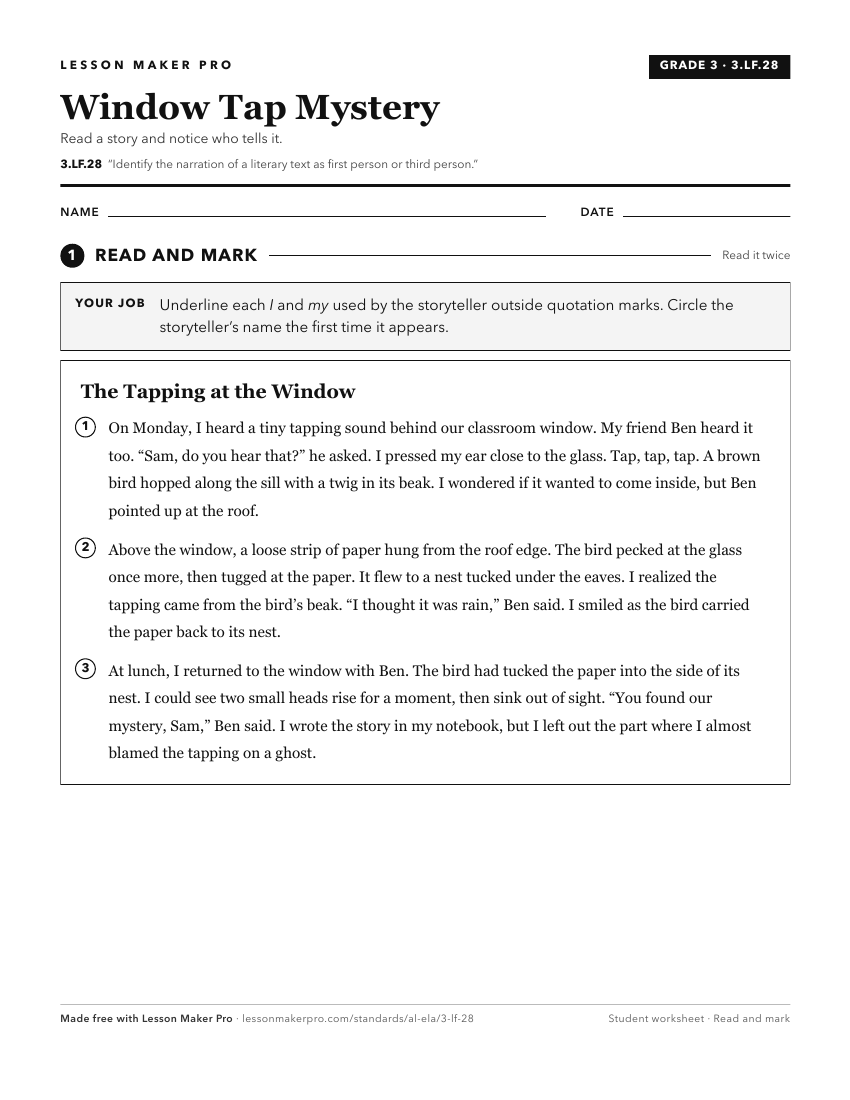
A ready-to-print activity worksheet aligned to 3.LF.28, with an answer key for the teacher on its own page. No account needed.
PDF, US Letter, prints cleanly in black and white.
Download the worksheetKeep exploring
Related Standards
- 4.LF.17
Identify the narrator's point of view in a literary text and explain how it differs from a character's perspective.
- 4.LF.17.a
Explain the difference between first person and third person narration, including omniscient and third person limited.
- 1.LF.24
Identify who is telling the story, using evidence from the text.
- 4.LF.18
Identify the point of view in a narrative and describe how the narrative would be different if told from the perspective of a different character or narrator.
Turn this exact standard into a lesson
Grade, subject, topic, and the complete standard are prefilled. Create one free, no account needed.
Also for this standard:Make a WorksheetMake a QuizMake a Sub Lesson