Alabama ELA 4.LF.17
Standard Cluster
Identify the narrator's point of view in a literary text and explain how it differs from a character's perspective. a. Explain the difference between first person and third person narration, including omniscient and third person limited. b. State an opinion of the author's use of narration, supporting reasoning with examples from the text.
2021 Alabama Course of Study: English Language Arts · Literacy Foundations 4-5
Cluster contents
Standards in This Cluster
4.LF.17 is a cluster heading. These are the individual standards under it.
Teacher's field guide
What This Cluster Means
What Students Need to Do
- Students identify who tells a story and whether the narrator speaks as a character or describes characters from outside the story. They tell whether a third-person narrator knows one character’s thoughts or several characters’ thoughts. They compare what the narrator knows with what a character believes and give an opinion about the author’s choice of narrator.
What Mastery Looks Like
- A student labels a passage first person, third person limited, or third person omniscient and points to a line that proves it. They explain what a character believes that the narrator knows is wrong. They say whether the narrator’s choice works and use a scene to support their opinion.
Common Misconceptions
- Students may call a story first person because a character says “I” in dialogue. They may assume every third-person narrator knows everyone’s thoughts. They may also treat a character’s guess as a fact the narrator has confirmed.
How to Assess It
- Read: “Mia thought the box held a gift. Ben knew it held a frog. Mia opened it.” Ask students to name the narrator type, explain what Mia does not know, and say whether revealing Ben’s secret makes the scene funnier, citing one line.
Lesson moves
Ways to Teach It
Give pairs a printed scene and two highlighters; mark narrator clues in yellow and each character’s thoughts in blue.
Ask, “Would the surprise work better if Mia told the story herself?” Have students support their answer with a line from the scene.
Play narrator sort: give groups six passage cards to sort into first person, third person limited, and third person omniscient.
Have students write a playground mix-up as an eyewitness and as an all-knowing storyteller, then compare what each version reveals.
Free download
Printable 4.LF.17 Worksheet
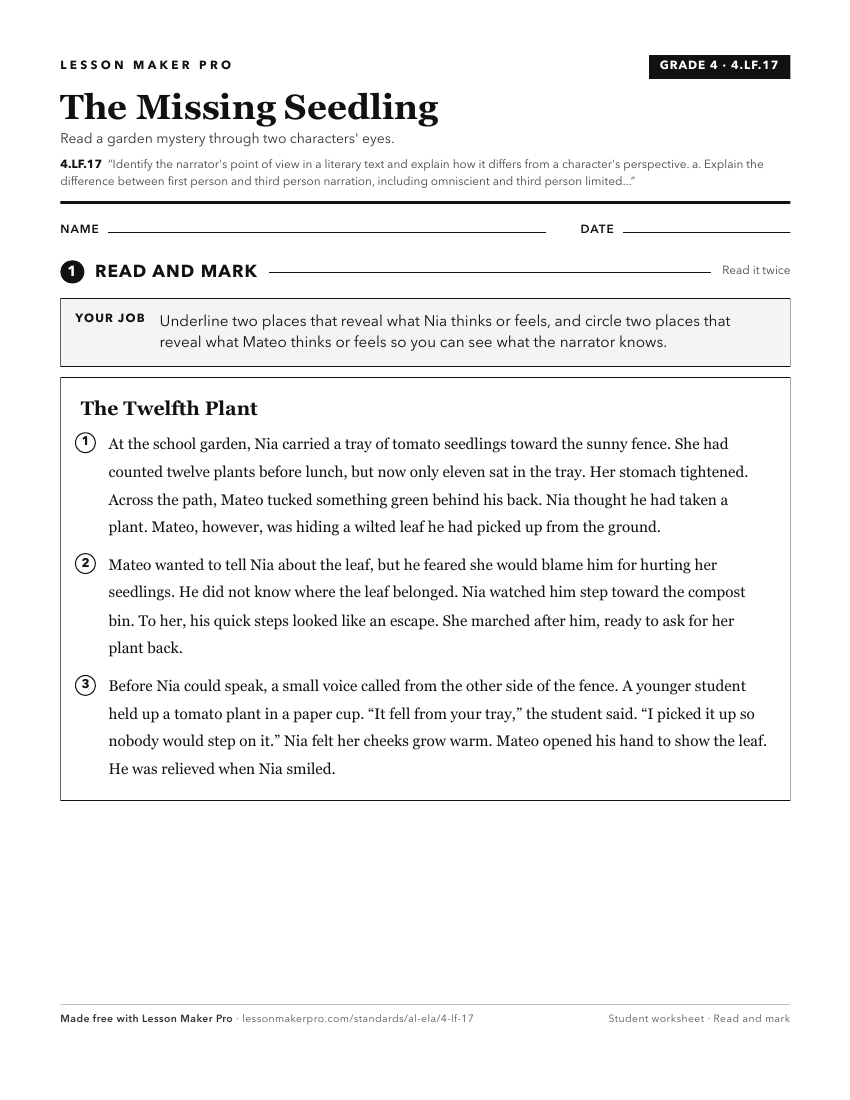
A ready-to-print activity worksheet aligned to 4.LF.17, with an answer key for the teacher on its own page. No account needed.
PDF, US Letter, prints cleanly in black and white.
Download the worksheetKeep exploring
Related Standards
- 4.LF.18
Identify the point of view in a narrative and describe how the narrative would be different if told from the perspective of a different character or narrator.
- 3.LF.28
Identify the narration of a literary text as first person or third person.
- 4.LF.18.b
Compare the perspectives of different characters within a text.
- K.LF.32.b
Compare and contrast the experiences of characters in a literary text.
Turn this cluster into a lesson
Grade, subject, topic, and the complete cluster are prefilled. Create one free, no account needed.
Also for this cluster:Make a WorksheetMake a QuizMake a Sub Lesson