Wyoming Math 7.SP.5
The Standard
Find and interpret the probability of a random event. Understand that the probability of a random event is a number between, and including, 0 and 1 that expresses the likelihood of the event occurring.
2023 Wyoming Mathematics Content and Performance Standards · Investigate chance processes and develop, use, and evaluate probability models.
Teacher's field guide
What This Standard Means
What Students Need to Do
- Students find the chance of a random event and write it as a number from 0 to 1. They use that number to say how likely the event is.
What Mastery Looks Like
- Given a bag with two blue cubes and three green cubes, a student finds the chance of drawing blue as 2/5. They explain that blue is less likely than green, but still possible.
Common Misconceptions
- Students may write 5/2 instead of 2/5 because they reverse the part and the total. They may think a 3/4 chance means an event must happen exactly three times in four tries.
How to Assess It
- Exit ticket: A bag holds two blue cubes and three green cubes. What is the probability of drawing blue, and is drawing blue more likely or less likely than drawing green?
Lesson moves
Ways to Teach It
Put three red cubes and one blue cube in a bag; have students draw with replacement 20 times and compare results with 3/4.
Ask, “Does a 3/4 chance of red mean exactly three red draws in four tries?” Have students explain their answers in writing.
Give pairs cards with equal-section spinners; have them match each color's chance to a fraction card.
Show a forecast with a 70% chance of rain; ask students to write the probability as 0.7 and decide whether to bring an umbrella.
Free download
Printable 7.SP.5 Worksheet
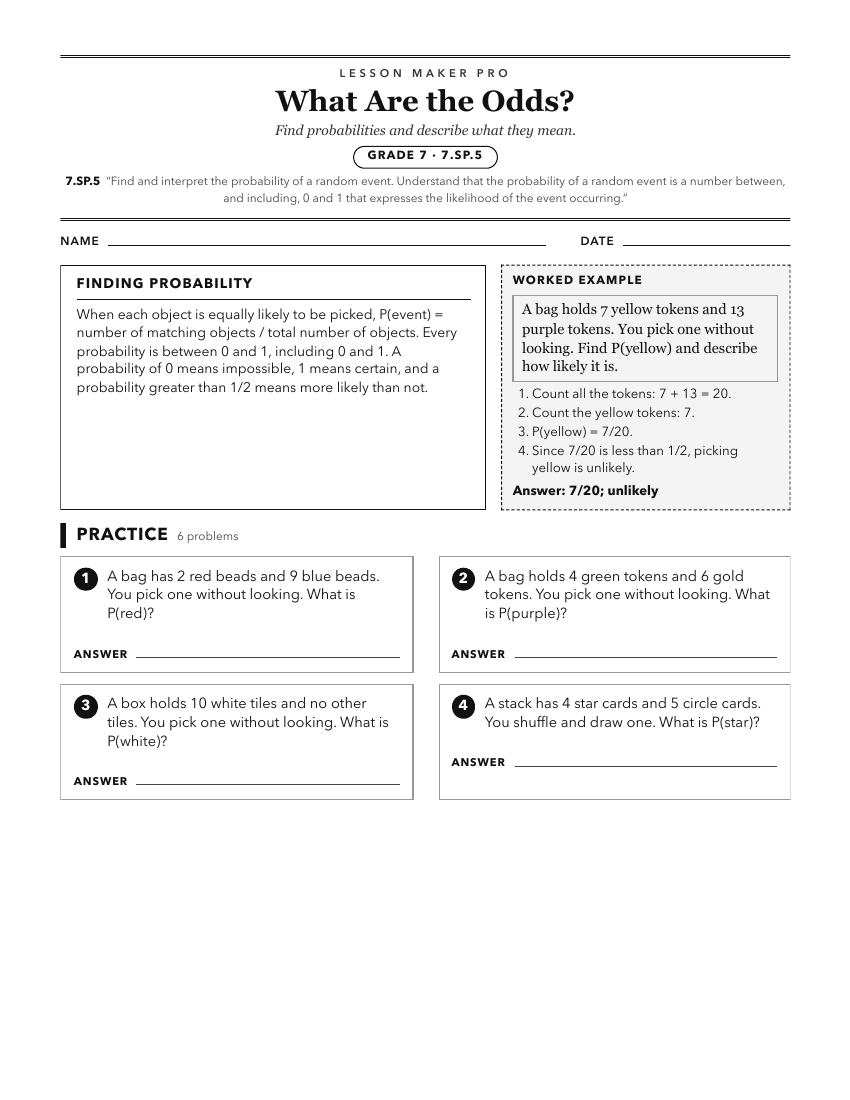
A ready-to-print activity worksheet aligned to 7.SP.5, with an answer key for the teacher on its own page. No account needed.
PDF, US Letter, prints cleanly in black and white.
Download the worksheetKeep exploring
Related Standards
- 7.SP.6
Collect multiple samples to compare the relationship between theoretical and experimental probabilities for simple events.
- 7.SP.1b
Differentiate between random and non-random sampling.
- 6.RP.3c
Understand that a percentage is a rate per 100 and use this to solve problems involving wholes, parts, and percentages.
Turn this exact standard into a lesson
Grade, subject, topic, and the complete standard are prefilled. Create one free, no account needed.
Also for this standard:Make a WorksheetMake a QuizMake a Sub Lesson