Wyoming Math 7.SP.1c
The Standard
Solve real-world and mathematical problems involving: Understand that generalizations from a sample are valid only if the sample is representative of the population.
2023 Wyoming Mathematics Content and Performance Standards · Use random sampling to draw inferences about a population.
Teacher's field guide
What This Standard Means
What Students Need to Do
- Students identify the full group a claim is about and check who was actually surveyed. They decide whether the sample reflects that group well enough to support the claim.
What Mastery Looks Like
- A student can spot why polling only friends leaves out other classmates. They can suggest drawing names from the full grade roster or limit the claim to the students surveyed.
Common Misconceptions
- Students may think a large sample is fair even if everyone comes from the same lunch table. They may mistake volunteers or nearby students for a random sample.
How to Assess It
- Exit ticket: A principal polls 30 students in the cafeteria line to learn whether all seventh graders want new lunch choices. Can she make a claim about the whole grade? Explain and suggest a better way to choose 30 students.
Lesson moves
Ways to Teach It
Give pairs 20 red and 10 blue counters; have them compare five chosen blindly from mixed counters with five chosen only from red counters.
Ask: A student polls only soccer players about the most popular school sport. Can the results describe the whole grade? Why?
Give teams three plans for a school lunch survey: poll friends, poll the cafeteria line, or draw names from the grade roster; rank them.
Show a headline claiming “Most students prefer buses” from a survey of bus riders; ask students to rewrite the claim to fit the sample.
Free download
Printable 7.SP.1c Worksheet
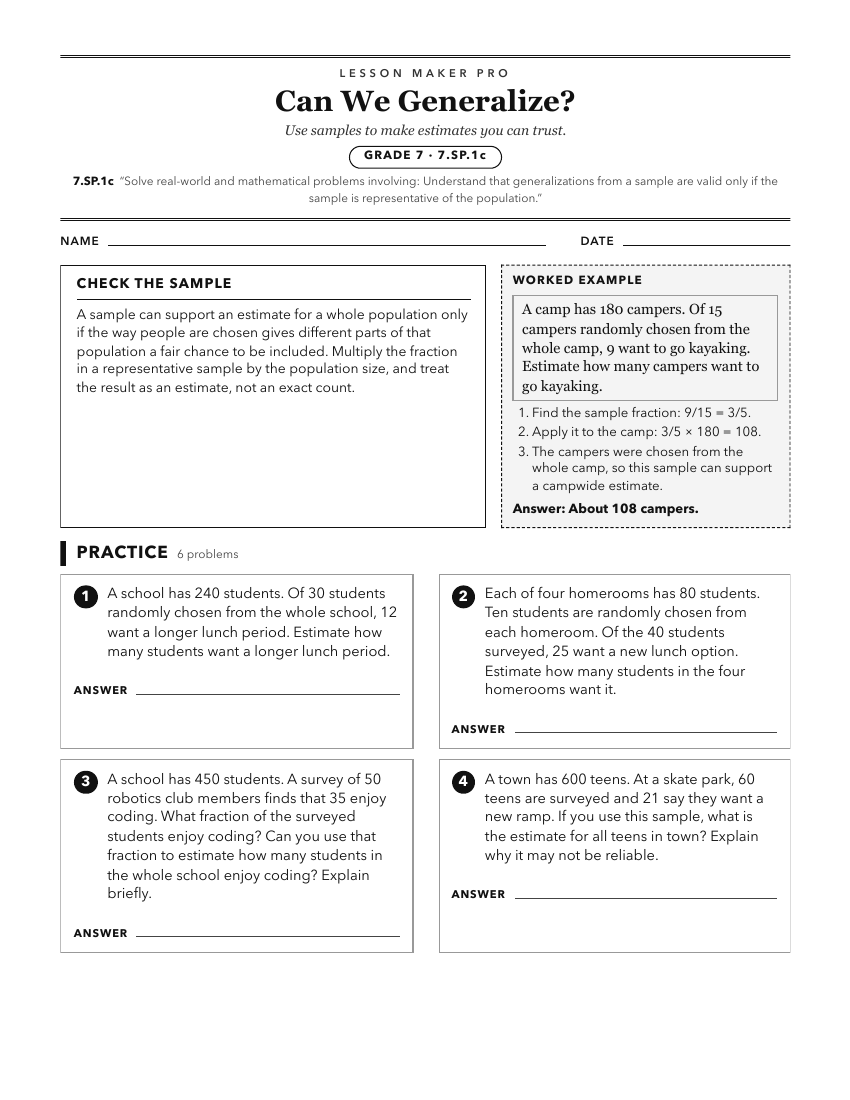
A ready-to-print activity worksheet aligned to 7.SP.1c, with an answer key for the teacher on its own page. No account needed.
PDF, US Letter, prints cleanly in black and white.
Download the worksheetKeep exploring
Related Standards
- 7.SP.1d
Understand that random sampling is used to gather a representative sample and tends to support valid inferences about the population.
- 7.SP.1b
Differentiate between random and non-random sampling.
- 4.NF.2a
Recognize that comparisons are valid only when the two fractions refer to the same whole.
- 7.SP.1a
Understand that a sample is a subset of a population.
Turn this exact standard into a lesson
Grade, subject, topic, and the complete standard are prefilled. Create one free, no account needed.
Also for this standard:Make a WorksheetMake a QuizMake a Sub Lesson