Wyoming Math 7.SP.1a
The Standard
Solve real-world and mathematical problems involving: Understand that a sample is a subset of a population.
2023 Wyoming Mathematics Content and Performance Standards · Use random sampling to draw inferences about a population.
Teacher's field guide
What This Standard Means
What Students Need to Do
- Students identify the whole group being studied and the smaller group selected from it. They explain that everyone in the smaller group belongs to the whole group.
What Mastery Looks Like
- Given a survey of 12 out of 80 seventh graders, a student names the 80 as the population and the 12 as the sample. They can explain why the 12 are not the population.
Common Misconceptions
- Students may call the people who answered a survey the population because those are the only people they see in the results. They may also name a group that is too broad, such as the whole school when only seventh graders were studied.
How to Assess It
- Exit ticket: Of 80 seventh graders at a school, 12 are asked about lunch. Name the population and the sample, and explain how they relate.
Lesson moves
Ways to Teach It
Put 20 name slips in a cup, draw five, and have students label the slips in the cup and the five drawn slips.
Ask: If 12 of 80 seventh graders answer a lunch survey, which group is the sample? Explain your choice in one sentence.
Play a card sort with '18 of 90 club members' and '6 of 24 soccer players'; label each full group and selected group.
Show a town survey of 50 out of 500 residents about park hours; have students label the population and sample.
Free download
Printable 7.SP.1a Worksheet
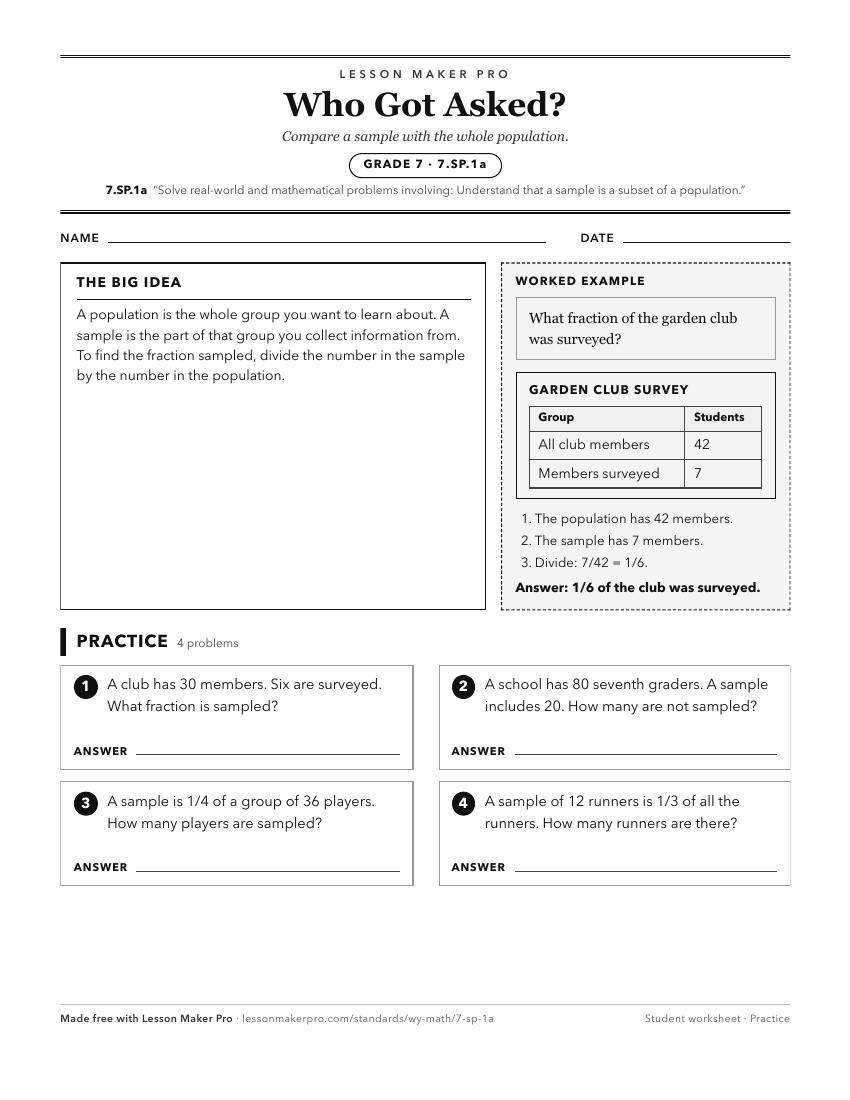
A ready-to-print activity worksheet aligned to 7.SP.1a, with an answer key for the teacher on its own page. No account needed.
PDF, US Letter, prints cleanly in black and white.
Download the worksheetKeep exploring
Related Standards
- 7.SP.1c
Understand that generalizations from a sample are valid only if the sample is representative of the population.
- 7.SP.1d
Understand that random sampling is used to gather a representative sample and tends to support valid inferences about the population.
- 7.SP.1b
Differentiate between random and non-random sampling.
Turn this exact standard into a lesson
Grade, subject, topic, and the complete standard are prefilled. Create one free, no account needed.
Also for this standard:Make a WorksheetMake a QuizMake a Sub Lesson