Virginia SOL PS.4
SOL Standard (Key Ideas Cluster)
The student will investigate and understand that the periodic table is a model used to organize elements based on their atomic structure. Key uses include symbols, atomic numbers, atomic mass, chemical groups (families), and periods are identified on the periodic table; and elements are classified as metals, metalloids, and nonmetals.
Virginia Standards of Learning for Science
Cluster contents
Key Ideas in This Standard
PS.4 is a Standards of Learning science standard. These are the key ideas and practices under it.
Teacher's field guide
What This Cluster Means
What Students Need to Do
- Students read an element square to find its symbol, atomic number, and atomic mass. They identify its group and period, then classify it as a metal, metalloid, or nonmetal.
What Mastery Looks Like
- Given any element, a student can report each piece of information accurately from a periodic table. The student can explain that groups are columns, periods are rows, and atomic number determines element order.
Common Misconceptions
- Students often confuse atomic number with atomic mass or reverse groups and periods. They may assume hydrogen is a metal because it appears above Group 1 metals.
How to Assess It
- Give students a periodic table and ask: “For silicon, list its symbol, atomic number, atomic mass, group, period, and classification.”
Lesson moves
Ways to Teach It
Give pairs element cards to sort by atomic number, then label each card as metal, metalloid, or nonmetal using a periodic table.
Ask students to write three clues that identify one element without using its name, then trade clues with a partner.
Play periodic table bingo using clues such as “a nonmetal in Period 3” or “the element with atomic number 12.”
Have students inspect product labels or device materials, then locate named elements such as aluminum, silicon, iron, or chlorine on the periodic table.
Free download
Printable PS.4 Worksheet
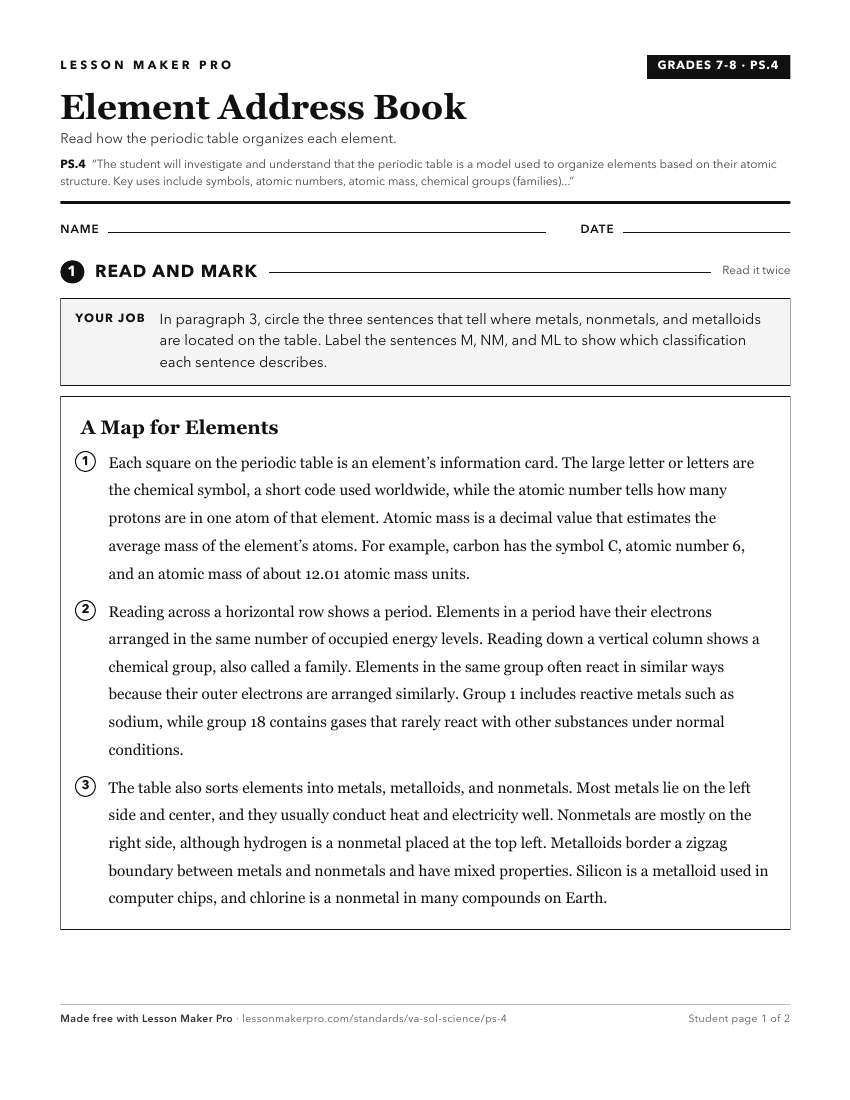
A ready-to-print activity worksheet aligned to PS.4, with an answer key for the teacher on its own page. No account needed.
PDF, US Letter, prints cleanly in black and white.
Download the worksheetKeep exploring
Related Standards
Turn this cluster into a lesson
Grade, subject, topic, and the complete cluster are prefilled. Create one free, no account needed.
Also for this cluster:Make a WorksheetMake a QuizMake a Sub Lesson