Virginia SOL PS.2.b
The Standard
- PS.2
- The student will investigate and understand that matter is composed of atoms. Key ideas include
the periodic table can be used to predict the chemical and physical properties of matter
Virginia Standards of Learning for Science · The student will investigate and understand that matter is composed of atoms. Key ideas include
Teacher's field guide
What This Standard Means
What Students Need to Do
- Students use an element’s location on the periodic table to predict its physical and chemical properties. They compare groups and regions to classify elements and identify likely similarities.
What Mastery Looks Like
- Given an unfamiliar element, students can predict whether it is a metal, nonmetal, or metalloid and describe likely conductivity and reactivity. They support predictions with group or region evidence.
Common Misconceptions
- Students may think elements in the same period have the same properties, rather than elements in the same group. They may also confuse physical properties, such as conductivity, with chemical properties, such as reactivity.
How to Assess It
- Ask: An unknown element is directly below lithium in Group 1. Predict two physical properties and one chemical property, then justify each prediction.
Lesson moves
Ways to Teach It
Give groups element cards with property clues, then have them sort the cards and place each one on a blank periodic table.
Ask students to write which location, group or period, better predicts similar chemical behavior and support their answer with two elements.
Play Periodic Table Mystery, giving one location or property clue at a time while teams identify the element and explain their reasoning.
Compare copper wiring, aluminum cans, and silicon chips, then connect each material’s use to properties predicted from its periodic table region.
Free download
Printable PS.2.b Worksheet
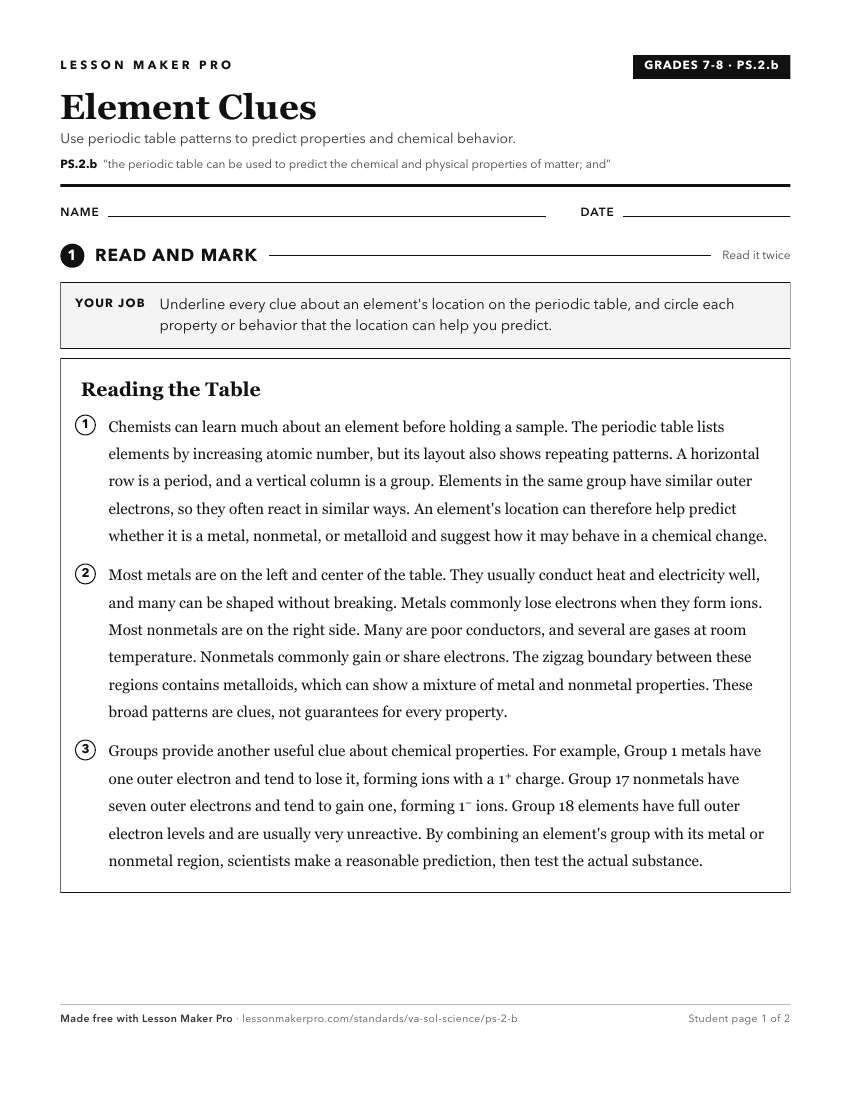
A ready-to-print activity worksheet aligned to PS.2.b, with an answer key for the teacher on its own page. No account needed.
PDF, US Letter, prints cleanly in black and white.
Download the worksheetKeep exploring
Related Standards
- PS.3.a
pure substances can be identified based on their chemical and physical properties
- PS.4.a
symbols, atomic numbers, atomic mass, chemical groups (families), and periods are identified on the periodic table
- 6.5.f
chemical equations can be used to model chemical changes
- PS.4
The student will investigate and understand that the periodic table is a model used to organize elements based on their atomic structure. Key uses include
Turn this exact standard into a lesson
Grade, subject, topic, and the complete standard are prefilled. Create one free, no account needed.
Also for this standard:Make a WorksheetMake a QuizMake a Sub Lesson