Virginia SOL PS.2.c
The Standard
- PS.2
- The student will investigate and understand that matter is composed of atoms. Key ideas include
the kinetic molecular theory is used to predict and explain matter interactions.
Virginia Standards of Learning for Science · The student will investigate and understand that matter is composed of atoms. Key ideas include
Teacher's field guide
What This Standard Means
What Students Need to Do
- Use particle motion, spacing, and attraction to explain solids, liquids, and gases. Predict how heating, cooling, or compression affects diffusion, pressure, volume, and changes of state.
What Mastery Looks Like
- Students draw accurate particle models before and after a change. They connect particle speed and collisions to an observable result and support their prediction with evidence.
Common Misconceptions
- Students may think particles get larger when heated or stop moving in solids. They may think gas has no mass or that particles themselves melt. Some confuse temperature with the total energy in a sample.
How to Assess It
- Exit ticket: A sealed balloon moves from a warm room to a freezer. Predict its volume, draw particle models, and explain using speed and collisions.
Lesson moves
Ways to Teach It
Compare food coloring in hot and cold water, then sketch particle motion that explains the different diffusion rates.
Have students explain in writing why a capped syringe resists more as the plunger is pushed.
Give teams heating, cooling, and compression cards, then award points for correct particle diagrams and predictions.
Use morning and afternoon tire pressure readings to connect temperature changes with particle speed and gas pressure.
Free download
Printable PS.2.c Worksheet
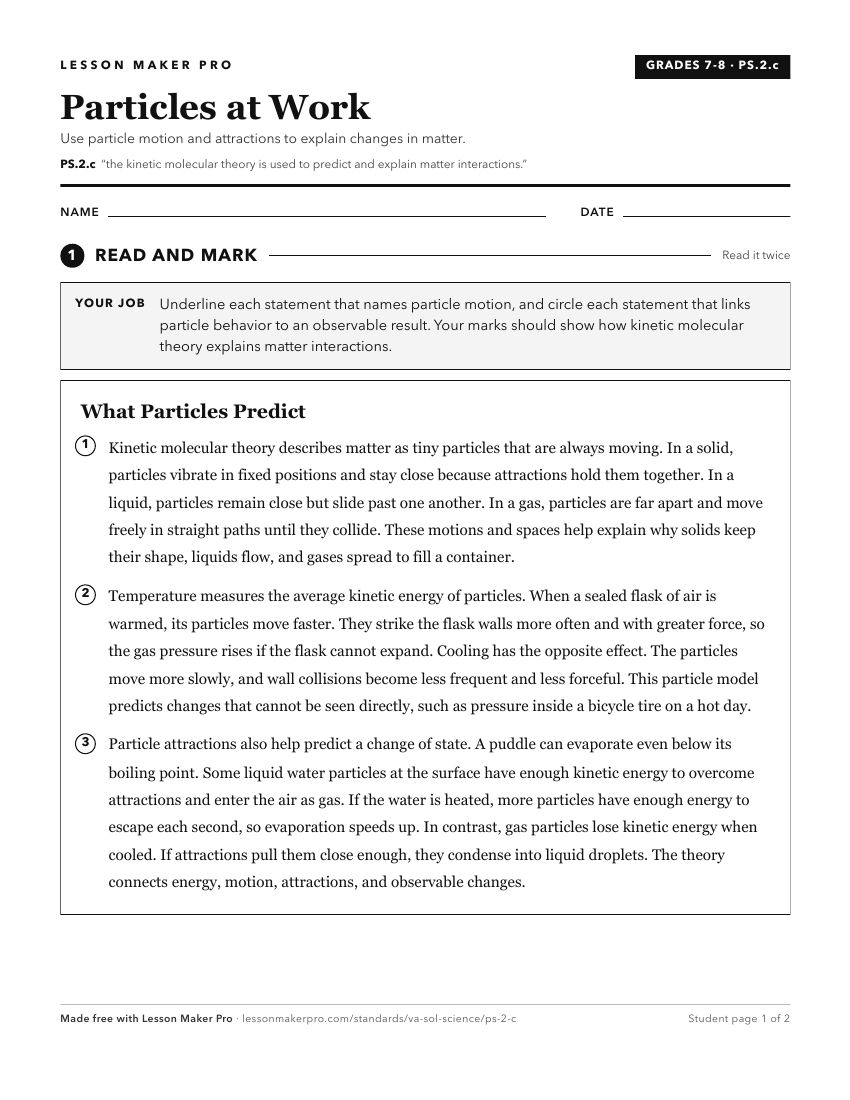
A ready-to-print activity worksheet aligned to PS.2.c, with an answer key for the teacher on its own page. No account needed.
PDF, US Letter, prints cleanly in black and white.
Download the worksheetKeep exploring
Related Standards
- 5.7
The student will investigate and understand that matter has properties and interactions. Key ideas include
- PS.2.b
the periodic table can be used to predict the chemical and physical properties of matter
- LS.1.e.i
construct and use models and simulations to illustrate, predict, and/or explain observable and unobservable phenomena, life processes, or mechanisms
- 6.1.e.ii
use, develop, and revise models to predict and explain phenomena
Turn this exact standard into a lesson
Grade, subject, topic, and the complete standard are prefilled. Create one free, no account needed.
Also for this standard:Make a WorksheetMake a QuizMake a Sub Lesson