Virginia SOL LS.7.a
The Standard
- LS.7
- The student will investigate and understand that adaptations support an organism’s survival in an ecosystem. Key ideas include
biotic and abiotic factors define land, marine, and freshwater ecosystems
Virginia Standards of Learning for Science · The student will investigate and understand that adaptations support an organism's survival in an ecosystem. Key ideas include
Teacher's field guide
What This Standard Means
What Students Need to Do
- Students sort ecosystem features into living and nonliving factors. They use salinity, soil, temperature, water depth, plants, and animals to distinguish land, marine, and freshwater environments.
What Mastery Looks Like
- Given a photo or data table, students correctly identify the ecosystem and cite evidence from both living and nonliving factors. They explain how changing one factor affects which organisms can survive there.
Common Misconceptions
- Students may think abiotic means dead, rather than never living. They may classify all water ecosystems alike or assume ecosystem types are defined only by their organisms.
How to Assess It
- Give students an unknown ecosystem with salinity, temperature, soil, and organism data. Ask them to identify it and cite one living and one nonliving clue.
Lesson moves
Ways to Teach It
Place a string quadrat outdoors, then have pairs record five living and five nonliving features inside it.
Ask students to explain why a trout cannot simply move from a river to the ocean.
Run a card-sort relay where teams match organisms and physical conditions to land, marine, or freshwater ecosystem mats.
Use a local watershed map and water-quality data to predict where freshwater organisms could live and explain which factor limits them.
Free download
Printable LS.7.a Worksheet
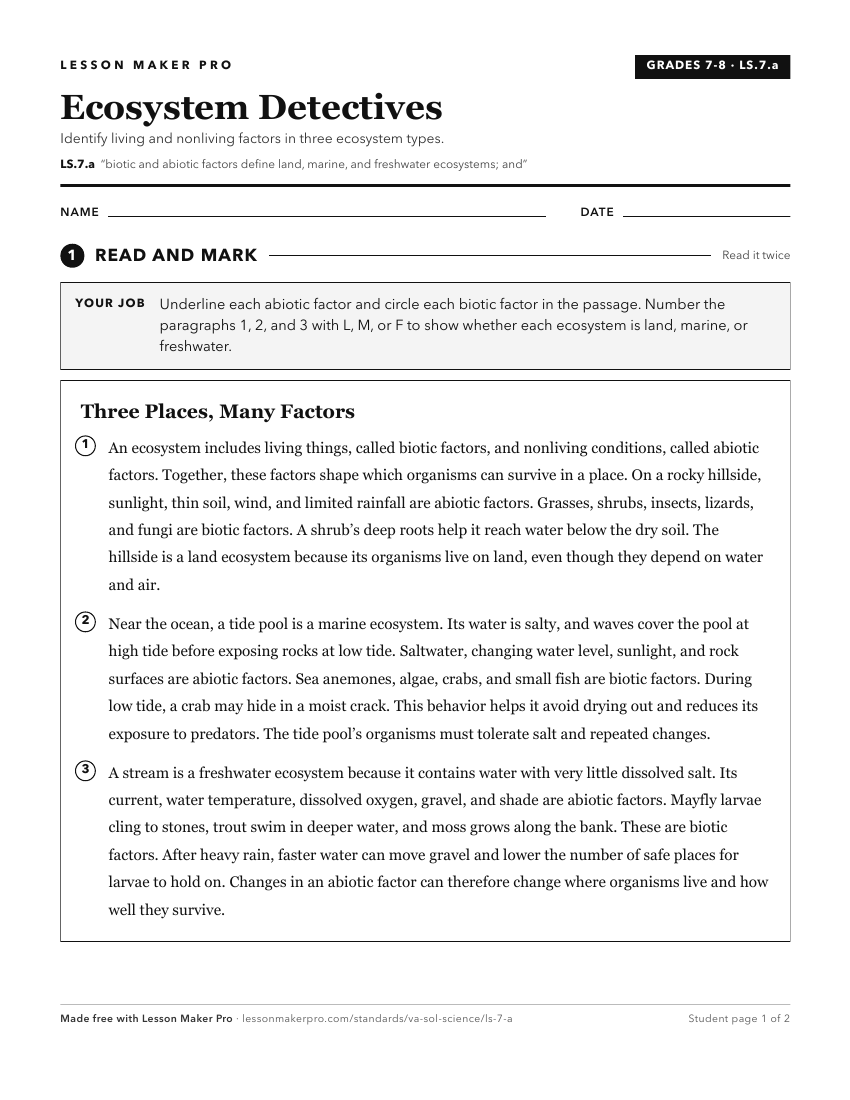
A ready-to-print activity worksheet aligned to LS.7.a, with an answer key for the teacher on its own page. No account needed.
PDF, US Letter, prints cleanly in black and white.
Download the worksheetKeep exploring
Related Standards
- LS.9.c
variations in biotic and abiotic factors can change ecosystems.
- 3.8.c
fire, flood, disease, and erosion affect ecosystems
- LS.5
The student will investigate and understand that biotic and abiotic factors affect an ecosystem. Key ideas include
- 3.5.a
ecosystems are made of living and nonliving components of the environment
Turn this exact standard into a lesson
Grade, subject, topic, and the complete standard are prefilled. Create one free, no account needed.
Also for this standard:Make a WorksheetMake a QuizMake a Sub Lesson