Virginia SOL K.8.c
The Standard
- K.8
- The student will investigate and understand that light influences temperature on Earth's surfaces and can cause shadows. Key ideas include
objects in shadows and objects in sunlight have different temperatures.
Virginia Standards of Learning for Science
Teacher's field guide
What This Standard Means
What Students Need to Do
- Students compare how warm objects feel after sitting in sunlight or shadow. They use observations to tell how sunlight affects an object’s temperature.
What Mastery Looks Like
- Students can predict that an object in sunlight will usually become warmer than the same kind of object in shadow. They can support their answer with touch observations or thermometer readings.
Common Misconceptions
- Students may think a shadow makes an object cold instead of blocking sunlight. They may also assume every object in sunlight reaches the same temperature.
How to Assess It
- Show two identical cups, one in sunlight and one in shadow. Ask students to circle the warmer cup and explain their choice.
Lesson moves
Ways to Teach It
Place two identical cups of water in sunlight and shadow, then compare their temperatures with classroom thermometers.
Ask, “Why might a dog choose to rest under a tree on a sunny day?”
Sort picture cards into likely warmer or cooler groups based on whether each object is in sunlight or shadow.
Walk around the playground and use a thermometer to compare a sunny spot with a shaded spot.
Free download
Printable K.8.c Worksheet
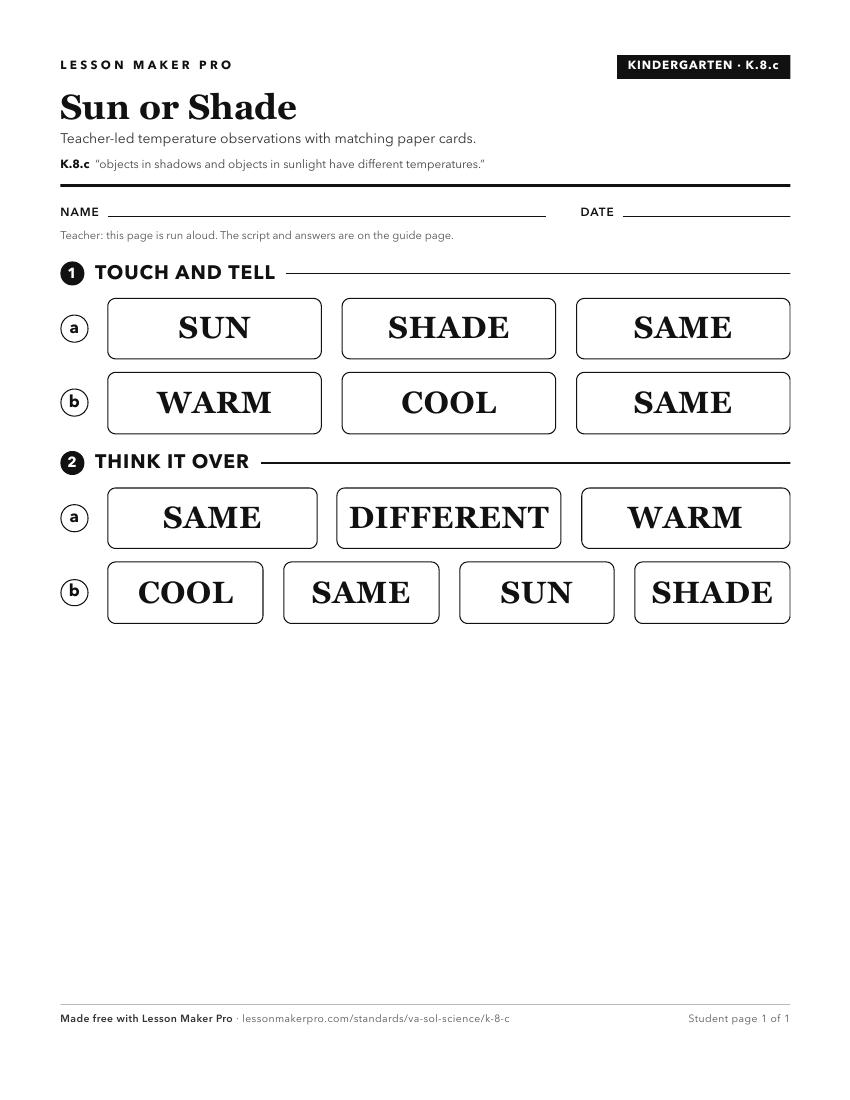
A ready-to-print activity worksheet aligned to K.8.c, with an answer key for the teacher on its own page. No account needed.
PDF, US Letter, prints cleanly in black and white.
Download the worksheetKeep exploring
Related Standards
- K.8.b
shadows can be produced when sunlight or artificial light is blocked by an object
- K.8
The student will investigate and understand that light influences temperature on Earth's surfaces and can cause shadows. Key ideas include
- 2.6.a
different types of weather have specific characteristics
- 1.7.a
changes in temperature, light, and precipitation occur over time
Turn this exact standard into a lesson
Grade, subject, topic, and the complete standard are prefilled. Create one free, no account needed.
Also for this standard:Make a WorksheetMake a QuizMake a Sub Lesson