Virginia SOL K.6.b
The Standard
- K.6
- The student will investigate and understand that there are differences between living organisms and nonliving objects. Key ideas include
living organisms have certain characteristics that distinguish them from nonliving objects.
Virginia Standards of Learning for Science
Teacher's field guide
What This Standard Means
What Students Need to Do
- Students observe plants, animals, and objects, then decide which are living and which are not. They support each choice with evidence such as growth, needing food or water, and responding to surroundings.
What Mastery Looks Like
- Students correctly classify familiar examples, including plants, animals, rocks, and toys. They explain their choices using observable features rather than movement alone.
Common Misconceptions
- Students may think anything that moves, such as a car or robot, is alive. They may think plants are not alive because plants do not walk or talk. They may also assume every natural object, including water or rocks, is alive.
How to Assess It
- Show pictures of a tree, dog, bicycle, and rock. Ask students to circle the living things and give one reason for each choice.
Lesson moves
Ways to Teach It
Give pairs a potted plant, rock, toy animal, and windup toy to observe and sort, then ask them to explain their evidence.
Show a plant and a robot, then ask, "Which is alive, and what evidence proves your answer?"
Play a sorting relay where students place picture cards under living or nonliving labels and explain one choice.
Walk around the schoolyard and have students sketch two living things and two nonliving things they observe.
Free download
Printable K.6.b Worksheet
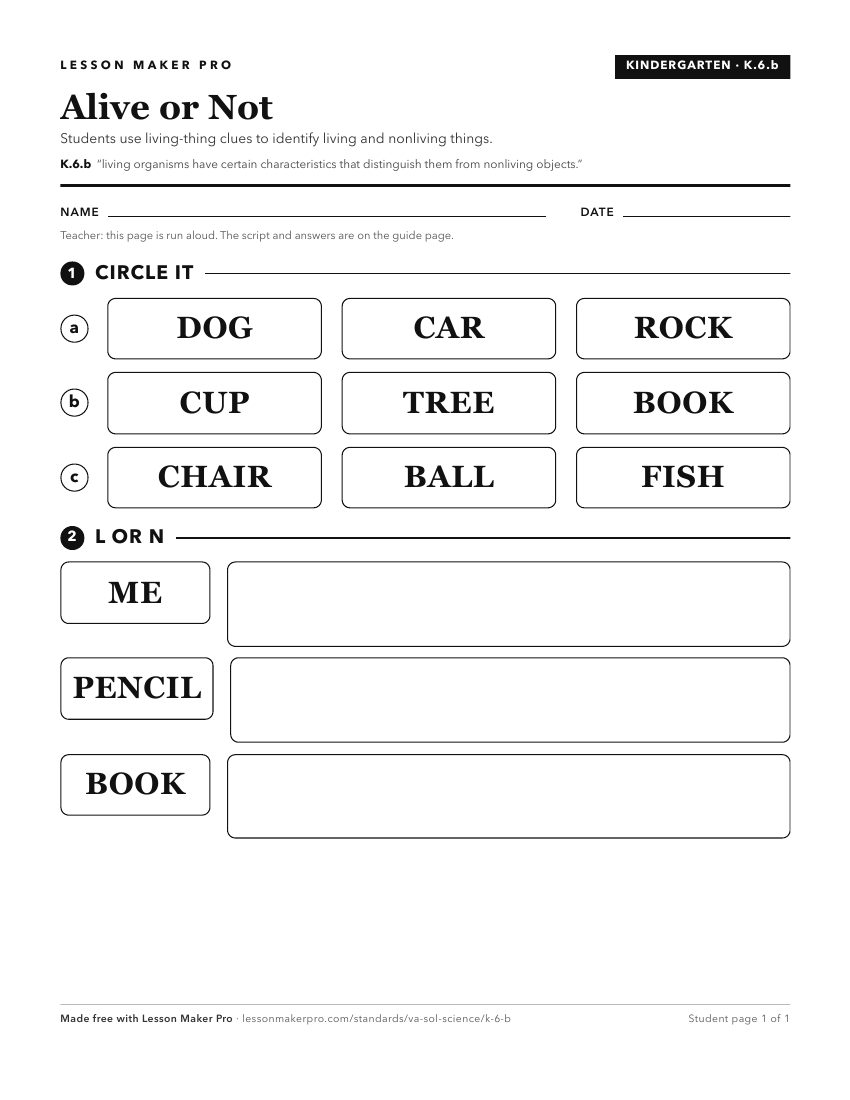
A ready-to-print activity worksheet aligned to K.6.b, with an answer key for the teacher on its own page. No account needed.
PDF, US Letter, prints cleanly in black and white.
Download the worksheetKeep exploring
Related Standards
- K.10.b
living and nonliving things change over time
- LS.3.c
similar characteristics determine the classification of organisms.
- K.6.a
all things can be classified as living or nonliving
- K.6
The student will investigate and understand that there are differences between living organisms and nonliving objects. Key ideas include
Turn this exact standard into a lesson
Grade, subject, topic, and the complete standard are prefilled. Create one free, no account needed.
Also for this standard:Make a WorksheetMake a QuizMake a Sub Lesson