Virginia SOL K.3.d
The Standard
- K.3
- The student will investigate and understand that physical properties of an object can be described. Properties include
relative sizes and weights of objects.
Virginia Standards of Learning for Science
Teacher's field guide
What This Standard Means
What Students Need to Do
- Students compare two objects by how big they are and how heavy they are. They use words such as bigger, smaller, heavier, and lighter.
What Mastery Looks Like
- Given two familiar objects, a student correctly describes which is bigger and which is heavier. The student uses a balance to check weight and explains that bigger does not always mean heavier.
Common Misconceptions
- Students often assume the bigger object must be heavier. They may judge weight only by sight or reverse heavier and lighter when reading a balance.
How to Assess It
- Place a large foam block and a small rock on a table. Ask students which is bigger, which is heavier, and how they could check.
Lesson moves
Ways to Teach It
Pairs compare classroom objects by size, then place selected pairs on a pan balance to identify which is heavier.
Show a beach ball and a baseball, then ask, "Can the bigger object be lighter? Explain how you know."
Play Compare It: pairs choose two classroom objects, earn a point for correct comparison words, then check weight with a balance.
Compare two grocery bags with different items, then decide which bag a child should carry based on its size and weight.
Free download
Printable K.3.d Worksheet
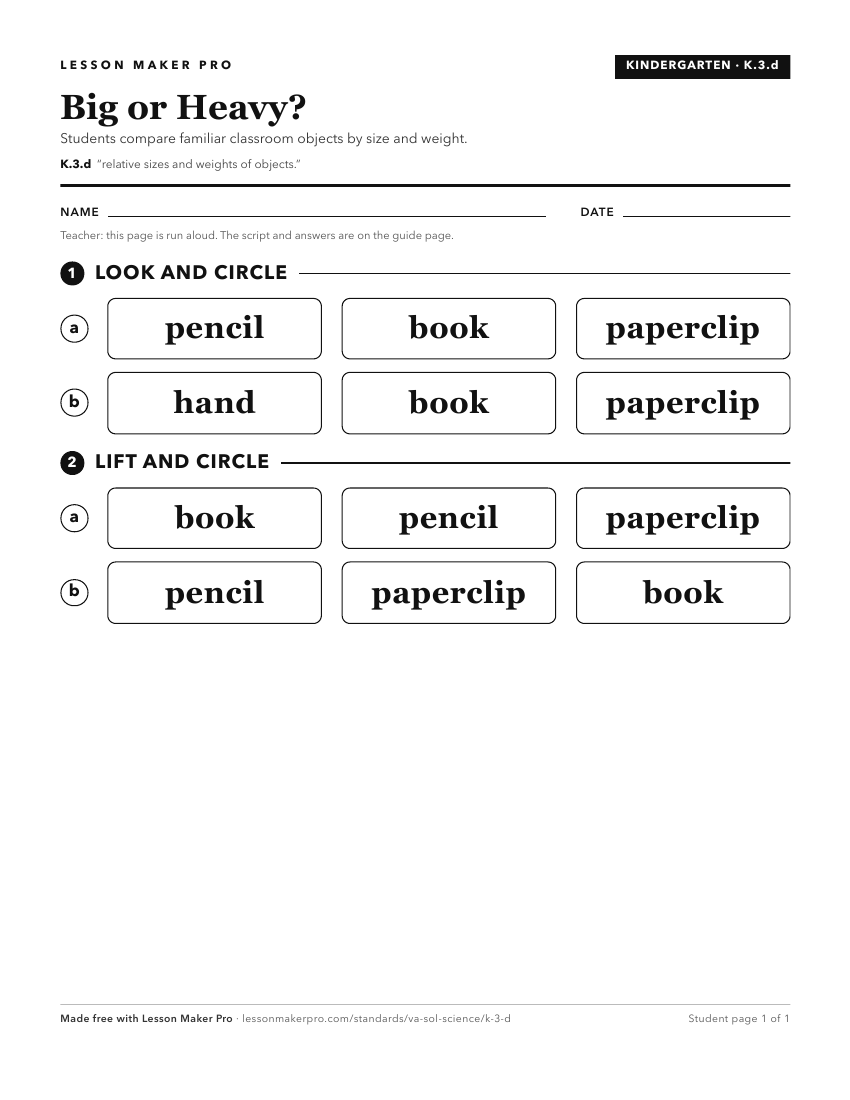
A ready-to-print activity worksheet aligned to K.3.d, with an answer key for the teacher on its own page. No account needed.
PDF, US Letter, prints cleanly in black and white.
Download the worksheetKeep exploring
Related Standards
- 2.1.b.ii
use appropriate tools to measure length, weight, and temperature of common objects using U.S. Customary units
- 1.1.b.iii
use tools to measure relative length, weight, volume, and temperature of common objects
- K.1.b.iii
measure the relative length and weight of common objects
- 4.5.c
the sizes of the sun and planets can be compared to one another.
Turn this exact standard into a lesson
Grade, subject, topic, and the complete standard are prefilled. Create one free, no account needed.
Also for this standard:Make a WorksheetMake a QuizMake a Sub Lesson