Virginia SOL 5.6.b
The Standard
- 5.6
- The student will investigate and understand that visible light has certain characteristics and behaves in predictable ways. Key ideas include
the visible spectrum includes light with different wavelengths
Virginia Standards of Learning for Science
Teacher's field guide
What This Standard Means
What Students Need to Do
- Students connect each visible color to a different wavelength. They arrange colors from longer red wavelengths to shorter violet wavelengths.
What Mastery Looks Like
- Given an unlabeled spectrum, a student places red and violet at the correct ends and orders the colors between them. The student explains that color differences come from wavelength differences.
Common Misconceptions
- Students may think all colors have the same wavelength or that wavelength means brightness. They may also think a prism creates colors instead of separating light into its color bands.
How to Assess It
- Exit ticket: Place red, green, and violet in wavelength order. Circle the longest wavelength and underline the shortest.
Lesson moves
Ways to Teach It
Shine a flashlight through a prism onto white paper, then trace and label the color bands from red to violet.
Ask students to explain in writing how red light and violet light differ, using the word wavelength.
Give pairs color cards to arrange by wavelength, then have them check their order against a spectrum diagram.
Examine a rainbow photo and label where the longer and shorter visible wavelengths appear.
Free download
Printable 5.6.b Worksheet
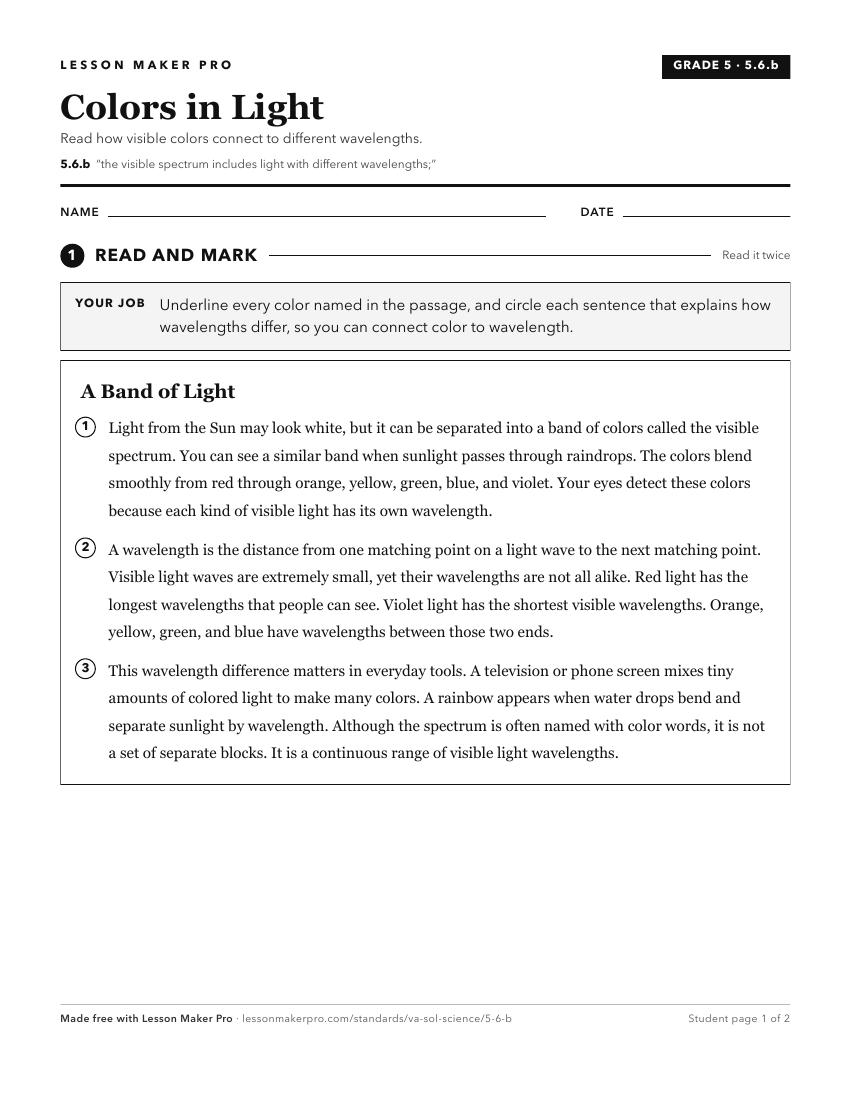
A ready-to-print activity worksheet aligned to 5.6.b, with an answer key for the teacher on its own page. No account needed.
PDF, US Letter, prints cleanly in black and white.
Download the worksheetKeep exploring
Related Standards
- 5.6.c
matter influences the path of light
- 5.6.a
visible light is radiant energy that moves in transverse waves
- PS.7.a
electromagnetic radiation, including visible light, has wave characteristics and behavior
- 5.6
The student will investigate and understand that visible light has certain characteristics and behaves in predictable ways. Key ideas include
Turn this exact standard into a lesson
Grade, subject, topic, and the complete standard are prefilled. Create one free, no account needed.
Also for this standard:Make a WorksheetMake a QuizMake a Sub Lesson