Virginia SOL 4.7.c
The Standard
- 4.7
- The student will investigate and understand that the ocean environment has characteristics. Key characteristics include
interaction of organisms in the ocean.
Virginia Standards of Learning for Science
Teacher's field guide
What This Standard Means
What Students Need to Do
- Students explain how ocean plants and animals depend on one another for food, shelter, and survival. They use examples to describe predator-prey relationships, competition, and cooperation.
What Mastery Looks Like
- Students can build an ocean food web and trace how energy moves through it. They can predict how one population change may affect other organisms.
Common Misconceptions
- Students may think all large ocean animals are predators or that seaweed gets food from other organisms. They may also treat a food web as separate chains instead of connected relationships.
How to Assess It
- Give students cards labeled phytoplankton, krill, fish, seal, and orca. Ask them to draw a food web and explain what might happen if krill declined.
Lesson moves
Ways to Teach It
Give groups ocean organism cards and yarn, then have them build a connected food web showing who eats whom.
Ask students to explain in writing how fewer sea otters could affect sea urchins and kelp.
Play a matching game in which students pair ocean organisms with predators, prey, competitors, or helpful partners.
Examine a coral reef photo and identify three ways organisms use the reef for food, shelter, or protection.
Free download
Printable 4.7.c Worksheet
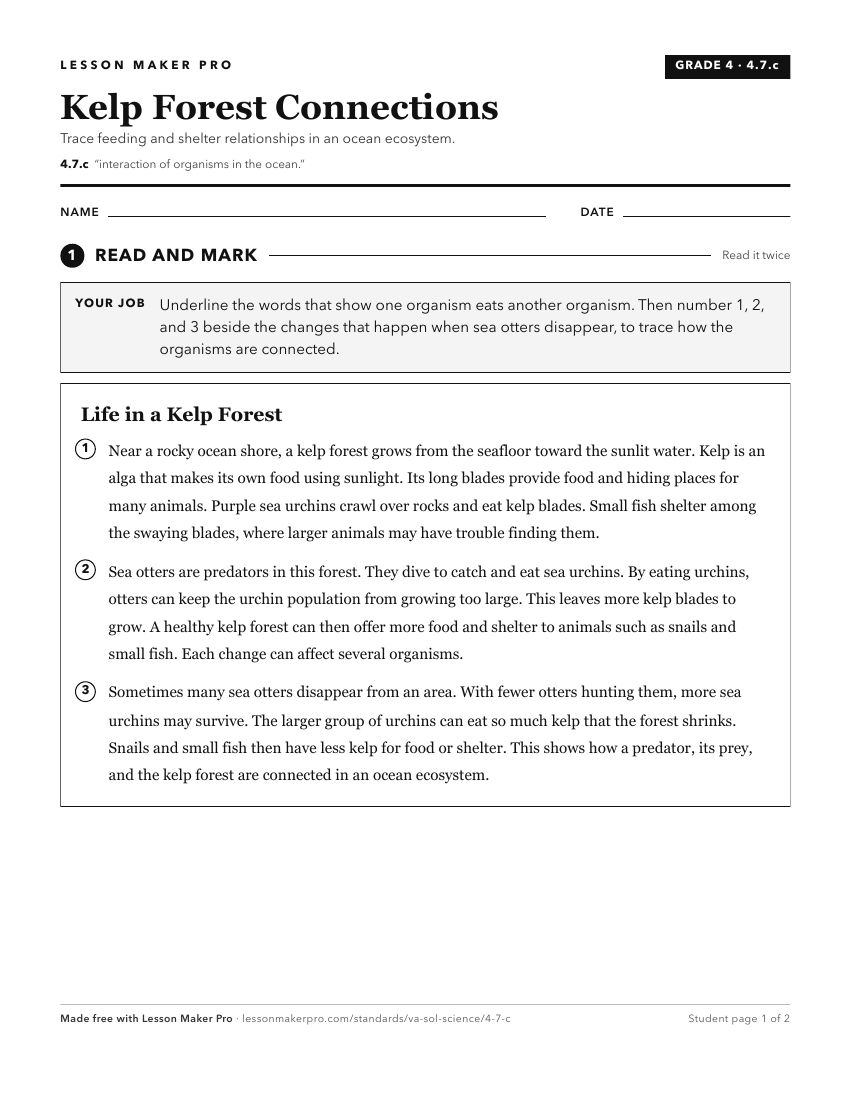
A ready-to-print activity worksheet aligned to 4.7.c, with an answer key for the teacher on its own page. No account needed.
PDF, US Letter, prints cleanly in black and white.
Download the worksheetKeep exploring
Related Standards
- 3.5.b
relationships exist among organisms in an ecosystem.
- 4.3.a
interrelationships exist in populations, communities, and ecosystems
- 4.3
The student will investigate and understand that organisms, including humans, interact with one another and with the nonliving components in the ecosystem. Key ...
- LS.6
The student will investigate and understand that populations in a biological community interact and are interdependent. Key ideas include
Turn this exact standard into a lesson
Grade, subject, topic, and the complete standard are prefilled. Create one free, no account needed.
Also for this standard:Make a WorksheetMake a QuizMake a Sub Lesson